Get your free personalized podcast brief
We scan new podcasts and send you the top 5 insights daily.
By integrating the open-source agent framework OpenClaw into its "Scout" agent, Microsoft executes a classic platform strategy. It embraces a popular open standard to attract developers while ensuring the core ecosystem runs on its proprietary cloud infrastructure.

Related Insights
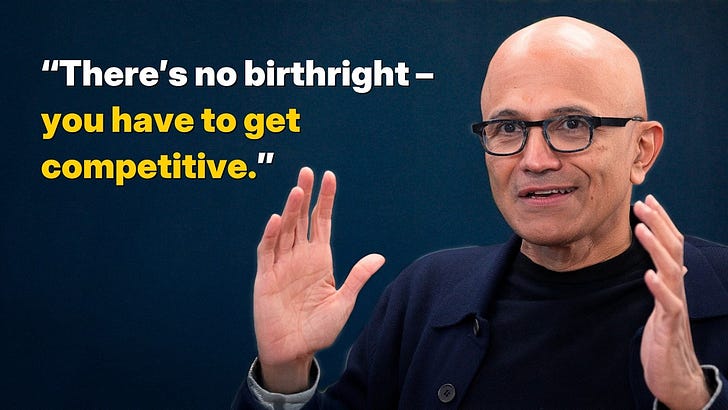
Nadella posits a future where the winner isn't the company with the best model. Instead, value accrues to the platform that provides the data, context, and tools (the 'scaffolding') that make any model useful, especially as capable open-source alternatives proliferate.
Instead of building a walled-garden AI, the Zed IDE created the Agent Client Protocol (ACP), allowing any coding agent to integrate. This 'Switzerland' strategy, modeled after the Language Server Protocol, lets Zed benefit from all AI innovation rather than competing against it, even attracting competitors like JetBrains to adopt the standard.

Microsoft's focus on open-source agents is strategic: to run agents safely at work, you need deep OS-level sandboxing. By contributing heavily to this space, Microsoft is building the foundational platform components that make Windows and Azure indispensable for the next generation of enterprise AI.
Open-source agent frameworks like OpenClaw allow users to retain ownership of their data and context. This enables them to switch between different LLMs (OpenAI, Anthropic, Google) for different tasks, like swapping engines in a car, avoiding the data lock-in promoted by major AI companies.

To compete with agent tools like OpenClaw, Microsoft CEO Satya Nadella reorganized by combining consumer and enterprise Copilot teams. This unified effort, with executives reporting directly to Nadella, signals a top-level priority to develop more autonomous, 'always-on' AI agents and centralize the company's response.

The race in enterprise AI isn't just about agent capabilities, but about owning the central dashboard where employees direct agents across all applications (Salesforce, Jira, etc.). Companies like OpenAI and Microsoft are vying to become this primary interface, controlling the customer relationship and relegating other apps to the background.
Faced with growing competition in AI coding assistants, Microsoft's GitHub is positioning itself as the central hub. By becoming the 'Agent HQ' where developers can manage and deploy multiple competing agents, GitHub ensures its platform's growth regardless of which agent wins.
While closed labs like OpenAI and Anthropic possess superior raw model capabilities, the open-source community is ahead in developing 'agent primitives'—the fundamental components like memory, orchestration, and evaluation. This creates a layered ecosystem where closed models may rely on open-source agent architectures.

At its Build conference, Microsoft is strategically pitching its own suite of homegrown AI models for coding, reasoning, and more. The play is to leverage its massive, existing developer community to create a viable third option in the AI model market, competing on cost, performance, and integration against the perceived OpenAI/Anthropic duopoly.
While Microsoft's Office suite provides a strong user base, its ownership of the Windows operating system is the real moat against competitors like Anthropic's Co-work (currently Mac-only). This "home turf" advantage allows for deeper, native integration, making it easier to build powerful AI agents that can organize files and orchestrate tasks across the entire user desktop.