Get your free personalized podcast brief
We scan new podcasts and send you the top 5 insights daily.
Despite stated goals to build a strong domestic AI industry, governments like the UK procure the vast majority of their AI services from foreign companies. This sends a negative signal about local technology and fails to create an internal market, starving homegrown AI companies of crucial revenue.

Related Insights
If AGI is concentrated in a few US companies, other nations could lose their economic sovereignty. When American AGI can produce goods far cheaper than local human labor, economies like the UK's could collapse. They would become economically dependent "client states," reliant on American technology for almost all production, with wealth accruing to Silicon Valley.

The pro-export argument for selling NVIDIA chips to China is strategic: flooding their market with good-enough, affordable chips makes it uneconomical for their domestic industry to compete. This fosters dependency on the U.S. ecosystem and can slow their independent technological progress.

The decision to allow NVIDIA to sell powerful AI chips to China has a counterintuitive goal. The administration believes that by supplying China, it can "take the air out" of the country's own efforts to build a self-sufficient AI chip ecosystem, thereby hindering domestic firms like Huawei.

While gross spending on AI appears to be a major growth driver, its net contribution to the US economy is significantly smaller. A large portion of AI-related hardware and software is imported, meaning the immediate GDP impact is diluted. AI's more substantial economic benefit is expected to manifest through longer-term productivity gains.

Leading AI companies, facing high operational costs and a lack of profitability, are turning to lucrative government and military contracts. This provides a stable revenue stream and de-risks their portfolios with government subsidies, despite previous ethical stances against military use.

Restricting sales to China is a catastrophic mistake that creates a protected, trillion-dollar market for domestic rivals like Huawei. This funds their R&D and global expansion with monopoly profits. To win the long-term AI race, American tech must be allowed to compete everywhere.

As countries from Europe to India demand sovereign control over AI, Microsoft leverages its decades of experience with local regulation and data centers. It builds sovereign clouds and offers services that give nations control, turning a potential geopolitical challenge into a competitive advantage.
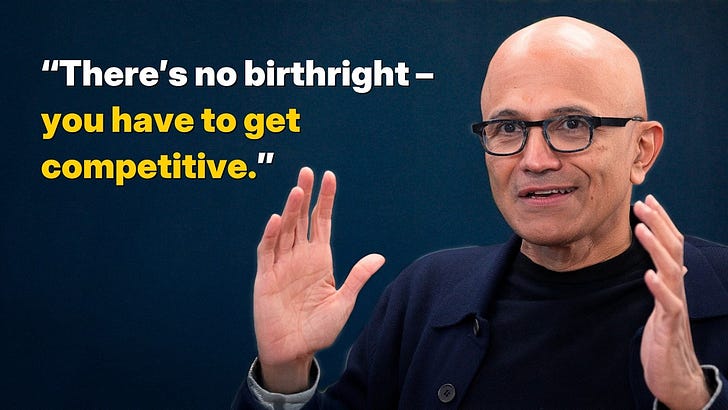
The UK is leveraging its post-Brexit autonomy to create a more favorable regulatory environment for AI and tech compared to the EU. This "pro-business" pragmatism, demonstrated during a recent state visit, has successfully attracted tens of billions in investment commitments from US tech giants like Microsoft, Google, and NVIDIA.

Restricting allies like the UAE from buying U.S. AI chips is a counterproductive policy. It doesn't deny them access to AI; it pushes them to purchase Chinese alternatives like Huawei. This strategy inadvertently builds up China's market share and creates a global technology ecosystem centered around a key U.S. competitor.

A core motivation for Poland's national AI initiative is to develop a domestic workforce skilled in building large language models. This "competency gap" is seen as a strategic vulnerability. Having the ability to build their own models, even if slightly inferior, is a crucial hedge against being cut off from foreign technology or facing unfavorable licensing changes.