Get your free personalized podcast brief
We scan new podcasts and send you the top 5 insights daily.
Grammarly has rebranded its corporate entity to Superhuman to reflect its broader mission. It reframes its core technology as an "assist" platform that proactively embeds AI into users' workflows, contrasting with "chat" interfaces (like ChatGPT) and "do" agents. Its new 'Go' product opens this platform to any AI agent, not just writing assistants.

Related Insights
The evolution of 'agentic AI' extends beyond content generation to automating the connective tissue of business operations. Its future value is in initiating workflows that span departments, such as kickstarting creative briefs for marketing, creating product backlogs from feedback, and generating service tickets, streamlining operational handoffs.

Instead of merely 'sprinkling' AI into existing systems for marginal gains, the transformative approach is to build an AI co-pilot that anticipates and automates a user's entire workflow. This turns the individual, not the software, into the platform, fundamentally changing their operational capacity.
Warp's explosive growth wasn't just about adding AI; it was about reframing their identity. The turning point came when they stopped being a "terminal with AI features" and became an "agentic development environment." This strategic repositioning made AI the core value proposition, not an add-on, which unlocked rapid market adoption.
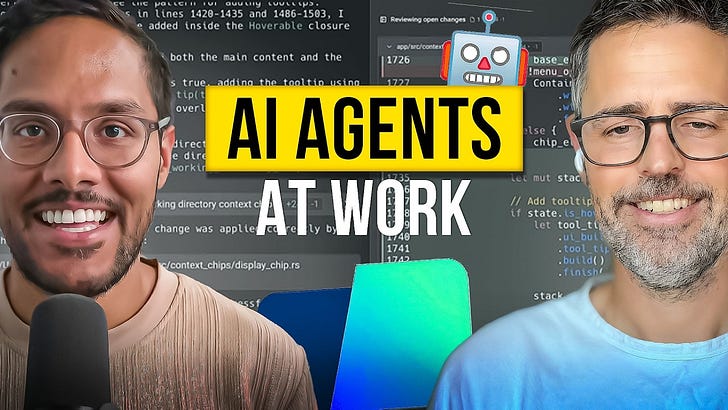
Don't just sprinkle AI features onto your existing product ('AI at the edge'). Transformative companies rethink workflows and shrink their old codebase, making the LLM a core part of the solution. This is about re-architecting the solution from the ground up, not just enhancing it.

ElevenLabs' defense against giants isn't just a better text-to-speech model. Their strategy focuses on building deep, workflow-specific platforms for agents and creatives. This includes features like CRM integrations and collaboration tools, creating a sticky application layer that a foundational model alone cannot replicate.
The terminology for AI tools (agent, co-pilot, engineer) is not just branding; it shapes user expectations. An "engineer" implies autonomous, asynchronous problem-solving, distinct from a "co-pilot" that assists or an "agent" that performs single-shot tasks. This positioning is critical for user adoption.
As consumers become wary of "AI," the winning strategy is integrating advanced capabilities into existing products seamlessly, like Google is doing with Gemini. The "AI" branding used for fundraising and recruiting will fade from consumer-facing marketing, making the technology feel like a natural product evolution.

Grammarly's co-founders discovered their plagiarism detection tool was flagging users who struggled to express thoughts in writing. Instead of building a better plagiarism cop, they built a tool to make writing easier, thereby addressing the core problem that led to plagiarism in the first place.
Tools like Descript excel by integrating AI into every step of the user's core workflow—from transcription and filler word removal to clip generation. This "baked-in" approach is more powerful than simply adding a standalone "AI" button, as it fundamentally enhances the entire job-to-be-done.

The paradigm shift with AI agents is from "tools to click buttons in" (like CRMs) to autonomous systems that work for you in the background. This is a new form of productivity, akin to delegating tasks to a team member rather than just using a better tool yourself.