Get your free personalized podcast brief
We scan new podcasts and send you the top 5 insights daily.
For complex, long-running agents, supervising individual token outputs is intractable. The new paradigm is to define a desired process (a spec or rubric) and then use a separate "judge" agent to verify if the primary agent's action trajectory adhered to that process.

Related Insights
As you manage a fleet of agents, you cannot manually review every output. Platforms like HyperAgent use "Rubrics"—an evaluation framework where one LLM judges another's work against predefined criteria. This automates quality control, which is essential for scaling an agent-first business.

The effectiveness of agent loops lies in their ability to spin up specialized sub-agents. A common framework involves a 'planning agent' that outlines steps and an 'evaluating agent' that quality-checks the output. This division of labor allows the AI system to tackle complex tasks more reliably than a single agent could.

Traditional systems can be controlled with simple, deterministic rules. Because modern AI agents are inherently unpredictable, effective governance requires using another layer of AI. A specialized AI must monitor, interpret, and block the actions of other agents in real-time.

Treating AI evaluation like a final exam is a mistake. For critical enterprise systems, evaluations should be embedded at every step of an agent's workflow (e.g., after planning, before action). This is akin to unit testing in classic software development and is essential for building trustworthy, production-ready agents.
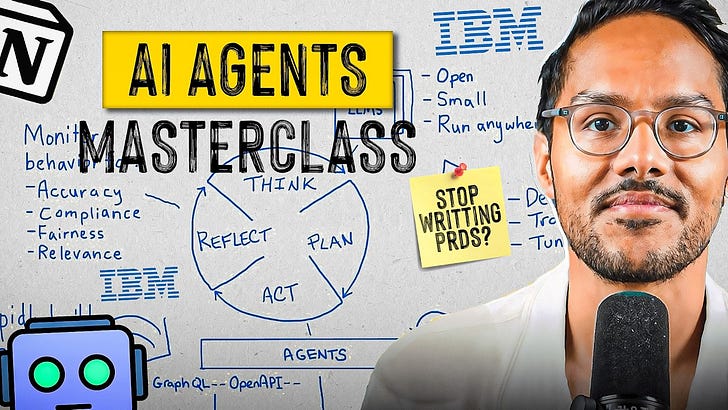
As AI agents become more autonomous and capable of executing complex, long-running tasks, the upfront planning phase (specs, PRDs) becomes even more critical. These documents are no longer just for human alignment but are essential for directing the AI and ensuring its expensive compute time is spent on the right objectives.

Building a functional AI agent is just the starting point. The real work lies in developing a set of evaluations ("evals") to test if the agent consistently behaves as expected. Without quantifying failures and successes against a standard, you're just guessing, not iteratively improving the agent's performance.

Explaining a predictive model's single output is a well-defined problem. For an agentic AI, the final outcome results from a complex chain of autonomous decisions and tool interactions. True explainability requires reconstructing this entire decision path, a task for which most current tools are ill-equipped.

Instead of relying solely on human oversight, AI governance will evolve into a system where higher-level "governor" agents audit and regulate other AIs. These specialized agents will manage the core programming, permissions, and ethical guidelines of their subordinates.

OpenAI identifies agent evaluation as a key challenge. While they can currently grade an entire task's trace, the real difficulty lies in evaluating and optimizing the individual steps within a long, complex agentic workflow. This is a work-in-progress area critical for building reliable, production-grade agents.

Traditional evals fall short for sophisticated agents. A more effective method is a built-in evaluation loop where one agent is tasked with grading the output of another. This allows for continuous, automated quality assessment, especially when done in separate context windows to avoid bias.
