Get your free personalized podcast brief
We scan new podcasts and send you the top 5 insights daily.
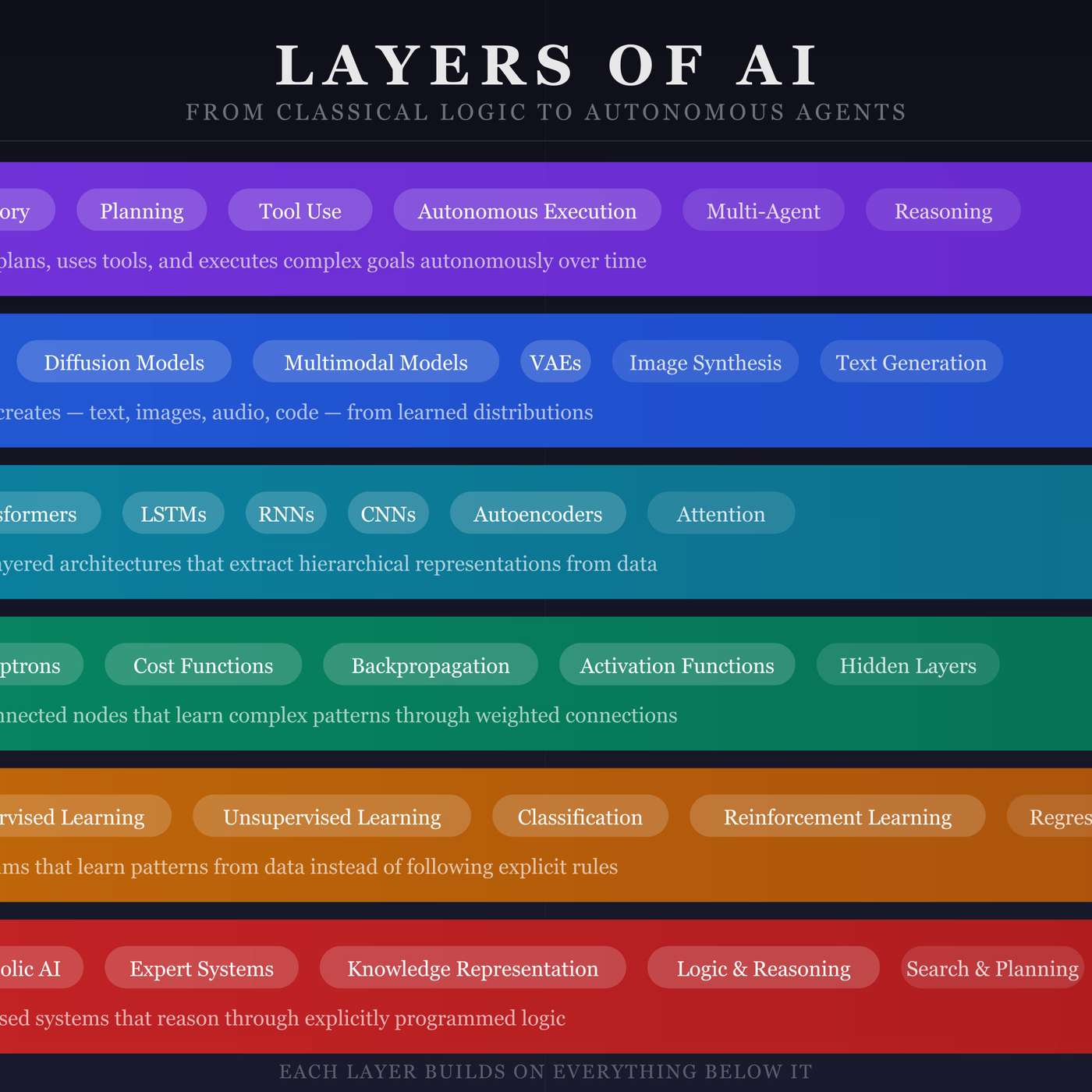
The current pinnacle of the AI stack, 'Agentic AI,' moves beyond simply generating answers to performing autonomous actions. By combining generative models with planning, memory, and tool use (like APIs or code interpreters), these systems can execute complex, multi-step tasks, defining the next wave of product development.
Related Insights
The GPT-5.5 announcement emphasizes its role in "powering agents built to understand complex goals, use tools, check its work and carry more tasks through to completion." This signals a strategic shift from merely improving conversational AI to building autonomous systems that can execute complex, multi-step workflows.

Moving beyond chatbots, tools like Claude Cowork empower non-coders to create complex, multi-step autonomous workflows using natural language. This 'agentic' capability—connecting documents, searches, and data—is a key trend that will democratize automation and software creation for all knowledge workers.

Unlike simple chat models that provide answers to questions, AI agents are designed to autonomously achieve a goal. They operate in a continuous 'observe, think, act' loop to plan and execute tasks until a result is delivered, moving beyond the back-and-forth nature of chat.

Unlike generative AI (like ChatGPT) which only provides text output, agentic AI can perform actions on your behalf. It can log into accounts, click buttons, and complete multi-step tasks, shifting AI from a smart consultant to an autonomous digital assistant.

Simply adding a generative AI co-pilot is now table stakes for SaaS companies. The founder argues the next evolution is 'agentic AI' — systems that don't just provide insights but autonomously perform tasks and make decisions for the user, like qualifying and actioning a sales lead.

Current Generative AI acts as a passive co-pilot, responding to prompts for single tasks. The emerging 'Agentic AI' is an active autopilot, capable of planning and executing multi-step workflows across different tools, fundamentally changing how complex work is accomplished.

The real breakthrough for empowering non-developers wasn't just AI that wrote code snippets. It was the emergence of 'agentic AI' that could execute multi-step tasks autonomously, finally enabling creation without deep coding knowledge, shifting the focus from 'learning to code' to 'learning to create'.

The next wave of AI is 'agentic,' meaning it can control a computer to execute commands and complete tasks, not just generate responses to prompts. This profound shift automates workflows like coding and administrative tasks, freeing humans for high-level creative and strategic work.

The next evolution of enterprise AI isn't conversational chatbots but "agentic" systems that act as augmented digital labor. These agents perform complex, multi-step tasks from natural language commands, such as creating a training quiz from a 700-page technical document.

Anthropic's upcoming 'Agent Mode' for Claude moves beyond simple text prompts to a structured interface for delegating and monitoring tasks like research, analysis, and coding. This productizes common workflows, representing a major evolution from conversational AI to autonomous, goal-oriented agents, simplifying complex user needs.