Get your free personalized podcast brief
We scan new podcasts and send you the top 5 insights daily.
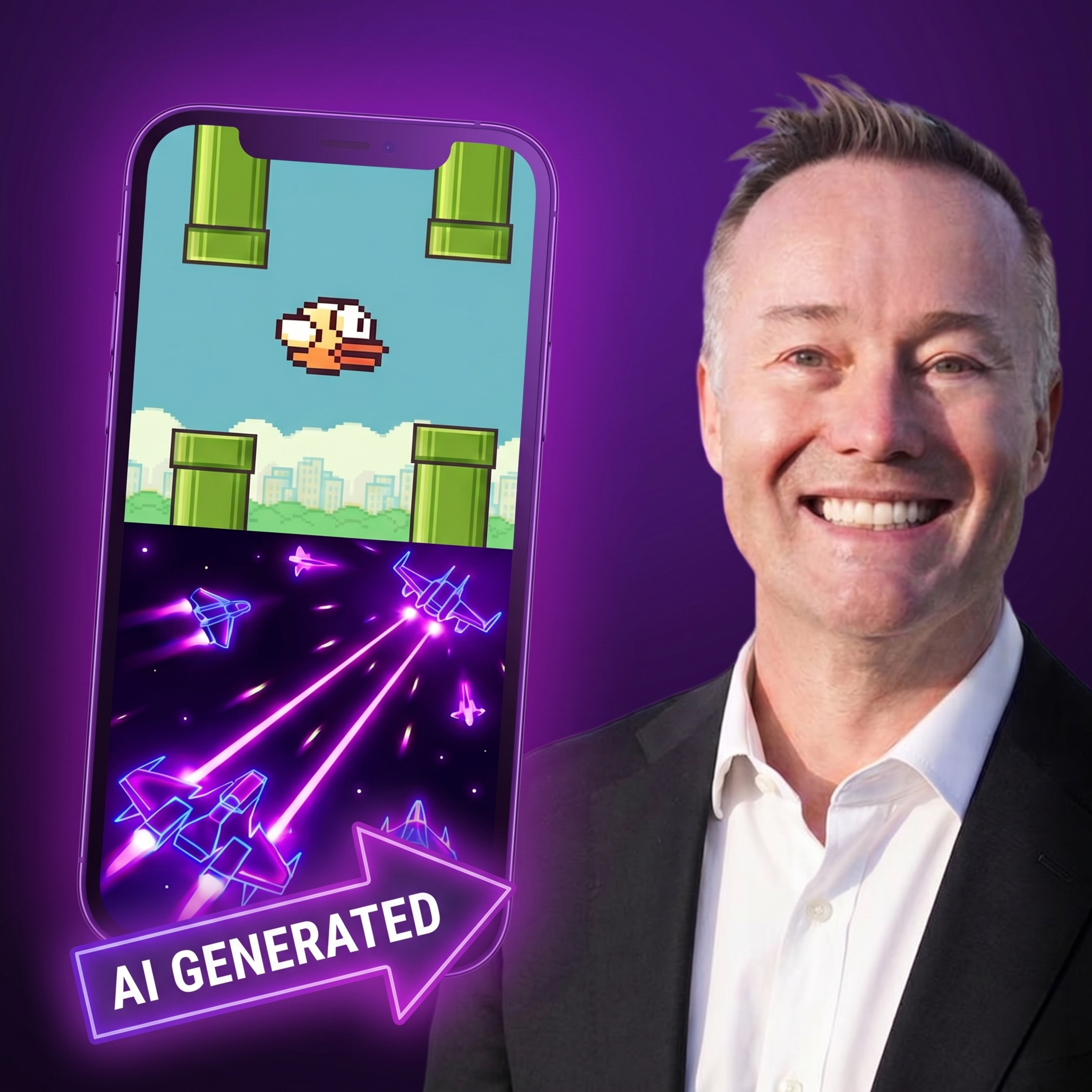
Nanogram, a 'TikTok for games' app, uses AI agents and a custom engine to allow users to generate fully playable 3D games from simple text prompts. What once took a programmer a week can now be accomplished in about 90 seconds, dramatically lowering the barrier to game creation.
Related Insights
Instead of traditional coding, a simple, descriptive prompt was used with GitHub Spark to instantly generate a functional mobile app for a Halloween block party. This "vibe coding" approach is ideal for single-use, creative projects where speed trumps robust engineering.
Rather than writing detailed specifications, Felix Lee demonstrated that a high-level FigJam flowchart can serve as the sole input for an AI to generate a complete, playable game like Flappy Bird. The AI interprets the user flow and game logic to build the application with animations and scoring in minutes.

Google's Project Genie can generate playable game worlds from text prompts, a feat that would have seemed like AGI recently. However, users' expectations immediately shift to the next challenge: demanding AI-generated game mechanics like timers, scoring, and complex interactions.

Creating custom "playground" tools for design exploration no longer requires advanced coding. You can simply describe the interface and the controls you want (e.g., "a grid with sliders for rows and opacity") in a natural language prompt to an AI, which will generate a functional tool.
Brands can use AI coding tools like Gemini to quickly build simple, themed games. These games act as engaging, shareable content for social media marketing campaigns, offering a fresh way to capture audience attention beyond traditional ads and posts.

The ability to generate playable 3D worlds from text, as demonstrated by Google's Genie 3, suggests future games won't be developed but generated on-demand. This capability is viewed as an existential threat to the traditional game industry, potentially making franchises like Grand Theft Auto obsolete.

The primary constraint on output is no longer a tool's capability but the user's skill in prompting it. This is exemplified by a developer who created a complex real-time strategy (RTS) game from scratch in one week by prompting an AI model, having not written a single line of code himself in two months.

Traditionally, building software required deep knowledge of many complex layers and team handoffs. AI agents change this paradigm. A creator can now provide a vague idea and receive a 60-70% complete, working artifact, dramatically shortening the iteration cycle from months to minutes and bypassing initial complexities.

AI tools like Claude Cowork can now handle complex tasks like app development, including UX/UI design and coding, from natural language prompts. This dramatically lowers the barrier to creating custom software, as demonstrated by one host building a fully functional meditation app in minutes.

AI coding assistants have radically lowered the barrier to software creation. A 14-year-old with no coding background successfully built a complex game in seven days by writing a PRD-like document and feeding it to an AI tool, demonstrating the new accessibility of development.
