Get your free personalized podcast brief
We scan new podcasts and send you the top 5 insights daily.
Engineering teams are not standardizing on a single AI coding agent. Individual developers often switch between tools like Claude and Codex based on personal preference, the specific task (e.g., planning vs. execution), or even pricing plan limits. This necessitates a centralized, tool-agnostic review process.

Related Insights
Once AI coding agents reach a high performance level, objective benchmarks become less important than a developer's subjective experience. Like a warrior choosing a sword, the best tool is often the one that has the right "feel," writes code in a preferred style, and integrates seamlessly into a human workflow.

The developer workflow is evolving beyond "vibe coding." New tools, like Anthropic's updated Claude Code desktop app, are being redesigned as command centers for managing multiple, parallel AI agent tasks across different projects. The developer's role is shifting from prompter to orchestrator of a fleet of agents.

In the fast-changing AI landscape, standardizing on a single tool is a mistake. Monumental's CPO encourages his team to use various tools (Cursor, Devon, Claude) based on their needs. The strategy is to explicitly avoid dependency on any one platform, ensuring flexibility as new, better technologies emerge.

A mental model for selecting AI tools based on two axes: the size of the task (from a small bug fix to a large new feature) and the amount of code that already exists in production. This framework helps designers decide when to use a prototyping tool versus a production-focused AI agent.
The comparison reveals that different AI models excel at specific tasks. Opus 4.5 is a strong front-end designer, while Codex 5.1 might be better for back-end logic. The optimal workflow involves "model switching"—assigning the right AI to the right part of the development process.
Treat different LLMs like colleagues with distinct personalities. Zevi Arnovitz views Claude as a collaborative dev lead, Codex (GPT) as a brilliant but terse bug-fixer, and Gemini as a creative but chaotic designer. This mental model helps in delegating tasks to the most suitable AI, maximizing their strengths and mitigating their weaknesses.
Instead of relying on a single, all-purpose coding agent, the most effective workflow involves using different agents for their specific strengths. For example, using the 'Friday' agent for UI tasks, 'Charlie' for code reviews, and 'Claude Code' for research and backend logic.

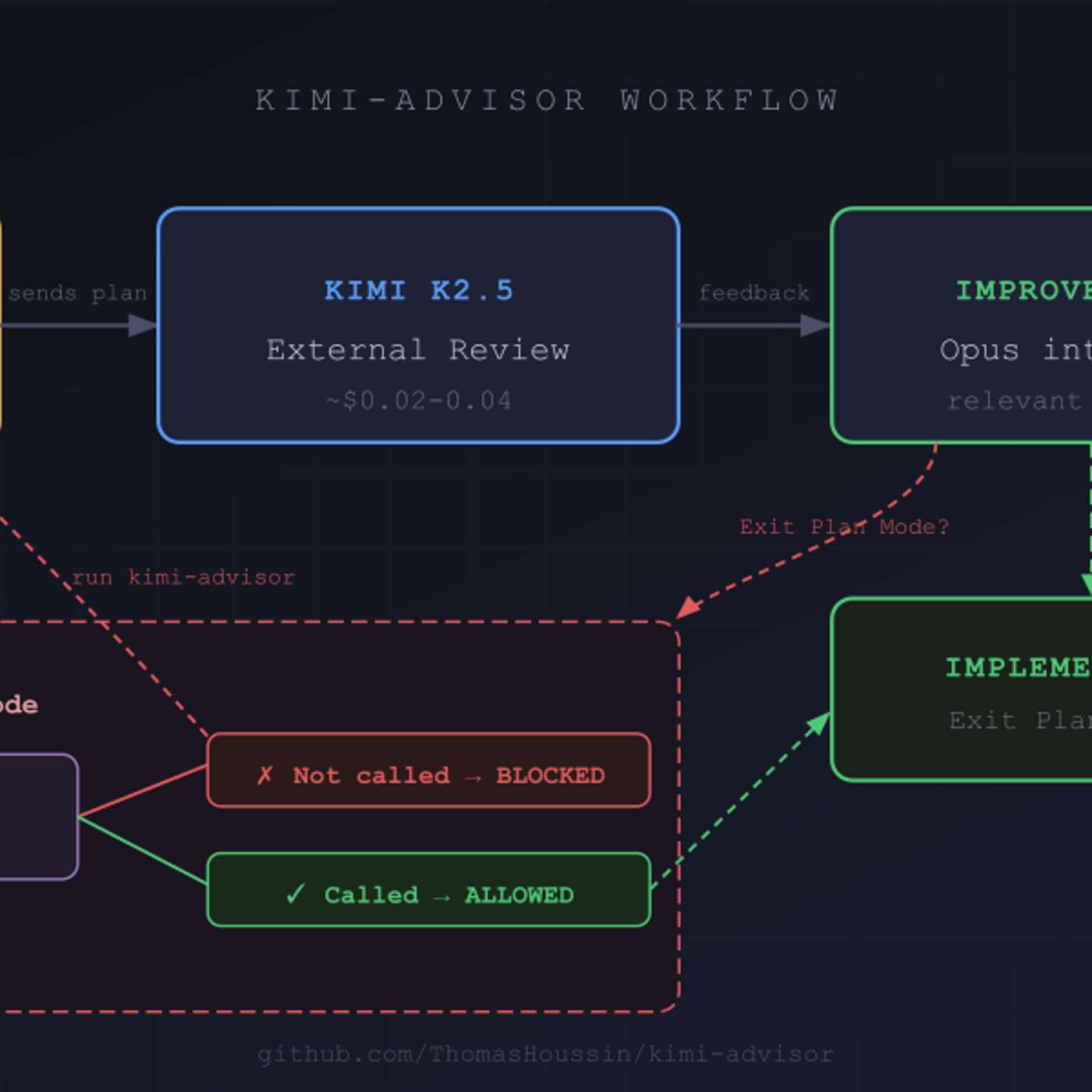
To improve code quality, use a secondary AI model from a different provider (e.g., Moonshot AI's Kimi) to review plans generated by a primary model (e.g., Anthropic's Claude). This introduces cognitive diversity and avoids the shared biases inherent in a single model family, leading to a more robust and enriching review process.
Instead of standardizing on a single AI coding assistant, large enterprises are providing engineers with access to multiple tools like Claude Code, Codex, and Cursor. This strategy fosters internal competition, drives adoption by catering to developer preferences, and prevents vendor lock-in, giving them leverage against price increases.

Don't get locked into a single AI model. Advanced platforms like Codex allow you to call competing models (e.g., Claude) from its terminal. This "best of breed" approach lets you use your preferred interface while still accessing the unique strengths of different models for specific tasks, such as using Claude for design.
