Get your free personalized podcast brief
We scan new podcasts and send you the top 5 insights daily.
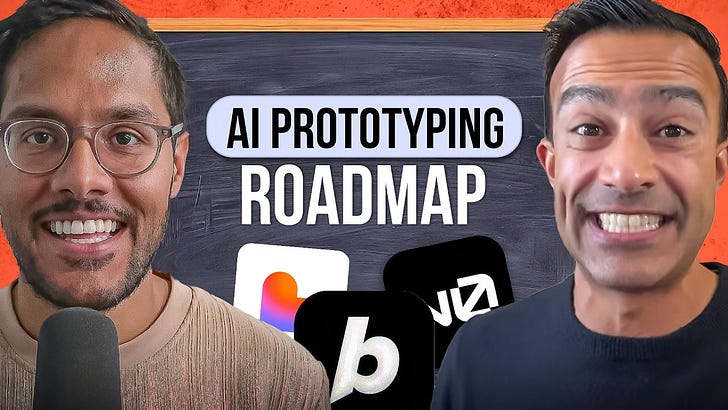
A mental model for selecting AI tools based on two axes: the size of the task (from a small bug fix to a large new feature) and the amount of code that already exists in production. This framework helps designers decide when to use a prototyping tool versus a production-focused AI agent.

Related Insights
Once AI coding agents reach a high performance level, objective benchmarks become less important than a developer's subjective experience. Like a warrior choosing a sword, the best tool is often the one that has the right "feel," writes code in a preferred style, and integrates seamlessly into a human workflow.

AI coding agents enable "vibe coding," where non-engineers like designers can build functional prototypes without deep technical expertise. This accelerates iteration by allowing designers to translate ideas directly into interactive surfaces for testing.
Connecting to a design system is insufficient. AI design tools gain true power by using the entire production codebase as context. This leverages years of embedded decisions, patterns, and "tribal knowledge" that design systems alone cannot capture.
High productivity isn't about using AI for everything. It's a disciplined workflow: breaking a task into sub-problems, using an LLM for high-leverage parts like scaffolding and tests, and reserving human focus for the core implementation. This avoids the sunk cost of forcing AI on unsuitable tasks.
The comparison reveals that different AI models excel at specific tasks. Opus 4.5 is a strong front-end designer, while Codex 5.1 might be better for back-end logic. The optimal workflow involves "model switching"—assigning the right AI to the right part of the development process.

As AI makes the act of writing code a commodity, the primary challenge is no longer execution but discovery. The most valuable work becomes prototyping and exploring to determine *what* should be built, increasing the strategic importance of the design function.
Instead of relying on a single, all-purpose coding agent, the most effective workflow involves using different agents for their specific strengths. For example, using the 'Friday' agent for UI tasks, 'Charlie' for code reviews, and 'Claude Code' for research and backend logic.

A seasoned CTO finds negligible performance differences between major AI coding tools (Claude, CodeX, Cursor) for rapid prototyping. The primary value is speed, not marginal accuracy. Subscribing to multiple services is more for staying current with market trends than for a specific tool's superiority.

The panel suggests a best practice for AI prototyping tools: focus on pinpointed interactions or small, specific user flows. Once a prototype grows to encompass the entire product, it's more efficient to move directly into the codebase, as you're past the point of exploration.

Resist the temptation to treat AI-generated prototype code as production-ready. Its purpose is discovery—validating ideas and user experiences. The code is not built to be scalable, maintainable, or robust. Let your engineering team translate the validated prototype into production-level code.