Get your free personalized podcast brief
We scan new podcasts and send you the top 5 insights daily.
Google's launch of Gemini 3.7 Flash highlights that competition between AI labs is no longer a single race for the most intelligent "frontier" model. Instead, it has fragmented into distinct races focused on different dimensions like inference speed, user distribution, and monetization strategies.

Related Insights
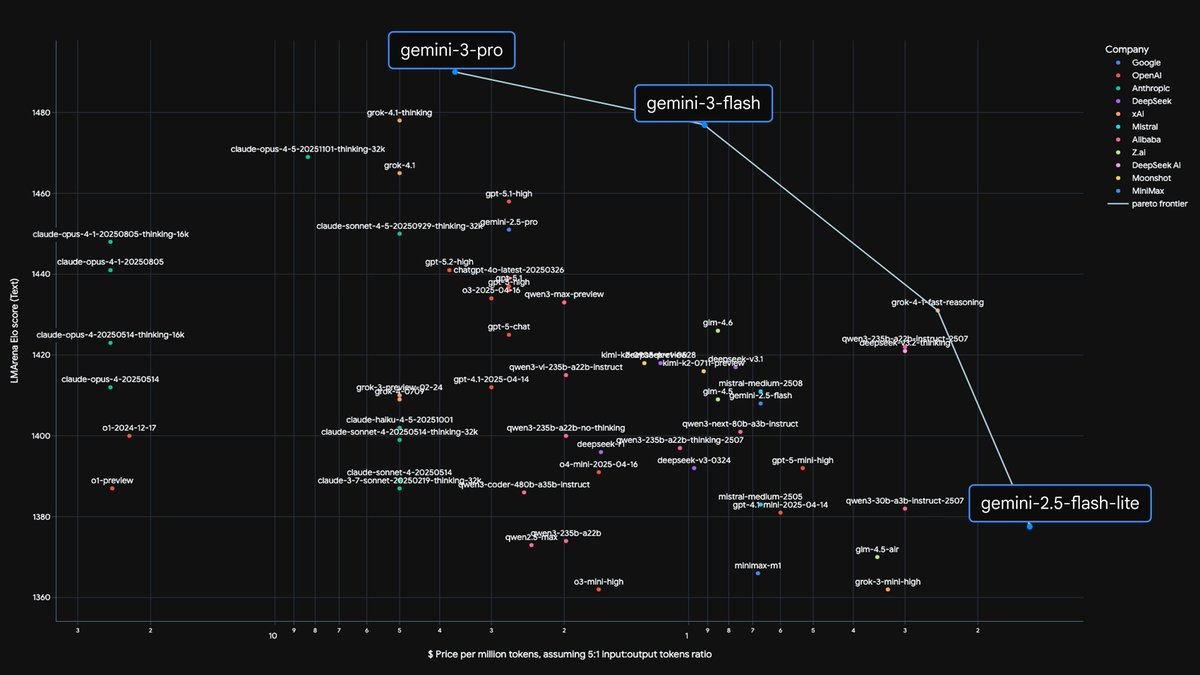
The primary threat from competitors like Google may not be a superior model, but a more cost-efficient one. Google's Gemini 3 Flash offers "frontier-level intelligence" at a fraction of the cost. This shifts the competitive battleground from pure performance to price-performance, potentially undermining business models built on expensive, large-scale compute.

The AI race has a new dimension beyond model performance. Leading labs like Google, Anthropic, and OpenAI are aggressively building consulting and forward-deployed engineering teams. The new battleground is successful enterprise integration and custom workflow deployment, not just benchmark scores.
By prioritizing token-efficient, cost-effective 'Flash' models over its delayed 'Pro' flagship, Google appears to be pivoting. It's competing with Chinese labs on price and speed for mid-tier tasks, rather than challenging OpenAI and Anthropic at the high-end performance frontier.
Google's focus on fast, cost-effective models like Gemini 3.5 Flash is driven by the needs of its massive-scale products (e.g., Search). For billions of users, low latency and cost are more critical than absolute peak performance, as users are often unwilling to wait for a slightly smarter but slower response.

Google's strategy involves creating both cutting-edge models (Pro/Ultra) and efficient ones (Flash). The key is using distillation to transfer capabilities from large models to smaller, faster versions, allowing them to serve a wide range of use cases from complex reasoning to everyday applications.
As AI model performance commoditizes, the strategic battleground is shifting from models to platforms. Tech giants like Google are positioning their offerings not as features, but as the fundamental 'operating system' for the agentic enterprise. The new competitive moat is the control plane that orchestrates agents.
Despite its models lagging behind the state-of-the-art, Google Gemini has reached one billion users. This milestone demonstrates that in the consumer AI race, massive, built-in distribution channels like Android and Search can be a more powerful driver of adoption than having the absolute best technology.
For Google, leadership on public AI model benchmarks is less critical than translating its AI capabilities directly into revenue-generating product features. An analyst suggests the true measure of success is successful product integration and revenue growth, not just winning the "model race" on leaderboards.

As AI models become commodities, the underlying hardware's speed and efficiency for inference is the true differentiator. The company that powers the fastest AI experiences will win, similar to how Google won with fast search, because there is no market for slow AI.

The release of Gemini 3.1 Pro highlights a market shift where raw capability is becoming table stakes. Google achieved a massive intelligence jump with zero incremental cost, demonstrating that the new competitive frontier for AI models is commoditizing intelligence and winning on distribution and price efficiency, rather than just holding the top spot on a benchmark for a few weeks.