Get your free personalized podcast brief
We scan new podcasts and send you the top 5 insights daily.
Liquid AI's origins lie in MIT research modeling the nervous system of the C. elegans worm. This led to differential equation-based networks where a small number of complex "liquid neurons" could perform complex robotics tasks like autonomous driving, showcasing extreme efficiency.

Related Insights
Cortical Labs' neuron-based systems require 5,000 times fewer steps than GPU systems to learn goal-seeking behaviors, a massive advantage for real-world robotics where time cannot be accelerated.
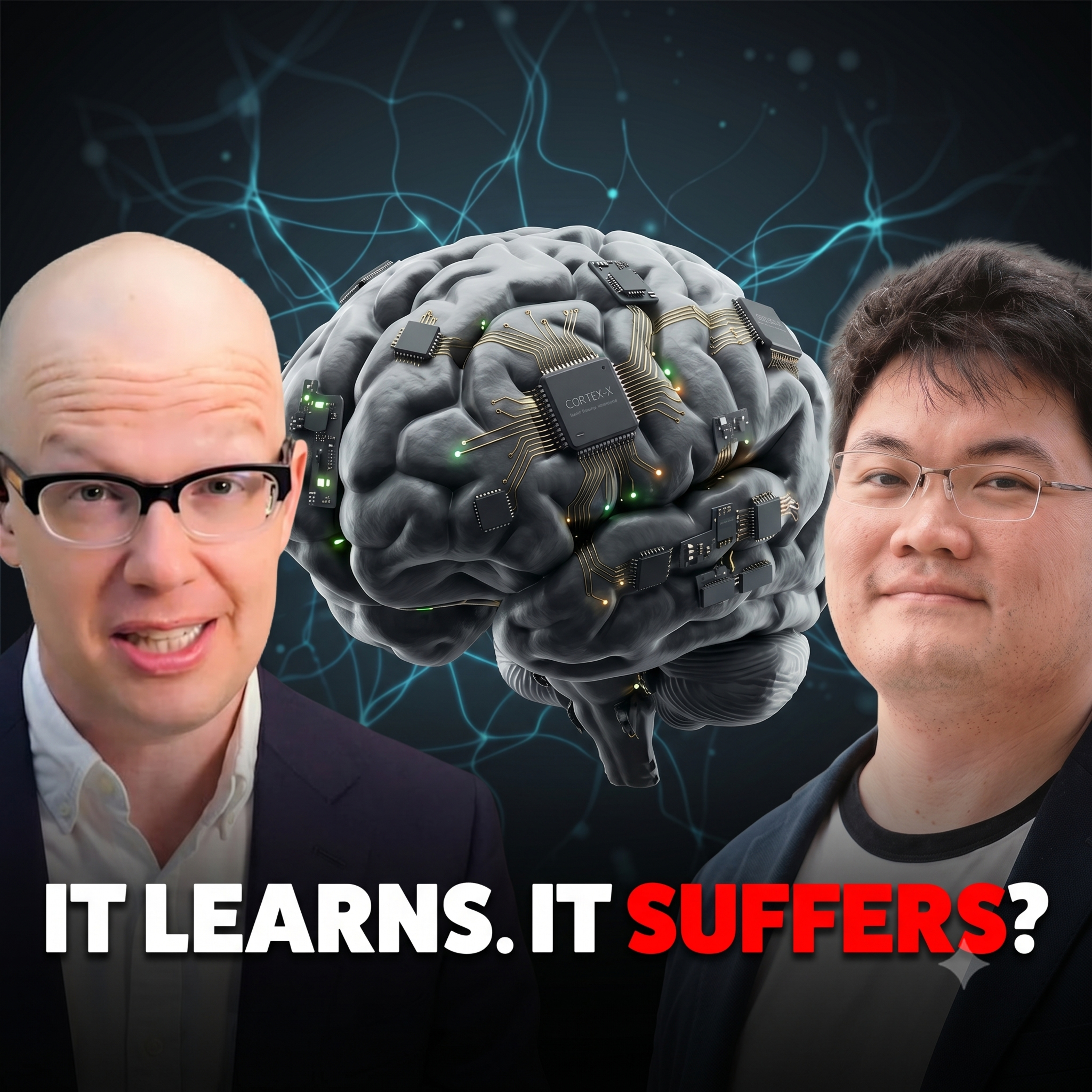
The primary motivation for biocomputing is not just scientific curiosity; it's a direct response to the massive, unsustainable energy consumption of traditional AI. Living neurons are up to 1,000,000 times more energy-efficient, offering a path to dramatically cheaper and greener AI.

Liquid AI uses an automated system to discover neural architectures, avoiding human bias. Crucially, it bypasses misleading proxy metrics like perplexity by putting the target hardware in the loop and evaluating models directly on the customer's downstream tasks, optimizing for latency, memory, and quality.
Unlike transformers which use dense activations (firing most neurons), Pathway's BDH architecture uses sparse positive activations, where only ~5% of neurons fire at once. This approach is more biologically plausible, mimicking the human brain's energy efficiency and enabling complex reasoning without the massive computational overhead of dense models.

Scientists mapped and simulated a fruit fly's brain. By only providing sensory inputs to the simulated neural structure, it correctly enacted motor responses like walking without any behavioral training or reinforcement learning. This suggests complex behaviors are inherent to the brain's wiring diagram itself.

A major breakthrough for Liquid AI was finding a closed-form solution for the differential equations governing their neural networks, a problem unsolved since 1907. This eliminated the need for slow, step-by-step numerical solvers, enabling a massive leap in scalability from hundreds to potentially billions of neurons.
Input-dependent gating, where a model's transformation is modified based on the current input, is a powerful theme in architectures like Mamba and Liquid AI's LFM. This allows the model to learn adaptable *dynamics* during backpropagation, not just static parameters, which is key for efficiency and generalization.
Traditional science failed to create equations for complex biological systems because biology is too "bespoke." AI succeeds by discerning patterns from vast datasets, effectively serving as the "language" for modeling biology, much like mathematics is the language of physics.

The "temporal difference" algorithm, which tracks changing expectations, isn't just a theoretical model. It is biologically installed in brains via dopamine. This same algorithm was externalized by DeepMind to create a world-champion Go-playing AI, representing a unique instance of biology directly inspiring a major technological breakthrough.

A neuroscientist-led startup is growing live neurons on electrodes not just for compute efficiency, but as a platform to discover novel algorithms. By studying how biological networks process information, they identify neuroscience principles that can be used as software plugins to improve current AI models and find successors to the transformer architecture.
