Get your free personalized podcast brief
We scan new podcasts and send you the top 5 insights daily.
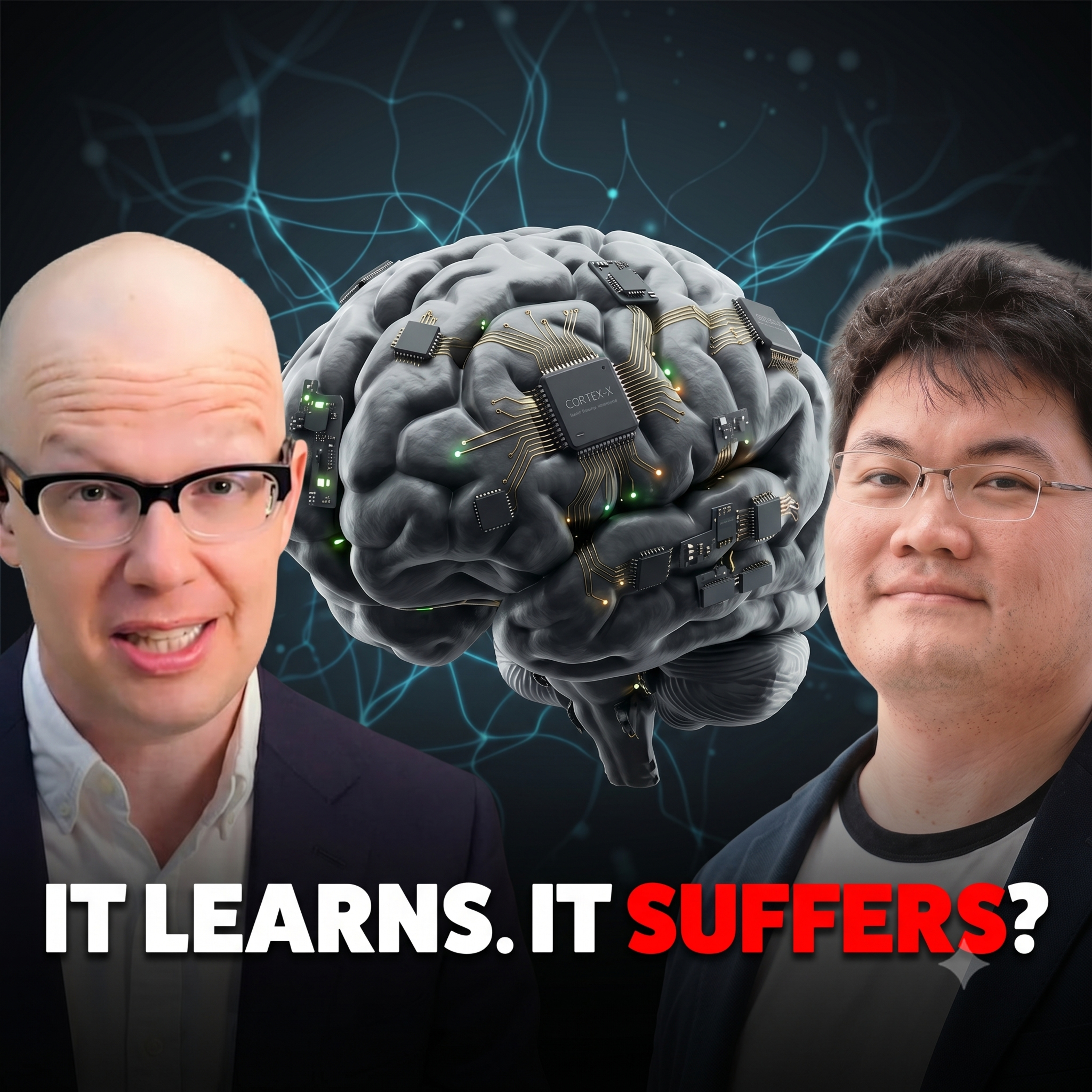
Cortical Labs' neuron-based systems require 5,000 times fewer steps than GPU systems to learn goal-seeking behaviors, a massive advantage for real-world robotics where time cannot be accelerated.
Related Insights
The brain's hardware limitations, like slow and stochastic neurons, may actually be advantages. These properties seem perfectly suited for probabilistic inference algorithms that rely on sampling—a task that requires explicit, computationally-intensive random number generation in digital systems. Hardware and algorithm are likely co-designed.

To achieve 1000x efficiency, Unconventional AI is abandoning the digital abstraction (bits representing numbers) that has defined computing for 80 years. Instead, they are co-designing hardware and algorithms where the physics of the substrate itself defines the neural network, much like a biological brain.

The primary motivation for biocomputing is not just scientific curiosity; it's a direct response to the massive, unsustainable energy consumption of traditional AI. Living neurons are up to 1,000,000 times more energy-efficient, offering a path to dramatically cheaper and greener AI.

Pre-training on internet text data is hitting a wall. The next major advancements will come from reinforcement learning (RL), where models learn by interacting with simulated environments (like games or fake e-commerce sites). This post-training phase is in its infancy but will soon consume the majority of compute.
![Dylan Patel - Inside the Trillion-Dollar AI Buildout - [Invest Like the Best, EP.442] thumbnail](https://megaphone.imgix.net/podcasts/799253cc-9de9-11f0-8661-ab7b8e3cb4c1/image/d41d3a6f422989dc957ef10da7ad4551.jpg?ixlib=rails-4.3.1&max-w=3000&max-h=3000&fit=crop&auto=format,compress)
While RL is compute-intensive for the amount of signal it extracts, this is its core economic advantage. It allows labs to trade cheap, abundant compute for expensive, scarce human expertise. RL effectively amplifies the value of small, high-quality human-generated datasets, which is crucial when expertise is the bottleneck.

The supply chain for neurons is not the main problem; they can be produced easily. The true challenge and next major milestone is "learning in vitro"—discovering the principles to program neural networks to perform consistent, desired computations like recognizing images or executing logic.
Unlike math or code with cheap, fast rewards, clinically valuable biology problems lack easily verifiable ground truths. This makes it difficult to create the rapid reinforcement learning loops that drive explosive AI progress in other fields.

AI models use simple, mathematically clean loss functions. The human brain's superior learning efficiency might stem from evolution hard-coding numerous, complex, and context-specific loss functions that activate at different developmental stages, creating a sophisticated learning curriculum.
The "temporal difference" algorithm, which tracks changing expectations, isn't just a theoretical model. It is biologically installed in brains via dopamine. This same algorithm was externalized by DeepMind to create a world-champion Go-playing AI, representing a unique instance of biology directly inspiring a major technological breakthrough.

A neuroscientist-led startup is growing live neurons on electrodes not just for compute efficiency, but as a platform to discover novel algorithms. By studying how biological networks process information, they identify neuroscience principles that can be used as software plugins to improve current AI models and find successors to the transformer architecture.
