Get your free personalized podcast brief
We scan new podcasts and send you the top 5 insights daily.
OpenAI is exploring how extremely fast models can replace deterministic scripts for tasks like Git operations. A model can handle errors and complex states more intelligently than a rigid script, and when latency is low enough, it becomes a viable alternative for UI button-click actions.

Related Insights
OpenAI's team found that as code generation speed approaches real-time, the new constraint is the human capacity to verify correctness. The challenge shifts from creating code to reviewing and testing the massive output to ensure it's bug-free and meets requirements.
The creative process with AI involves exploring many options, most of which are imperfect. This makes the collaboration a version control problem. Users need tools to easily branch, suggest, review, and merge ideas, much like developers use Git, to manage the AI's prolific but often flawed output.

Tools like Git were designed for human-paced development. AI agents, which can make thousands of changes in parallel, require a new infrastructure layer—real-time repositories, coordination mechanisms, and shared memory—that traditional systems cannot support.

Purely agentic systems can be unpredictable. A hybrid approach, like OpenAI's Deep Research forcing a clarifying question, inserts a deterministic workflow step (a "speed bump") before unleashing the agent. This mitigates risk, reduces errors, and ensures alignment before costly computation.

Unlike previous models that frequently failed, Opus 4.5 allows for a fluid, uninterrupted coding process. The AI can build complex applications from a simple prompt and autonomously fix its own errors, representing a significant leap in capability and reliability for developers.
Newer models like OpenAI's 5.2 can solve bugs that were previously impossible for AI by "thinking" for extended periods—up to 37 minutes in one example. This reframes latency not as a flaw, but as a necessary trade-off for tackling deep, complex problems.

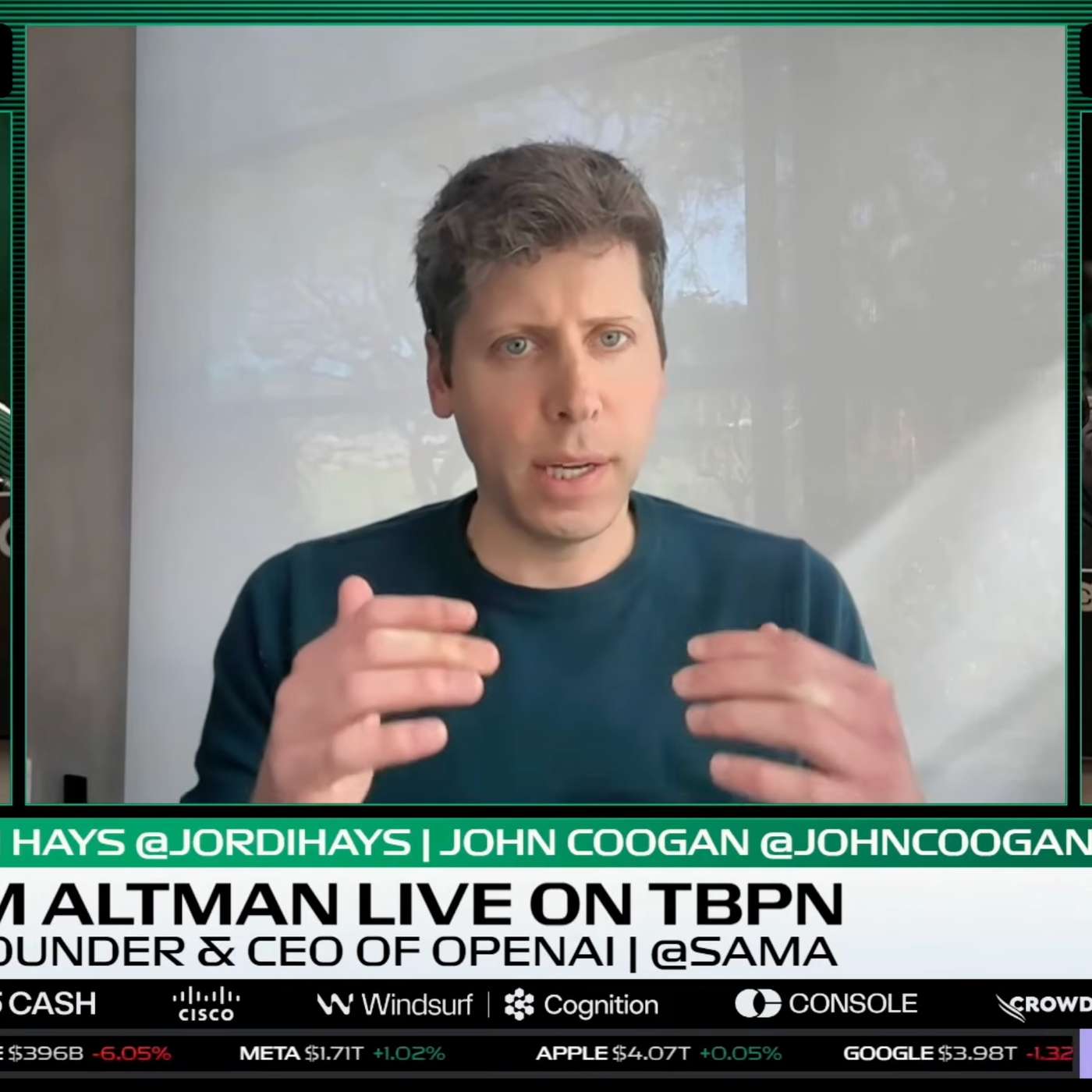
Sam Altman highlights that allowing users to correct an AI model while it's working on a long task is a crucial new capability. This is analogous to correcting a coworker in real-time, preventing wasted effort and enabling more sophisticated outcomes than 'one-shot' generation.
Long-horizon agents are not yet reliable enough for full autonomy. Their most effective current use cases involve generating a "first draft" of a complex work product, like a code pull request or a financial report. This leverages their ability to perform extensive work while keeping a human in the loop for final validation and quality control.
The speed of the new Codex model created an unexpected UX problem: it generated code too fast for a human to follow. The team had to artificially slow down the text rendering in the app to make the stream of information comprehensible and less overwhelming.
A central 'world model'—a dynamic, predictive representation of a scientific domain—is crucial for automating science. It acts as a shared state and memory, updated by experiments and analysis, much like a Git repository coordinates software engineers, allowing different AI agents to contribute to a unified understanding.
