Get your free personalized podcast brief
We scan new podcasts and send you the top 5 insights daily.
Purely agentic systems can be unpredictable. A hybrid approach, like OpenAI's Deep Research forcing a clarifying question, inserts a deterministic workflow step (a "speed bump") before unleashing the agent. This mitigates risk, reduces errors, and ensures alignment before costly computation.

Related Insights
To avoid failure, launch AI agents with high human control and low agency, such as suggesting actions to an operator. As the agent proves reliable and you collect performance data, you can gradually increase its autonomy. This phased approach minimizes risk and builds user trust.

Contrary to the vision of free-wheeling autonomous agents, most business automation relies on strict Standard Operating Procedures (SOPs). Products like OpenAI's Agent Builder succeed by providing deterministic, node-based workflows that enforce business logic, which is more valuable than pure autonomy.

Fully autonomous agents are not yet reliable for complex production use cases because accuracy collapses when chaining multiple probabilistic steps. Zapier's CEO recommends a hybrid "agentic workflow" approach: embed a single, decisive agent within an otherwise deterministic, structured workflow to ensure reliability while still leveraging LLM intelligence.

An AI agent uses an LLM with tools, giving it agency to decide its next action. In contrast, a workflow is a predefined, deterministic path where the LLM's actions are forced. Most production AI systems are actually workflows, not true agents.
Treating AI evaluation like a final exam is a mistake. For critical enterprise systems, evaluations should be embedded at every step of an agent's workflow (e.g., after planning, before action). This is akin to unit testing in classic software development and is essential for building trustworthy, production-ready agents.
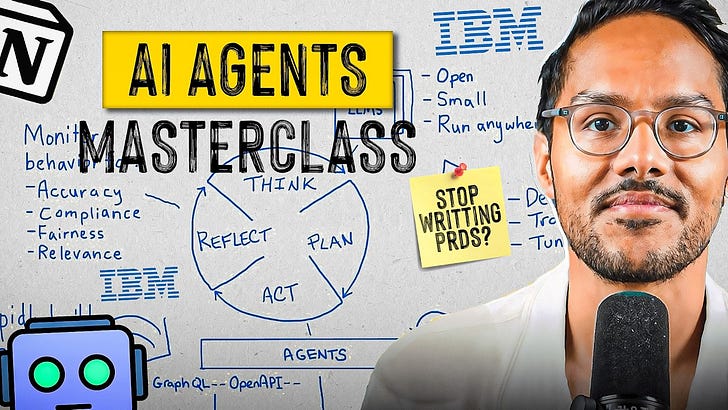
Tasklet's CEO argues that while traditional workflow automation seems safer, agentic systems that let the model plan and execute will ultimately prove more robust. They can handle unexpected errors and nuance that break rigid, pre-defined workflows, a bet on future model improvements.

To mitigate risks like AI hallucinations and high operational costs, enterprises should first deploy new AI tools internally to support human agents. This "agent-assist" model allows for monitoring, testing, and refinement in a controlled environment before exposing the technology directly to customers.

While AI models excel at gathering and synthesizing information ('knowing'), they are not yet reliable at executing actions in the real world ('doing'). True agentic systems require bridging this gap by adding crucial layers of validation and human intervention to ensure tasks are performed correctly and safely.

Fully autonomous AI agents are not yet viable in enterprises. Alloy Automation builds "semi-deterministic" agents that combine AI's reasoning with deterministic workflows, escalating to a human when confidence is low to ensure safety and compliance.

To get AI agents to perform complex tasks in existing code, a three-stage workflow is key. First, have the agent research and objectively document how the codebase works. Second, use that research to create a step-by-step implementation plan. Finally, execute the plan. This structured approach prevents the agent from wasting context on discovery during implementation.
