Get your free personalized podcast brief
We scan new podcasts and send you the top 5 insights daily.
Contrary to fears of fewer PMs, AI-driven development efficiency will increase the need for strategic guidance. This shifts the bottleneck to product strategy, requiring tighter PM alignment and potentially leading to smaller, more senior teams with ratios as low as one PM for every two developers.

Related Insights
As AI automates time-consuming tasks like data analysis, requirement writing, and prototyping, the product manager's focus will shift. More time will be spent on upstream activities like customer discovery and market strategy, transforming the role from operational execution to strategic thinking.

AI agents will automate PM tasks like competitive analysis, user feedback synthesis, and PRD writing. This efficiency gain could shift the standard PM-to-developer ratio from 1:6-10 to 1:20-30, allowing PMs to cover a much broader product surface area and focus on higher-level strategy.
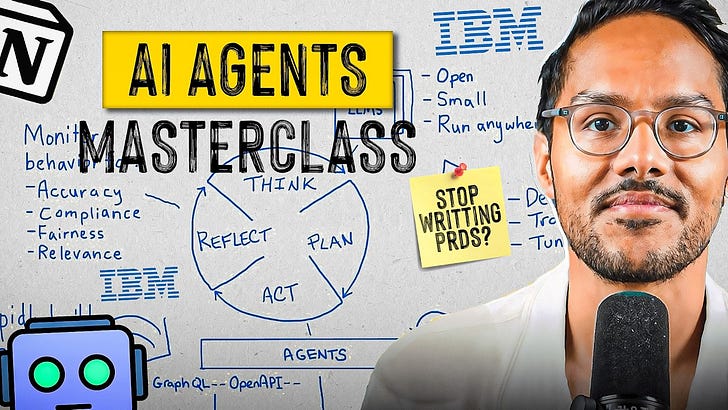
As AI tools automate coding and prototyping, the product manager's core function is no longer detailed specification writing. Instead, their value multiplies in judging, facilitating, and making the right strategic decisions quickly. The emphasis moves from the 'how' of building to the 'what' and 'why,' making decision-making the critical skill.

The most significant and immediate productivity leap from AI is happening in software development, with some teams reporting 10-20x faster progress. This isn't just an efficiency boost; it's forcing a fundamental re-evaluation of the structure and roles within product, engineering, and design organizations.

AI tools are blurring the lines between roles. Vercel SVP Aparna Sinha notes that product managers can now build and test working products, not just prototypes. This allows for hyper-efficient, small teams—sometimes just one person—to achieve the output of a full squad.

The PM role has often devolved into tactical development execution. By automating these tasks, AI forces the role to return to its original strategic function, akin to a P&G brand manager. The focus shifts back to owning the entire system: business model, market dynamics, and go-to-market strategy.
AI won't replace product managers but will elevate their role. PMs will shift from executing tasks like financial forecasting to managing a team of specialized AI agents, forcing them to focus on high-level strategy and assumption-checking.
AI's value for PMs is augmentation, not replacement. By automating tactical tasks that consume most of a PM's day (e.g., "six out of eight hours"), AI frees up critical capacity for higher-level strategic, creative, and innovative work—the core functions of a product leader.

As AI tools accelerate engineering output, the limiting factor in product development is no longer coding speed but the quality of product discovery and strategy. This increases the demand for effective product managers who can feed the more efficient engineering pipeline.

As AI automates synthesis and creation, the product manager's core value shifts from managing the development process to deeply contextualizing all available information (market, customer, strategy) to define the *right* product direction.
