Get your free personalized podcast brief
We scan new podcasts and send you the top 5 insights daily.
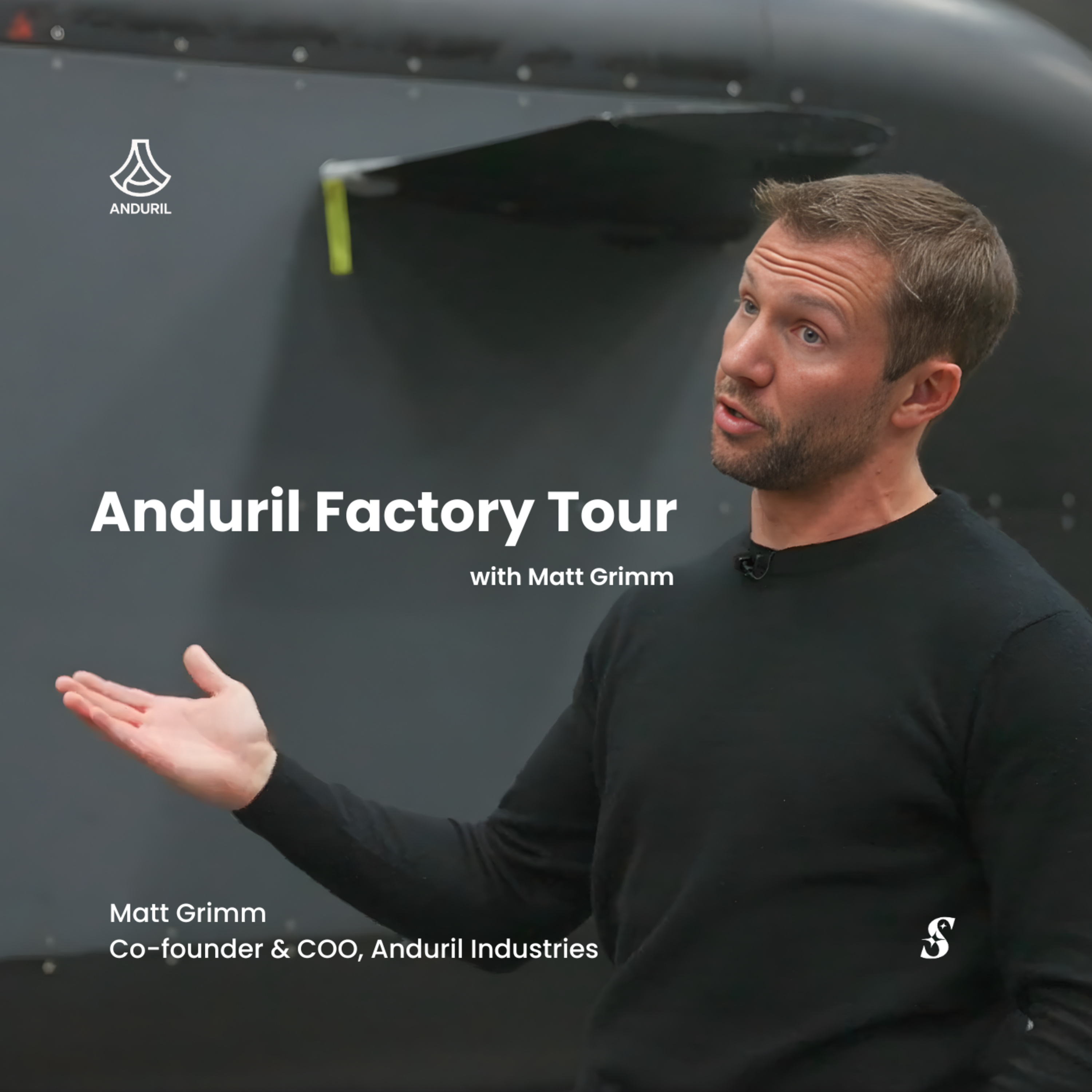
To test its electronic warfare products, Anduril uses an anechoic chamber. This is not just for a clean signal environment but a legal necessity. Their proximity to John Wayne Airport makes it illegal to broadcast powerful jamming signals openly, requiring a specialized, enclosed facility to develop and test these capabilities.
Related Insights
Before its massive headquarters, Anduril's first office for its 10 initial employees was a sub-5,000 sq ft garage formerly used by an airline to store lost luggage. It had mold, no bathroom, and no A/C, demonstrating that category-defining companies can emerge from the most unglamorous and scrappy beginnings.
Luckey reveals that Anduril prioritized institutional engagement over engineering in its early days, initially hiring more lawyers and lobbyists. The biggest challenge wasn't building the technology, but convincing the Department of Defense and political stakeholders to believe in a new procurement model, proving that shaping the system is a prerequisite for success.
![Palmer Luckey - Inventing the Future of Defense - [Invest Like the Best, CLASSICS] thumbnail](https://megaphone.imgix.net/podcasts/f7c9aa8e-cb8d-11f0-828e-0b281809c10a/image/cc07f91ec47f95abbde771a4956b37b7.jpg?ixlib=rails-4.3.1&max-w=3000&max-h=3000&fit=crop&auto=format,compress)
Massive backlogs for critical US military hardware are making America an unreliable supplier. This strategic vulnerability is pushing allied nations to develop their own defense industrial bases, creating a huge market for companies like Anduril that can co-develop and establish local production.

Unlike traditional contractors paid for time and materials, Anduril invests its own capital to develop products first. This 'defense product company' model aligns incentives with the government's need for speed and effectiveness, as profits are tied to rapid, successful delivery, not prolonged development cycles.
Many defense startups fail despite superior technology because the government isn't ready to purchase at scale. Anduril's success hinges on identifying when the customer is ready to adopt new capabilities within a 3-5 year window, making market timing its most critical decision factor.

While optical camouflage to trick the human eye is a solved technology, it's irrelevant on the modern battlefield. Adversaries rely on a wide spectrum of sensors like infrared, thermal, and radar, which can easily detect optically-cloaked objects, making the technology strategically impractical for Anduril's customers.
The decisive advantage in future conflicts will not be just technological superiority, but the ability to mass-produce weapons efficiently. After decades of offshoring manufacturing, re-industrializing the US to produce hardware at scale is Anduril's core strategic focus, viewing the factory itself as the ultimate weapon.
Anduril's R&D building houses machine shops, labs, and a 'dev test area' designed specifically to break products. By putting engineers across the parking lot from facilities that can rapidly prototype and test for failures (e.g., saltwater corrosion, vibration), they create an extremely tight feedback loop, speeding up iteration.
Unlike mass manufacturers, defense tech requires flexibility for a high mix of low-volume products. Anduril addresses this by creating a core platform of reusable software, hardware, and sensor components, enabling fast development and deployment of new systems without starting from scratch.
Anduril prototypes drone frames by milling them from solid metal blocks. While extremely wasteful and expensive for mass production, this method bypasses the slow and costly process of creating molds for casting, drastically reducing latency during the critical iterative design phase and getting products to market faster.