Get your free personalized podcast brief
We scan new podcasts and send you the top 5 insights daily.
Despite possessing frontier models through its OpenAI investment, Microsoft's cloud growth is throttled by the physical limitation of data center and AI hardware availability. This bottleneck directly caps Azure's revenue potential, demonstrating that AI dominance is fundamentally dependent on solving real-world infrastructure challenges.
Related Insights
The primary bottleneck for scaling AI over the next decade may be the difficulty of bringing gigawatt-scale power online to support data centers. Smart money is already focused on this challenge, which is more complex than silicon supply.

While AI models and coding agents scale to $100M+ revenues quickly, the truly exponential growth is in the hardware ecosystem. Companies in optical interconnects, cooling, and power are scaling from zero to billions in revenue in under two years, driven by massive demand from hyperscalers building AI infrastructure.

The focus in AI has evolved from rapid software capability gains to the physical constraints of its adoption. The demand for compute power is expected to significantly outstrip supply, making infrastructure—not algorithms—the defining bottleneck for future growth.

The critical constraint on AI and future computing is not energy consumption but access to leading-edge semiconductor fabrication capacity. With data centers already consuming over 50% of advanced fab output, consumer hardware like gaming PCs will be priced out, accelerating a fundamental shift where personal devices become mere terminals for cloud-based workloads.

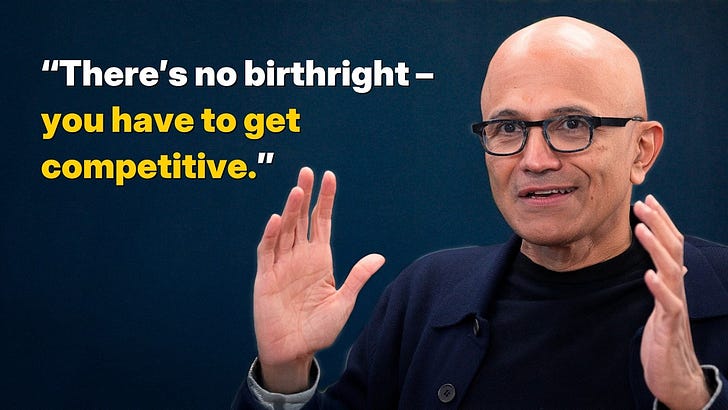
Satya Nadella reveals that Microsoft prioritizes building a flexible, "fungible" cloud infrastructure over catering to every demand of its largest AI customer, OpenAI. This involves strategically denying requests for massive, dedicated data centers to ensure capacity remains balanced for other customers and Microsoft's own high-margin products.

Despite strong earnings and its OpenAI partnership, Microsoft's stock dropped because limited AI hardware and data center capacity are constraining Azure's revenue growth. This shows physical infrastructure is a major bottleneck for cloud giants, directly impacting market perception.
The widely discussed compute shortage is primarily an inference problem, not a training one. According to Mustafa Suleiman, Microsoft has enough power for training next-gen models, but is constrained by the massive demand for running existing services like Copilot.

Satya Nadella clarifies that the primary constraint on scaling AI compute is not the availability of GPUs, but the lack of power and physical data center infrastructure ("warm shelves") to install them. This highlights a critical, often overlooked dependency in the AI race: energy and real estate development speed.
Despite appearing to lose ground to competitors, Microsoft's 2023 pause in leasing new datacenter sites was a strategic move. It aimed to prevent over-investing in hardware that would soon be outdated, ensuring it could pivot to newer, more power-dense and efficient architectures.
Sam Altman claims OpenAI is so "compute constrained that it hits the revenue lines so hard." This reframes compute from a simple R&D or operational cost into the primary factor limiting growth across consumer and enterprise. This theory posits a direct correlation between available compute and revenue, justifying enormous spending on infrastructure.
