Get your free personalized podcast brief
We scan new podcasts and send you the top 5 insights daily.
Anthony Bradley points out that AI should not be expected to design a drug candidate in a single molecule. Instead, algorithms far outperform human intuition by selecting batches of compounds that maximize data learning over time. This disciplined iterative cycle significantly cuts candidate timeline discovery and reduces wasted compound synthesis.

Related Insights
AI modeling transforms drug development from a numbers game of screening millions of compounds to an engineering discipline. Researchers can model molecular systems upfront, understand key parameters, and design solutions for a specific problem, turning a costly screening process into a rapid, targeted design cycle.

Traditional drug discovery separates finding a 'hit' from the long process of optimizing it into a drug candidate. DenovAI's 'one-shot' platform builds in advanced features from the start, collapsing a multi-year, disjointed process into a single, efficient design phase.

Anthony Bradley disputes the belief that AI drug discovery is unproven until a medicine reaches commercial approval. Advancing candidate molecules into Phase 1 or Phase 2 with fewer compounds already validates the technology. Garry Pairaudeau notes downstream clinical results depend on biological safety that affects all molecules equally.
Traditional lab-in-the-loop systems require slow robotic synthesis to test model hypotheses. By generating millions of physical binding interactions upfront, language models acting as medicinal chemists can hypothesize, select test compounds, and receive instant grounded feedback as if operating in a coding sandbox.

AI's primary value in early-stage drug discovery is not eliminating experimental validation, but drastically compressing the ideation-to-testing cycle. It reduces the in-silico (computer-based) validation of ideas from a multi-month process to a matter of days, massively accelerating the pace of research.

At Fathom Therapeutics, the AI platform autonomously iterates to generate drug candidates, bypassing tedious manual steps. This frees up scientists from the time-consuming "mechanic" work of building molecular connections, allowing them to dedicate their expertise to analyzing the high-quality, system-generated options and data.
Traditional drug discovery is a slow, sequential "waterfall" process with expensive gates. AI models that generate promising candidates quickly are transforming this into an agile, iterative loop, much like the revolution in software development. This dramatically reduces the cost of early experimentation.
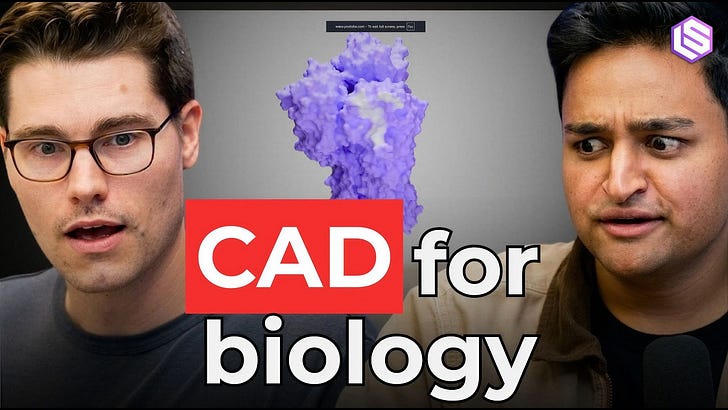
Antonov provides a stark comparison: a previous startup synthesized 400 molecules for a drug target and found one weak binder. Deep Origin's platform screened just 140 compounds and identified 50 binders, demonstrating a massive leap in hit-finding efficiency.
Unlike fields with vast training data like image recognition, effective drug discovery has too few successful examples for AI to learn from alone. To be useful, AI models must be explicitly taught the foundational principles and complex rules of medicinal chemistry that human experts use.

The immediate goal for AI in drug design is finding initial "hits" for difficult targets. The true endgame, however, is to train models on manufacturability data—like solubility and stability—so they can generate molecules that are already optimized, drastically compressing the development timeline.