/
© 2026 RiffOn. All rights reserved.

Get your free personalized podcast brief

We scan new podcasts and send you the top 5 insights daily.

  1. Latent Space: The AI Engineer Podcast
  2. 🔬The BioAI Phase Shift - Matthew McPartlon & Neil Patil, Chai Discovery
🔬The BioAI Phase Shift - Matthew McPartlon & Neil Patil, Chai Discovery

🔬The BioAI Phase Shift - Matthew McPartlon & Neil Patil, Chai Discovery

Latent Space: The AI Engineer Podcast · Aug 11, 2026

Chai Discovery is turning drug discovery into an engineering discipline, building a bio-AI 'software factory' for pharma partners.

BioAI Product Design Mirrors Autodesk and Figma, Not ChatGPT

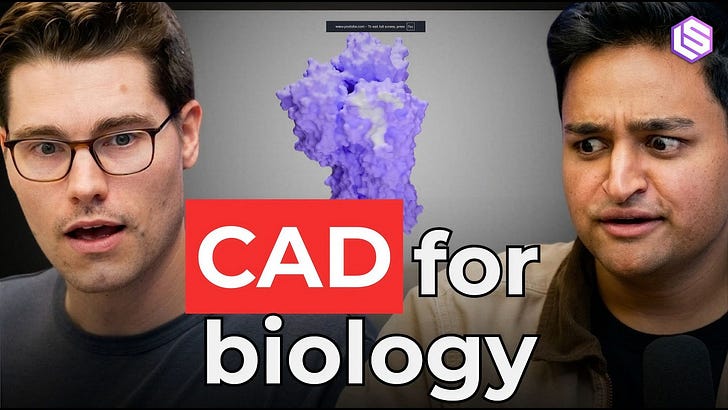
The user interface for advanced protein design isn't a conversational chatbot. It's a visual, CAD-like design suite where scientists can "paint" targets and use AI as a "content-aware fill" to generate molecules, emphasizing visual interaction over text prompts.

🔬The BioAI Phase Shift - Matthew McPartlon & Neil Patil, Chai Discovery thumbnail

🔬The BioAI Phase Shift - Matthew McPartlon & Neil Patil, Chai Discovery

Latent Space: The AI Engineer Podcast·17 hours ago

AI Turns "Waterfall" Drug Discovery into an Agile, Iterative Loop

Traditional drug discovery is a slow, sequential "waterfall" process with expensive gates. AI models that generate promising candidates quickly are transforming this into an agile, iterative loop, much like the revolution in software development. This dramatically reduces the cost of early experimentation.

🔬The BioAI Phase Shift - Matthew McPartlon & Neil Patil, Chai Discovery thumbnail

🔬The BioAI Phase Shift - Matthew McPartlon & Neil Patil, Chai Discovery

Latent Space: The AI Engineer Podcast·17 hours ago

Chai Discovery’s Pure Software Platform Was a Controversial Bet

Chai's strategy to be a neutral software and modeling layer for pharma, rather than developing its own drugs, was highly controversial two years ago. The founders bet that AI models would mature enough to make this pure-platform play viable, a risk that is now paying off with major partnerships.

🔬The BioAI Phase Shift - Matthew McPartlon & Neil Patil, Chai Discovery thumbnail

🔬The BioAI Phase Shift - Matthew McPartlon & Neil Patil, Chai Discovery

Latent Space: The AI Engineer Podcast·17 hours ago

Chai Used Open-Sourcing AlphaFold as an Internal Forcing Function for Infrastructure

When a new AlphaFold model was released, Chai's five-person team decided to build and open-source their own version. The public goal served as a powerful internal forcing function, compelling them to build production-grade infrastructure at a speed they wouldn't have otherwise achieved.

🔬The BioAI Phase Shift - Matthew McPartlon & Neil Patil, Chai Discovery thumbnail

🔬The BioAI Phase Shift - Matthew McPartlon & Neil Patil, Chai Discovery

Latent Space: The AI Engineer Podcast·17 hours ago

AI's True Value in Pharma is Unlocking Previously Impossible Drug Modalities

The main benefit of AI in drug discovery isn't just accelerating existing processes. It's enabling the design of complex therapeutics like bispecific antibodies, which are nearly impossible to create through traditional methods like mouse immunization, thus opening entirely new classes of medicine.

🔬The BioAI Phase Shift - Matthew McPartlon & Neil Patil, Chai Discovery thumbnail

🔬The BioAI Phase Shift - Matthew McPartlon & Neil Patil, Chai Discovery

Latent Space: The AI Engineer Podcast·17 hours ago

The Slow Feedback Loop from Wet Lab Validation is BioAI's Biggest Bottleneck

The primary obstacle in advancing protein design isn't creating better models, but the multi-week or multi-month delay in getting experimental validation from wet labs. This slow feedback loop fundamentally constrains the speed of research and model iteration, a problem the entire field is trying to solve.

🔬The BioAI Phase Shift - Matthew McPartlon & Neil Patil, Chai Discovery thumbnail

🔬The BioAI Phase Shift - Matthew McPartlon & Neil Patil, Chai Discovery

Latent Space: The AI Engineer Podcast·17 hours ago

BioAI Products Must Be Built to Be Rewritten at Higher Abstraction Levels

As AI models in biology become more powerful, the product UI will evolve from a low-level tool for inspecting atoms to a high-level orchestrator for scientific campaigns. Product teams must anticipate this and build for disposability, knowing today's tool is just a bridge to the next level of abstraction.

🔬The BioAI Phase Shift - Matthew McPartlon & Neil Patil, Chai Discovery thumbnail

🔬The BioAI Phase Shift - Matthew McPartlon & Neil Patil, Chai Discovery

Latent Space: The AI Engineer Podcast·17 hours ago

BioAI Success Depends More on Core ML Skills Than a Biology Background

A common misconception is that a biology PhD is required to work in AI for biology. The reality is that these are fundamentally machine learning problems. The necessary domain expertise can be learned, much like a computer vision expert doesn't need to be a professional filmmaker.

🔬The BioAI Phase Shift - Matthew McPartlon & Neil Patil, Chai Discovery thumbnail

🔬The BioAI Phase Shift - Matthew McPartlon & Neil Patil, Chai Discovery

Latent Space: The AI Engineer Podcast·17 hours ago

The Biggest Competitor to AI Drug Discovery is Still a Mouse

The primary alternative to computational protein design is immunizing a mouse and screening billions of molecules to find a "needle in a haystack" binder. This highlights how AI is shifting the paradigm from brute-force discovery to intentional, targeted design.

🔬The BioAI Phase Shift - Matthew McPartlon & Neil Patil, Chai Discovery thumbnail

🔬The BioAI Phase Shift - Matthew McPartlon & Neil Patil, Chai Discovery

Latent Space: The AI Engineer Podcast·17 hours ago

Thinking of Pharma as VCs is Key to Selling to Them

Big Pharma operates less like a traditional manufacturer and more like a venture capital firm, managing a portfolio of high-risk assets (drug targets) and allocating capital accordingly. This mental model explains their focus on platform technologies that improve the success rate of their portfolio bets.

🔬The BioAI Phase Shift - Matthew McPartlon & Neil Patil, Chai Discovery thumbnail

🔬The BioAI Phase Shift - Matthew McPartlon & Neil Patil, Chai Discovery

Latent Space: The AI Engineer Podcast·17 hours ago

The Compute Market is Overly Optimized for LLMs, Hindering Other AI Fields

Modern high-performance compute infrastructure, from GPUs to software stacks, is becoming "LLM-pilled"—designed specifically for large language models. This creates significant inefficiencies for other critical AI domains, like structural biology, that have different computational needs.

🔬The BioAI Phase Shift - Matthew McPartlon & Neil Patil, Chai Discovery thumbnail

🔬The BioAI Phase Shift - Matthew McPartlon & Neil Patil, Chai Discovery

Latent Space: The AI Engineer Podcast·17 hours ago

AI Platforms Are a Direct Counterattack on Eroom's Law in Pharma

The cost of developing new drugs doubles roughly every nine years (Eroom's Law, or Moore's Law backwards), an unsustainable trend. AI platforms aim to reverse this by making discovery more efficient and predictable, potentially saving the industry from a future where R&D returns become negative.

🔬The BioAI Phase Shift - Matthew McPartlon & Neil Patil, Chai Discovery thumbnail

🔬The BioAI Phase Shift - Matthew McPartlon & Neil Patil, Chai Discovery

Latent Space: The AI Engineer Podcast·17 hours ago

Small AI Research Teams Should Act Like VCs Allocating Compute to Ideas

For a lean research team, the primary job isn't just building models but acting as investors allocating a scarce resource: compute. This capital allocator mindset focuses the team on placing bets on the most promising ideas and architectures, rather than spreading resources thin.

🔬The BioAI Phase Shift - Matthew McPartlon & Neil Patil, Chai Discovery thumbnail

🔬The BioAI Phase Shift - Matthew McPartlon & Neil Patil, Chai Discovery

Latent Space: The AI Engineer Podcast·17 hours ago