Get your free personalized podcast brief
We scan new podcasts and send you the top 5 insights daily.
Traditional lab-in-the-loop systems require slow robotic synthesis to test model hypotheses. By generating millions of physical binding interactions upfront, language models acting as medicinal chemists can hypothesize, select test compounds, and receive instant grounded feedback as if operating in a coding sandbox.

Related Insights
AI modeling transforms drug development from a numbers game of screening millions of compounds to an engineering discipline. Researchers can model molecular systems upfront, understand key parameters, and design solutions for a specific problem, turning a costly screening process into a rapid, targeted design cycle.
The explosion of AI-generated molecular candidates creates a new problem: physically testing them at scale. A significant portion of R&D effort should be redirected from AI model development to inventing novel, high-throughput instrumentation and assays to experimentally validate the flood of predictions AI produces.

The transition to an engineering discipline in drug discovery, analogous to aeronautics, means using powerful in silico models to get much closer to a final product before physical testing. This reduces reliance on iterative, expensive, and time-consuming wet lab experiments.
Unlike traditional methods that simulate physical interactions like a key in a lock, ProPhet's AI learns the fundamental patterns governing why certain molecules and proteins interact. This allows for prediction without needing slow, expensive, and often impossible physical or computational simulations.

Moving beyond simulation, Genesis uses a cycle where their AI proposes molecules, a pharma partner synthesizes and tests them in a wet lab, and the experimental outcomes are used as feedback to retrain the generative model. This is akin to RLHF but with physical experiments.

While AI promises to design therapeutics computationally, it doesn't eliminate the need for physical lab work. Even if future models require no training data, their predicted outputs must be experimentally validated. This ensures a continuous, inescapable cycle where high-throughput data generation remains critical for progress.

Earli combines wet lab experiments with AI in a continuous feedback loop. They test massive libraries of synthetic DNA promoter sequences, feed the performance results into a Large Language Model (LLM), which then designs new, potentially more effective sequences. This iterative process rapidly optimizes their cancer-specific genetic switches.
AI's primary value in early-stage drug discovery is not eliminating experimental validation, but drastically compressing the ideation-to-testing cycle. It reduces the in-silico (computer-based) validation of ideas from a multi-month process to a matter of days, massively accelerating the pace of research.
Traditional drug discovery is a slow, sequential "waterfall" process with expensive gates. AI models that generate promising candidates quickly are transforming this into an agile, iterative loop, much like the revolution in software development. This dramatically reduces the cost of early experimentation.
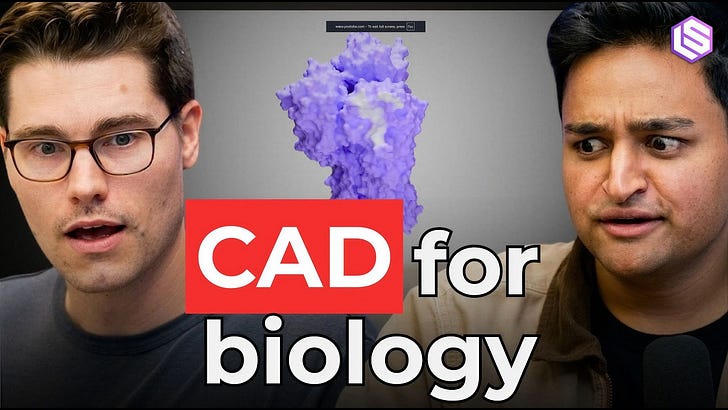
Antonov provides a stark comparison: a previous startup synthesized 400 molecules for a drug target and found one weak binder. Deep Origin's platform screened just 140 compounds and identified 50 binders, demonstrating a massive leap in hit-finding efficiency.