Get your free personalized podcast brief
We scan new podcasts and send you the top 5 insights daily.
Anthony Bradley disputes the belief that AI drug discovery is unproven until a medicine reaches commercial approval. Advancing candidate molecules into Phase 1 or Phase 2 with fewer compounds already validates the technology. Garry Pairaudeau notes downstream clinical results depend on biological safety that affects all molecules equally.

Related Insights
The long-term strategy for AI in drug discovery is a two-step process. First, create an AI platform to design effective drugs. Second, after a dozen or so AI-designed drugs succeed, use that data to convince regulators to trust AI predictions, potentially allowing future drugs to skip steps like animal testing and accelerate trials.

The lengthy timelines of drug development create a significant perception lag for AI's impact. Molly Gibson clarifies that molecules currently in clinical trials were designed years ago using nascent AI models. The true capabilities of today's more advanced AI platforms won't be evident in approved drugs for several more years.
AI's impact isn't one magic bullet. It will accelerate drug discovery by enhancing multiple stages simultaneously: biasing protein drug candidates to fold correctly, improving their targeting and stability, and enabling the synthesis and testing of massive libraries in parallel. This multi-pronged optimization will create an exponential effect.
AI is delivering tangible results now. An internal Eli Lilly study showed that using an AI-enabled triaging workflow for developability and structural diversity in early discovery has significantly reduced the number of 'surprises' and liabilities for molecules entering later development stages.
AI's primary value in early-stage drug discovery is not eliminating experimental validation, but drastically compressing the ideation-to-testing cycle. It reduces the in-silico (computer-based) validation of ideas from a multi-month process to a matter of days, massively accelerating the pace of research.

While AI for novel drug discovery has lofty goals, its most practical value lies in accelerating development. This includes applying AI to de-risked assets for new indications, improving delivery methods, and designing faster, more effective clinical trials, which is where the real bottleneck lies.

While AI is on the verge of cracking preclinical challenges, the biggest problem is the high drug failure rate in human trials. The next wave of innovation will use AI to design molecules for properties that predict human efficacy, addressing the fundamental reason drugs fail late-stage.
Traditional drug discovery is a slow, sequential "waterfall" process with expensive gates. AI models that generate promising candidates quickly are transforming this into an agile, iterative loop, much like the revolution in software development. This dramatically reduces the cost of early experimentation.
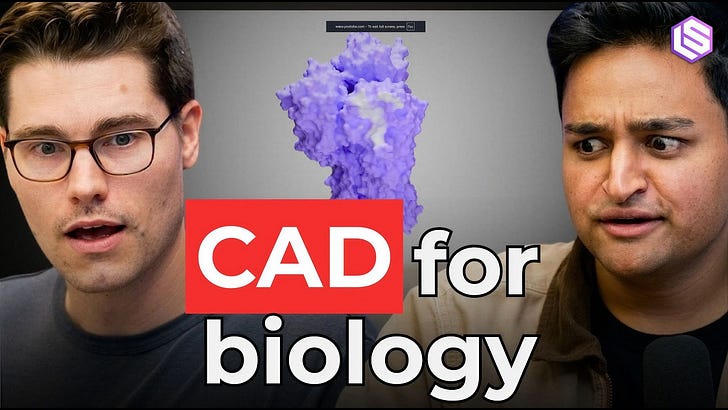
The field of AI for molecule design reached a critical inflection point in 2025. According to Chai Discovery's co-founder, models went from having sub-1% success rates to being actively deployed in the core discovery engines of major pharmaceutical companies like Eli Lilly and Pfizer within a single year.

Garry Pairaudeau notes biotechs must advance molecules before funding runs out. This financial urgency forces computational teams to focus strictly on project speed rather than theoretical models. Anthony Bradley adds that serving real partners keeps developers honest, preventing them from building shiny algorithms for their own sake.