Get your free personalized podcast brief
We scan new podcasts and send you the top 5 insights daily.
Traditional drug discovery is a slow, sequential "waterfall" process with expensive gates. AI models that generate promising candidates quickly are transforming this into an agile, iterative loop, much like the revolution in software development. This dramatically reduces the cost of early experimentation.
Related Insights
AI modeling transforms drug development from a numbers game of screening millions of compounds to an engineering discipline. Researchers can model molecular systems upfront, understand key parameters, and design solutions for a specific problem, turning a costly screening process into a rapid, targeted design cycle.

The long-term strategy for AI in drug discovery is a two-step process. First, create an AI platform to design effective drugs. Second, after a dozen or so AI-designed drugs succeed, use that data to convince regulators to trust AI predictions, potentially allowing future drugs to skip steps like animal testing and accelerate trials.

The transition to an engineering discipline in drug discovery, analogous to aeronautics, means using powerful in silico models to get much closer to a final product before physical testing. This reduces reliance on iterative, expensive, and time-consuming wet lab experiments.
Genentech uses an iterative AI model where an algorithm predicts an experiment, scientists run it in a wet lab, and the results are fed back to improve the model. This human-in-the-loop system has dramatically increased R&D productivity, cutting molecule design time from a typical 36 months down to just 10.
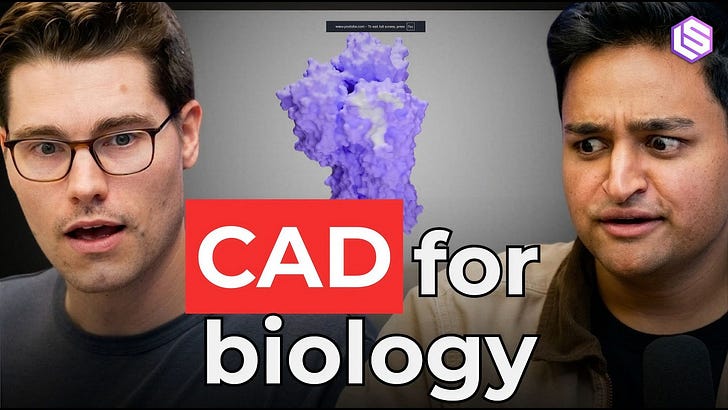
Traditional drug discovery separates finding a 'hit' from the long process of optimizing it into a drug candidate. DenovAI's 'one-shot' platform builds in advanced features from the start, collapsing a multi-year, disjointed process into a single, efficient design phase.

AI's impact isn't one magic bullet. It will accelerate drug discovery by enhancing multiple stages simultaneously: biasing protein drug candidates to fold correctly, improving their targeting and stability, and enabling the synthesis and testing of massive libraries in parallel. This multi-pronged optimization will create an exponential effect.

The future of AI in drug discovery is shifting from merely speeding up existing processes to inventing novel therapeutics from scratch. The paradigm will move toward AI-designed drugs validated with minimal wet lab reliance, changing the key question from "How fast can AI help?" to "What can AI create?"

AI's primary value in early-stage drug discovery is not eliminating experimental validation, but drastically compressing the ideation-to-testing cycle. It reduces the in-silico (computer-based) validation of ideas from a multi-month process to a matter of days, massively accelerating the pace of research.

A major biotech revolution is underway as AI now enables effective 'in silico' (simulated) experiments. This shift from physical "wet labs" to cheap, infinitely scalable simulations drastically cuts time and cost for drug discovery, making audacious goals like curing cancer scientifically plausible.

The immediate goal for AI in drug design is finding initial "hits" for difficult targets. The true endgame, however, is to train models on manufacturability data—like solubility and stability—so they can generate molecules that are already optimized, drastically compressing the development timeline.