Get your free personalized podcast brief
We scan new podcasts and send you the top 5 insights daily.
A significant, hidden component of AI costs comes from 'reasoning tokens'—the model's internal thinking process before generating an answer. This is invisible to the user but billed at the higher output-token rate and can increase a request's cost by 4x to 20x, similar to a restaurant charging for 'kitchen time'.

Related Insights
Flat-rate AI plans are becoming economically unviable due to token-hungry agents. Companies like Google and Microsoft are pushing usage-based billing, forcing enterprises to confront the surprisingly high real cost of running models at scale, which was previously hidden by subsidized pricing experiments.
A key operational detail of Kimi K3 is its locked "always-on" reasoning mode. The model consumes tokens for internal "thinking" processes, and these are billed at the expensive output rate of $15 per million. This makes it powerful for complex tasks but potentially wasteful and costly for simple lookups.

Newer AI models may have low per-token prices but are often "token hungry," requiring more tokens to complete a task. This can make them more expensive overall. The true measure of economic viability is the final cost-per-task, not the misleading per-token price.

Models that generate "chain-of-thought" text before providing an answer are powerful but slow and computationally expensive. For tuned business workflows, the latency from waiting for these extra reasoning tokens is a major, often overlooked, drawback that impacts user experience and increases costs.

While early generative AI costs were negligible, the shift to complex, multi-step agentic workflows is causing a massive spike in token usage. This has elevated cost optimization and ROI from a minor concern to a C-suite priority for the first time.

A paradox exists where the cost for a fixed level of AI capability (e.g., GPT-4 level) has dropped 100-1000x. However, overall enterprise spend is increasing because applications now use frontier models with massive contexts and multi-step agentic workflows, creating huge multipliers on token usage that drive up total costs.

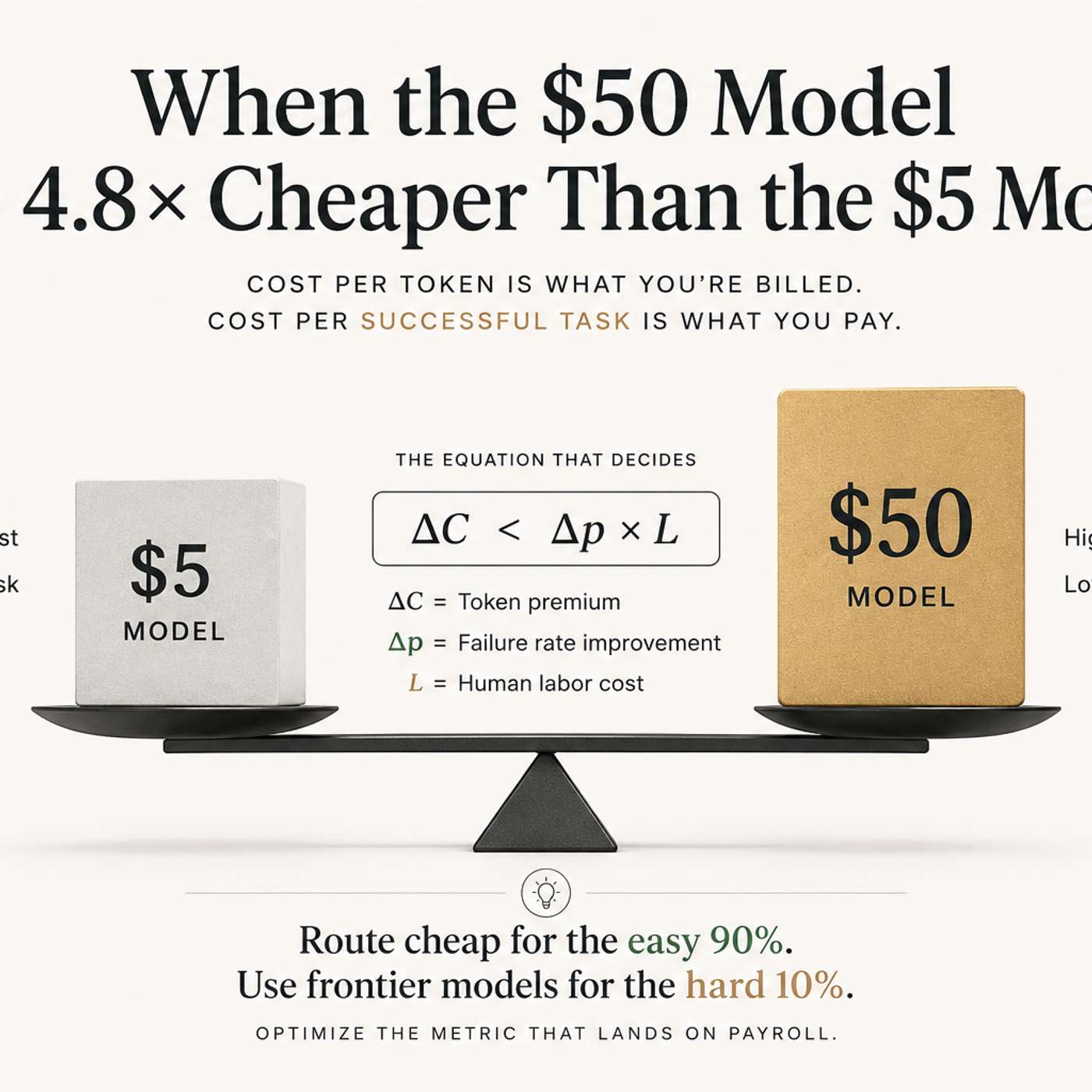
Evaluating AI models on cost-per-token is misleading because it ignores the hidden cost of human labor to fix failures. The true 'cost per successful task' is a business metric that accounts for both the API invoice and the payroll expense for rework, revealing a more accurate total cost of ownership.
The opacity of AI billing has created non-obvious costs for enterprises. A key issue is being charged for tokens consumed during API sessions that time out and fail to return a result. This represents a significant, previously unscrutinized billing flaw that can inflate costs without delivering value.
A model with a low per-token price can be more expensive if it's inefficient, verbose, or requires multiple attempts ('overthinking'). The actual invoice depends on the total tokens needed to complete a task, making token efficiency a hidden multiplier that savvy enterprises are now tracking to determine the true cost.
AI vendors can increase effective costs without altering their price-per-token sheets. When Anthropic updated its model, a new tokenizer produced ~30% more tokens for the same text. While the sticker price was unchanged, real-world bills grew 12-27%—a classic case of 'shrinkflation' applied to AI.