Get your free personalized podcast brief
We scan new podcasts and send you the top 5 insights daily.
Beyond chat or voice, the ability to simply forward an email to an AI agent to initiate complex tasks—like researching an investment or summarizing a newsletter—is a game-changing feature. This leverages an existing, universal behavior to seamlessly integrate AI into daily workflows, a feature few are discussing.

Related Insights
The evolution of 'agentic AI' extends beyond content generation to automating the connective tissue of business operations. Its future value is in initiating workflows that span departments, such as kickstarting creative briefs for marketing, creating product backlogs from feedback, and generating service tickets, streamlining operational handoffs.

To discover high-value AI use cases, reframe the problem. Instead of thinking about features, ask, "If my user had a human assistant for this workflow, what tasks would they delegate?" This simple question uncovers powerful opportunities where agents can perform valuable jobs, shifting focus from technology to user value.
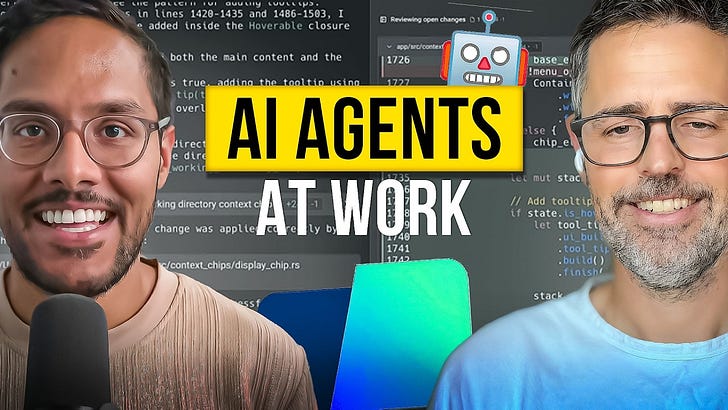
The emergence of personal AI assistants that can be integrated with private data (email, Slack) and execute tasks (send emails, build CRMs) represents a new paradigm. This moves AI from a passive research tool to an active, autonomous agent capable of performing complex knowledge work, fundamentally changing productivity.

The key product innovation of Agent Skills is changing the user's perception of AI. Instead of just a tool that answers questions, AI becomes a practical executor of defined workflows, making it feel less like a chat interface and more like powerful, responsive software.
Unlike tools like Zapier where users manually construct logic, advanced AI agent platforms allow users to simply state their goal in natural language. The agent then autonomously determines the steps, writes necessary code, and executes the task, abstracting away the workflow.

The killer feature for AI assistants isn't just answering abstract queries, but deeply integrating with user data. The ability for Gemini to analyze your unread emails to identify patterns and suggest improvements provides immediate, tangible value, showcasing the advantage of AI embedded in existing productivity ecosystems.

By summarizing emails and suggesting 'to-dos', Google is embedding agentic AI into a daily habit for over two billion users. This strategy serves as a massive, low-friction entry point to familiarize consumers with AI assistants that perform tasks on their behalf, potentially driving mass adoption for its Gemini ecosystem.

The most effective application of AI isn't a visible chatbot feature. It's an invisible layer that intelligently removes friction from existing user workflows. Instead of creating new work for users (like prompt engineering), AI should simplify experiences, like automatically surfacing a 'pay bill' link without the user ever consciously 'using AI.'

The next major leap for AI is its ability to connect disparate apps and data sources (email, calendar, location) to take autonomous actions. This will move AI from a Q&A tool to a proactive agent that seamlessly manages complex workflows.

Prioritize using AI to support human agents internally. A co-pilot model equips agents with instant, accurate information, enabling them to resolve complex issues faster and provide a more natural, less-scripted customer experience.
