Get your free personalized podcast brief
We scan new podcasts and send you the top 5 insights daily.
Waymo robo-taxis are calling 911 because passengers are falling asleep. This isn't a critical system failure, but a human-robot interaction problem. It reveals that successful automation requires solving not just complex technical challenges but also simple, unpredictable human edge cases that arise in real-world deployment.

Related Insights
After proving its robo-taxis are 90% safer than human drivers, Waymo is now making them more "confidently assertive" to better navigate real-world traffic. This counter-intuitive shift from passive safety to calculated aggression is a necessary step to improve efficiency and reduce delays, highlighting the trade-offs required for autonomous vehicle integration.

A key risk in deploying AI is its inability to generalize to 'long-tail' or out-of-distribution events. Models trained on vast but finite data often fail when encountering novel situations common in the open-ended real world, such as a self-driving car mistaking a stop sign on a billboard for a real one.

Current self-driving technology cannot solve the complex, unpredictable situations human drivers navigate daily. This is not a problem that more data or better algorithms can fix, but a fundamental limitation. According to the 'Journey of the Mind' theory, full autonomy will only be possible when vehicles can incorporate the actual mechanism of consciousness.

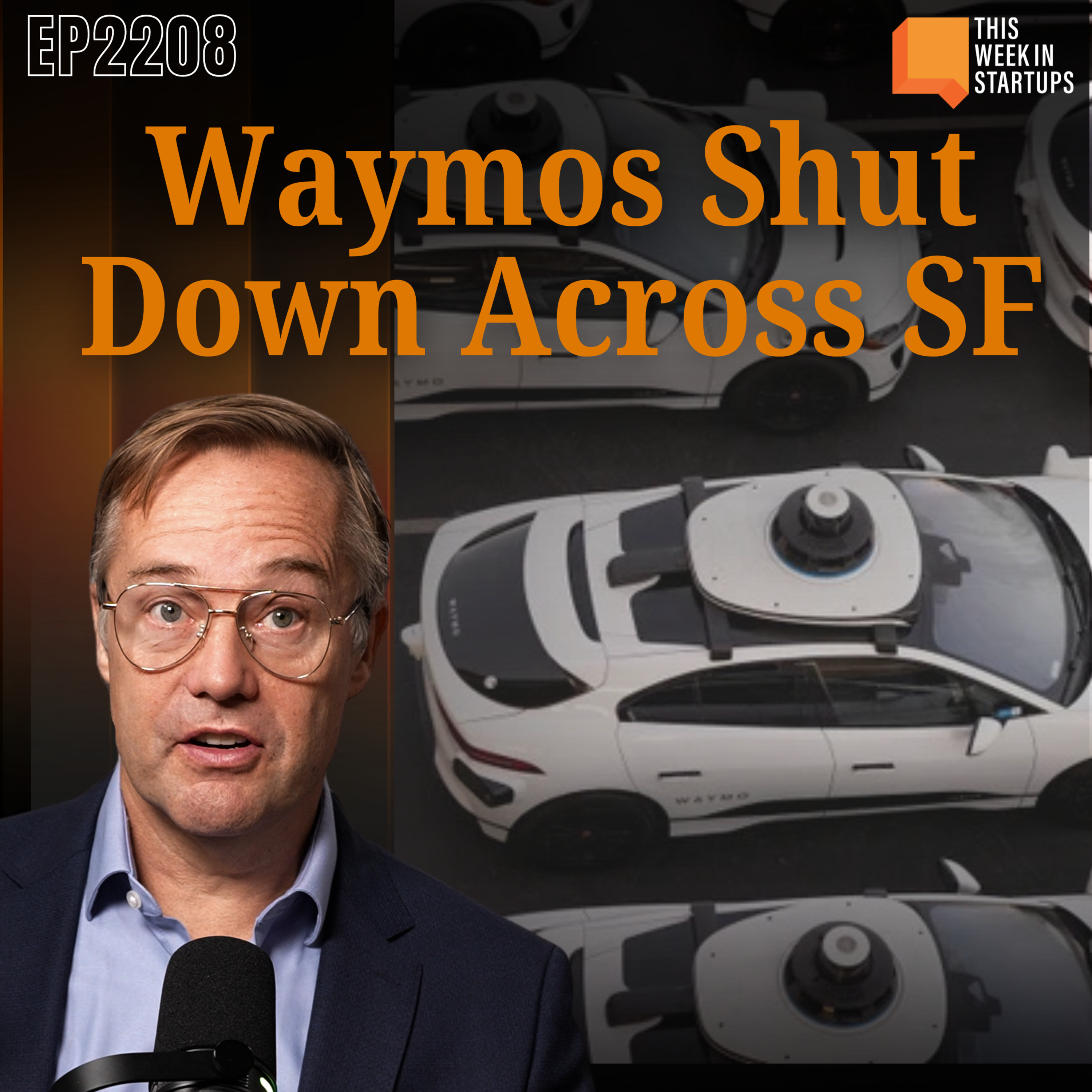
Waymo vehicles froze during a San Francisco power outage because traffic lights went dark, causing gridlock. This highlights the vulnerability of current AV systems to real-world infrastructure failures and the critical need for protocols to handle such "edge cases."
Early self-driving cars were too cautious, becoming hazards on the road. By strictly adhering to the speed limit or being too polite at intersections, they disrupted traffic flow. Waymo learned its cars must drive assertively, even "aggressively," to safely integrate with human drivers.

Dmitri Dolgov explains that while AI advancements create hype, they primarily speed up progress on the initial, easier parts of a problem. They don't change the "long tail" of complex, rare edge cases, which remains the core challenge in achieving full, superhuman autonomy.

The debate over robo-taxi safety is flawed when comparing broad categories. While Waymo is ~5x safer than the average human driver, hyper-segmenting the data reveals specific human cohorts (e.g., a 60-year-old married woman in Massachusetts on a Tuesday) who still outperform the AI, highlighting the need for nuanced data analysis in AI performance claims.

Beyond basic navigation, the most nuanced challenge for AVs is mastering pickups and drop-offs. The system must understand complex social context, like when it is acceptable to briefly double-park or how to avoid blocking a driveway, which is a more subtle problem than structured highway driving.

The public holds new technologies to a much higher safety standard than human performance. Waymo could deploy cars that are statistically safer than human drivers, but society would not accept them killing tens of thousands of people annually, even if it's an improvement. This demonstrates the need for near-perfection in high-stakes tech launches.

The initial excitement for fully autonomous agents has cooled. The industry now recognizes that 'autonomy without structure creates as much slop as leverage.' The new focus is on building systems where humans are central, providing direction, oversight, and strategic decision-making to guide agentic work.
