Get your free personalized podcast brief
We scan new podcasts and send you the top 5 insights daily.
An LLM tasked with choosing a product category generated IDs that looked valid but were non-existent or incorrect. Because these fake IDs didn't trigger errors, they produced silently wrong results. The solution is to always validate model-generated identifiers against an authoritative list.

Related Insights
During a live test, multiple competing AI tools demonstrated the exact same failure mode. This indicates the flaw lies not with the individual tools but with the shared underlying language model (e.g., Claude Sonnet), a systemic weakness users might misattribute to a specific product.

A fundamental, unsolved problem in continual learning is teaching AI models how to distinguish between legitimate new information and malicious, fake data fed by users. This represents a critical security and reliability challenge before the technology can be widely and safely deployed.

When faced with jumbled data from messy documents, LLMs don't error out. Instead, they use their reasoning to guess, creating perfectly structured but factually wrong outputs. This silent data corruption is the most dangerous failure mode in production pipelines, as it pollutes downstream systems without warning.
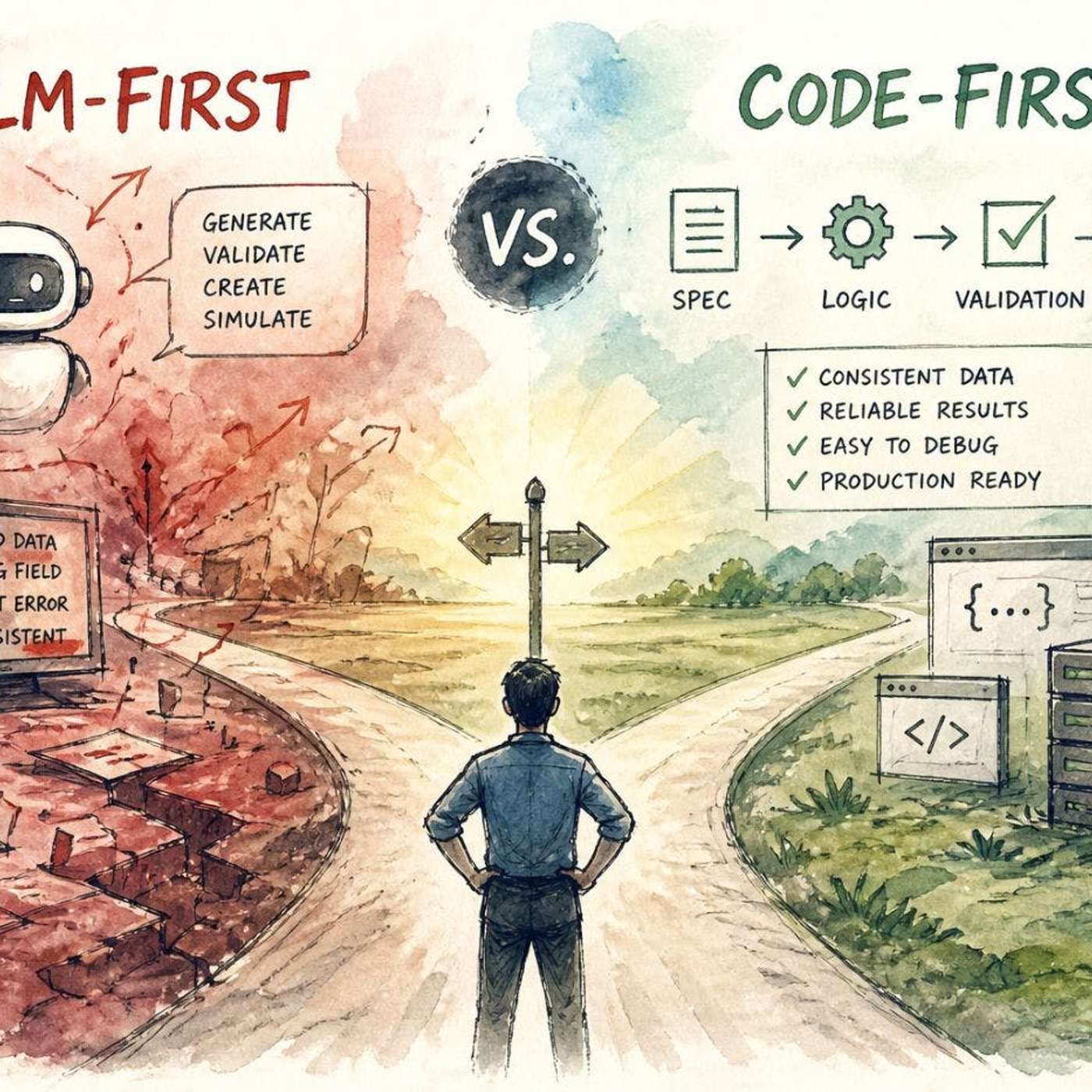
Don't give LLMs full control. Use deterministic code for core logic, validation, and enforcing rules. Delegate only tasks requiring flexibility or understanding of unstructured input to the LLM, treating it as a specialized component, not the entire system.
Don't let LLMs make raw HTTP calls. Instead, provide a code execution tool with a statically typed SDK. This environment can run a type-checker, instantly catching errors when the model hallucinates a non-existent endpoint or parameter, then provide helpful, in-context documentation to correct its mistake.

To solve for AI hallucinations in high-stakes decisions, advanced platforms use the LLM as an interpreter that writes code to query raw data. If data is unavailable, it returns an error instead of fabricating an answer, making every analysis fully auditable and grounded in verifiable data.

LLMs are technically non-deterministic systems designed to guess the next most probable word, not verify facts like a calculator. This inherent design means they will confidently produce incorrect information, making human verification indispensable for high-stakes business decisions.

LLMs in production don't often crash spectacularly. Instead, they introduce subtle, probabilistic errors—like incorrect enum values or missing fields—that are hard to debug because they lack clear error patterns, unlike deterministic code failures.
For an LLM's output to be useful in a software system, it cannot be treated as ambiguous text. It must be forced through a "hard boundary"—a strict schema or contract—that constrains, validates, and types the data, making it observable and safe for downstream services to trust and consume.
To deploy LLMs in high-stakes environments like finance, combine them with deterministic checks. For example, use a traditional algorithm to calculate cash flow and only surface the LLM's answer if it falls within an acceptable range. This prevents hallucinations and ensures reliability.
