Get your free personalized podcast brief
We scan new podcasts and send you the top 5 insights daily.
When faced with jumbled data from messy documents, LLMs don't error out. Instead, they use their reasoning to guess, creating perfectly structured but factually wrong outputs. This silent data corruption is the most dangerous failure mode in production pipelines, as it pollutes downstream systems without warning.
Related Insights
While generative AI models can hallucinate with low stakes, industrial AI cannot afford errors. This has created a premium for companies with unique, real-world datasets that are verifiable and critical for high-stakes decisions where failure could be catastrophic, like an explosion.

A novel threat to AI is the deliberate poisoning of its training data. Malicious actors can publish fake but plausible-sounding academic papers or data online. When large language models ingest this information, their foundational 'facts' become corrupted, making them dangerously unreliable for critical military or policy decisions.
![Darren Farber on Iran, China, and the Rise of Neoprimes - [Invest Like the Best, EP.474] thumbnail](https://megaphone.imgix.net/podcasts/ef669774-cccd-11ed-889b-c36caad6646f/image/158efdddfb983d2678b3530d484e8aa2.jpg?ixlib=rails-4.3.1&max-w=3000&max-h=3000&fit=crop&auto=format,compress)
MIT research reveals that large language models develop "spurious correlations" by associating sentence patterns with topics. This cognitive shortcut causes them to give domain-appropriate answers to nonsensical queries if the grammatical structure is familiar, bypassing logical analysis of the actual words.

Instead of solving underlying data quality issues, AI agents amplify and expose them immediately. This makes protecting and managing data at its source a critical prerequisite for maintaining trust and achieving successful AI implementation, as poor data becomes an immediate operational bottleneck.

The way LLMs generate confident but incorrect answers mirrors the neurological phenomenon of confabulation, where patients with memory gaps invent plausible stories. This behavior is fundamentally misleading, as humans aren't cognitively prepared to interact with a system that constantly "fills in the blanks" with fiction.

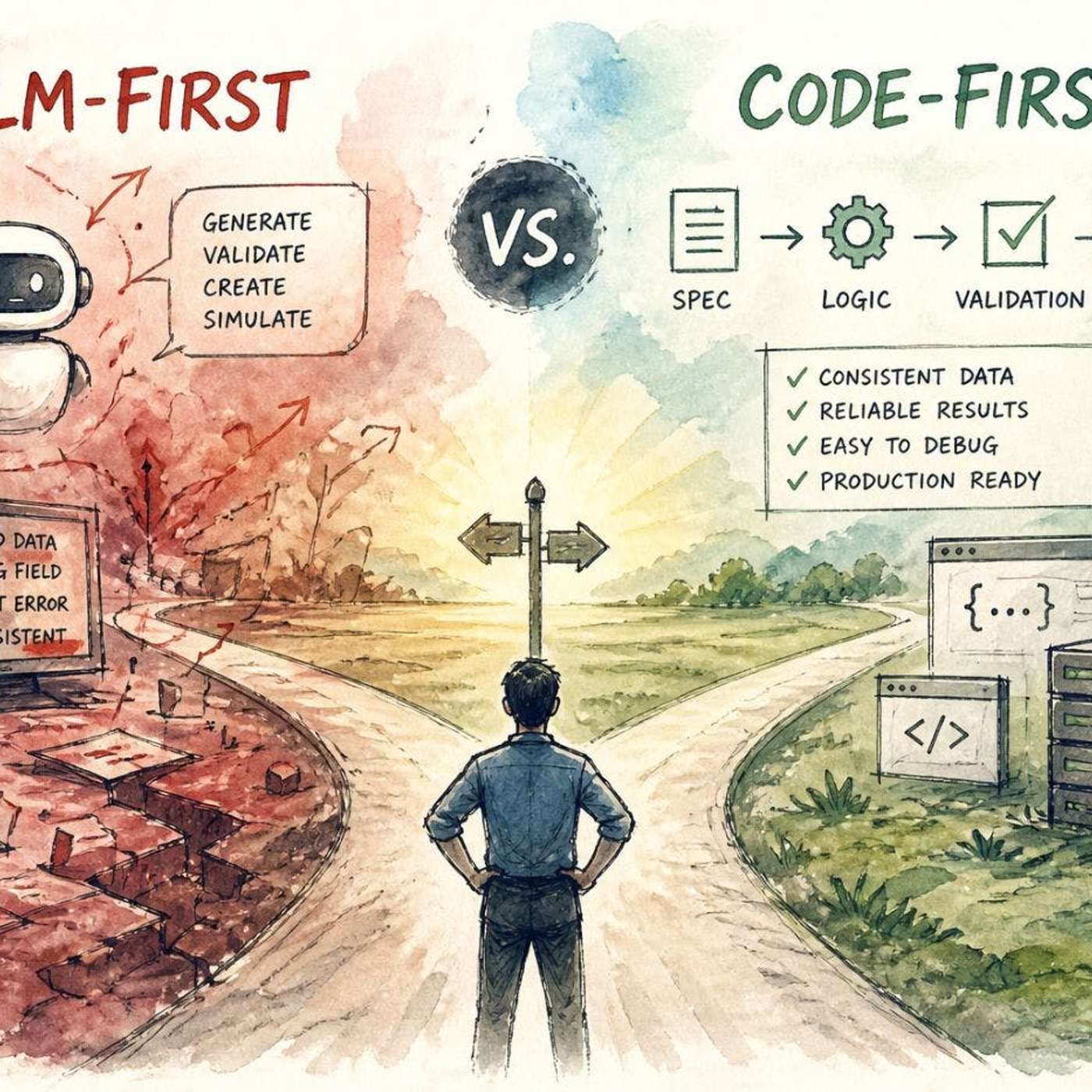
To make AI agents reliable with messy data, strip the layout-parsing responsibility from the LLM. Build a defensive, code-based wrapper that pre-checks document quality, pre-structures the data using coordinates, and uses separate validation steps. This treats the LLM as a reasoner, not a parser.
LLMs are technically non-deterministic systems designed to guess the next most probable word, not verify facts like a calculator. This inherent design means they will confidently produce incorrect information, making human verification indispensable for high-stakes business decisions.

When an AI agent receives a hallucinated data point, it doesn't just pass the error along. It treats the falsehood as a foundational fact, building new, complex inferences upon it. This 'downstream amplification' buries the original mistake under layers of seemingly logical secondary conclusions, making it much harder to detect and trace.

LLMs in production don't often crash spectacularly. Instead, they introduce subtle, probabilistic errors—like incorrect enum values or missing fields—that are hard to debug because they lack clear error patterns, unlike deterministic code failures.
When asked to analyze 100 papers, LLMs often admit they didn't complete the task. This failure stems from outcome-based training, which prioritizes a plausible-looking final output over correctly following the required process, revealing a fundamental flaw in current training paradigms.
