Get your free personalized podcast brief
We scan new podcasts and send you the top 5 insights daily.
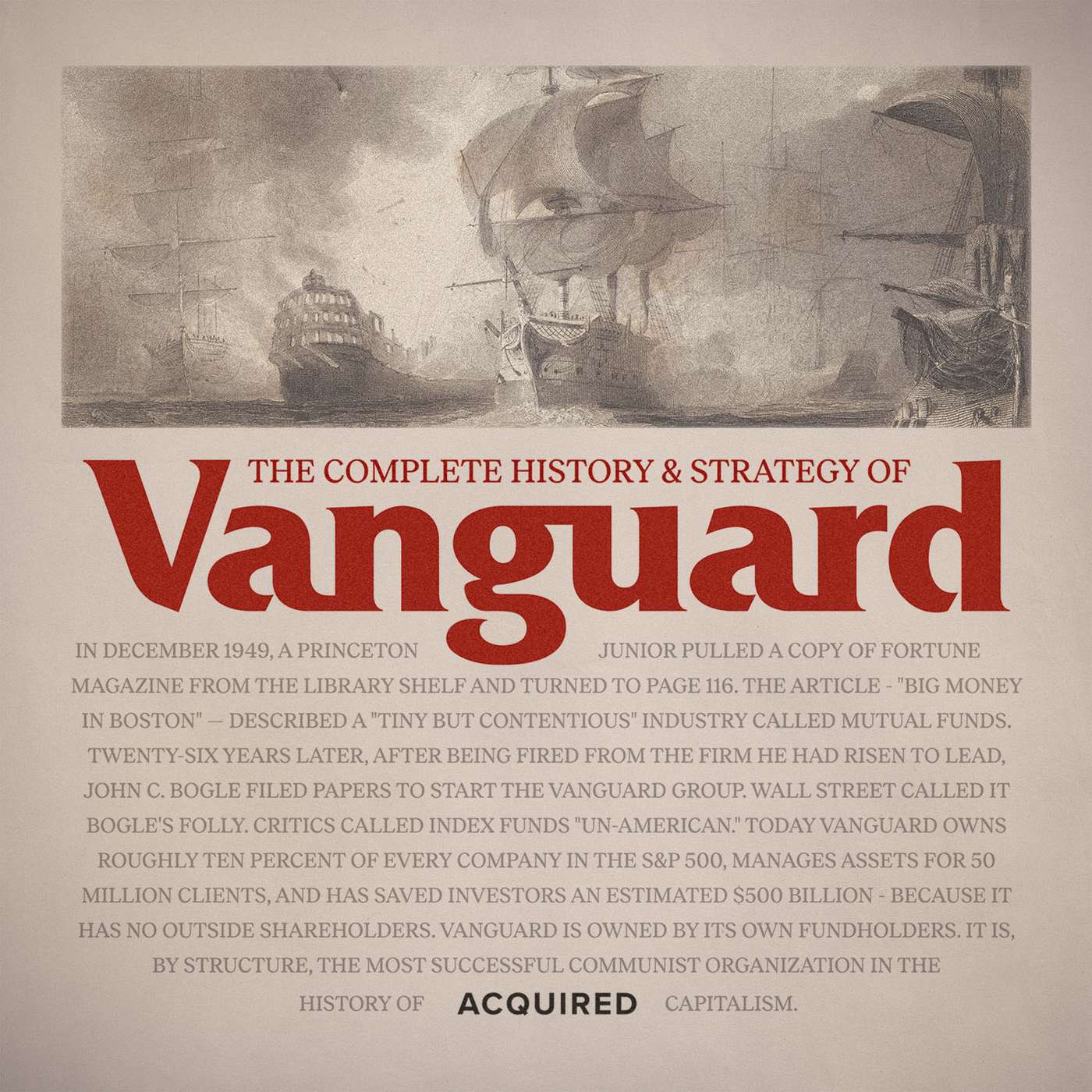
Vanguard's low-cost strategy is a direct result of its unique corporate structure. Since the company is owned by its fund investors, there's no incentive to generate profits for outside shareholders. Excess earnings are returned to customers via lower fees, a concept Jack Bogle called "strategy follows structure."
Related Insights
Vanguard founder Jack Bogle initially opposed ETFs, viewing intraday trading as speculation. Leadership overcame this by framing ETFs not as a trading product, but as an 'alternative distribution vehicle' to get their low-cost funds onto brokerage platforms and into advisors' hands, ultimately widening their market.

For nearly two decades, Vanguard's revolutionary low-cost index funds did not generate enough revenue to sustain the company. Ironically, the firm's survival depended on the profits from its traditional, actively managed funds, which performed exceptionally well and kept the lights on.
Beyond managing funds, Vanguard uses its scale to improve global market infrastructure, such as pushing for the creation of a closing auction in India. By making markets more efficient and transparent, they lower their own transaction costs and improve price discovery, benefiting all investors.
Beyond compounding returns, Jack Bogle's core insight was the destructive power of compounding costs. He showed that a 1% annual fee could consume one-third of an investor's long-term gains (e.g., reducing a $1.5M nest egg to $1M over 40 years), making low fees paramount.
When Jack Bogle proposed eliminating management company profits and running funds 'at cost,' it was a fringe idea. There was no pressure from customers, regulators, or activists. He was proposing corporate suicide for a problem only he seemed to see, highlighting how far his thinking was ahead of the industry.
Vanguard's first index fund had a ~2% expense ratio (180 bps), far from today's near-zero fees. This historical fact shows that for innovative financial products, low costs are an outcome of achieving massive scale, not a viable starting point. Early fees must be high enough to build a sustainable business.

Vanguard wasn't started purely from idealism. It was a strategic counter-attack by Jack Bogle after his partners at Wellington Management fired him. He used a legal loophole, leveraging his chairmanship of the funds' board to sever ties with the management company and create a new, mutually-owned entity.
Founder Jack Bogle noted Vanguard's investor-owned structure was never copied because "there's no money in it" for external shareholders. The model's core competitive advantage is its inherent unprofitability for anyone but the end customer, making it unattractive for competitors.

Superior returns can come from a firm's structure, not just its stock picks. By designing incentive systems and processes that eliminate 'alpha drags'—like short-term pressures, misaligned compensation, and herd behavior—a firm can create a durable, structural competitive advantage that boosts performance.
The downside of Vanguard's at-cost structure is a lack of excess profits to reinvest. This has led to subpar technology and customer service, creating a significant vulnerability that profit-driven competitors like Fidelity exploit by offering superior user experiences.