Get your free personalized podcast brief
We scan new podcasts and send you the top 5 insights daily.
For nearly two decades, Vanguard's revolutionary low-cost index funds did not generate enough revenue to sustain the company. Ironically, the firm's survival depended on the profits from its traditional, actively managed funds, which performed exceptionally well and kept the lights on.
Related Insights
The world's first retail index fund was a commercial failure at launch. Vanguard aimed to raise $150 million but only secured $11 million. The fund was so sub-scale it couldn't even buy all the S&P 500 stocks and had to be saved by merging with another fund just to survive.
Marks argues that the massive shift to indexation is less a testament to its brilliance and more a direct consequence of the widespread failure of active managers. They consistently underperformed while charging high fees, making the low-cost, average-return option of index funds far more attractive.

The dominance of low-cost index funds means active managers cannot compete in liquid, efficient markets. Survival depends on creating strategies in areas Vanguard can't easily replicate, such as illiquid micro-caps, niche geographies, or complex sectors that require specialized data and analysis.

Vanguard's first index fund had a ~2% expense ratio (180 bps), far from today's near-zero fees. This historical fact shows that for innovative financial products, low costs are an outcome of achieving massive scale, not a viable starting point. Early fees must be high enough to build a sustainable business.
Founder Jack Bogle noted Vanguard's investor-owned structure was never copied because "there's no money in it" for external shareholders. The model's core competitive advantage is its inherent unprofitability for anyone but the end customer, making it unattractive for competitors.

A Vanguard study of over 2,000 active funds revealed a stark reality: even among the top quartile that survived and outperformed long-term, 95% still lagged their benchmark in at least five years out of the period studied. This proves that frequent underperformance is a normal feature of a winning strategy.

The 2008 crisis was Vanguard's defining moment. The widespread failure of 'smart' active managers to protect investors destroyed their credibility. In contrast, Vanguard's simple, non-profit model resonated with a distrustful public, causing its share of fund inflows to double almost overnight.
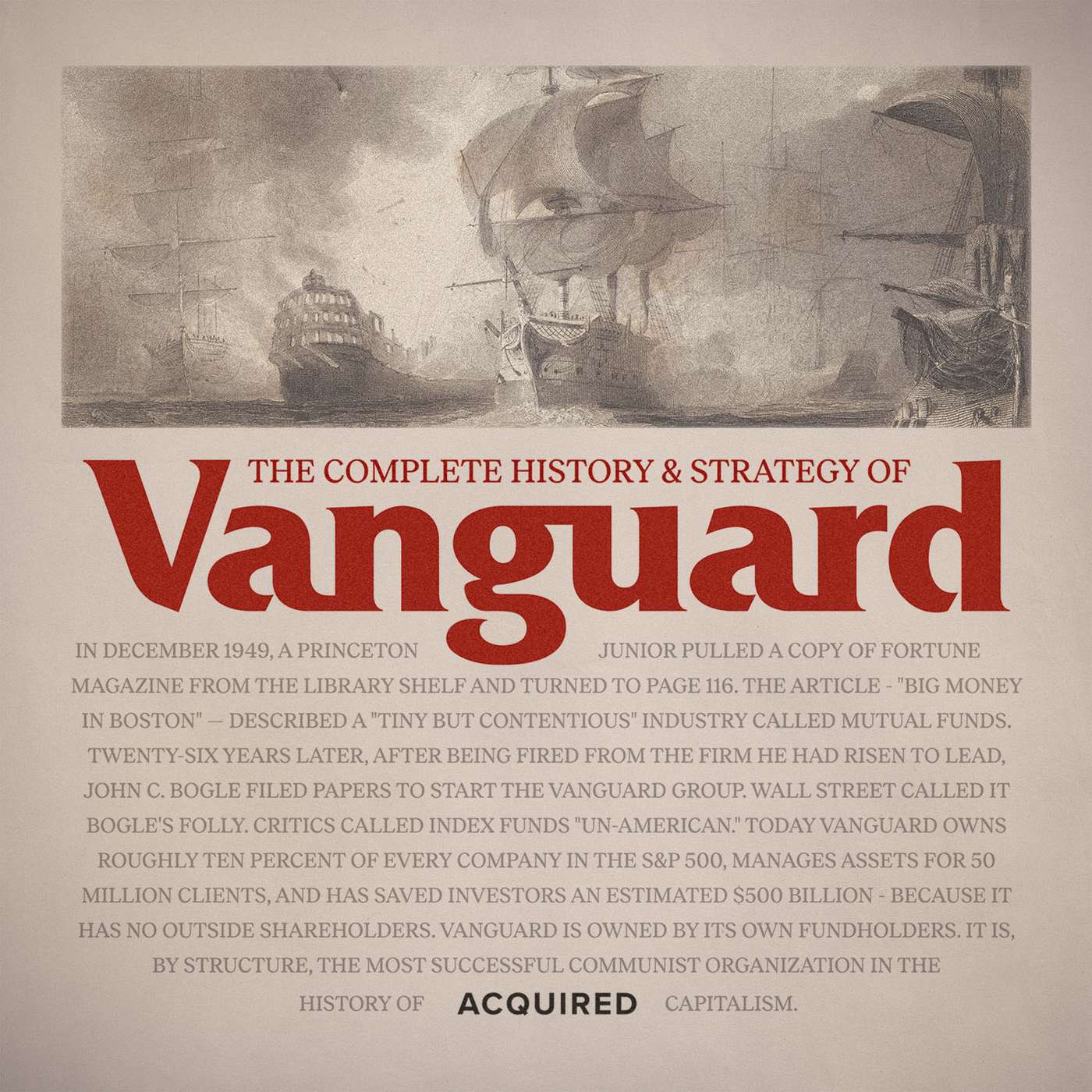
Vanguard's low-cost strategy is a direct result of its unique corporate structure. Since the company is owned by its fund investors, there's no incentive to generate profits for outside shareholders. Excess earnings are returned to customers via lower fees, a concept Jack Bogle called "strategy follows structure."
In a surprising twist, Wellington Management—the firm that fired Jack Bogle—became a trillion-dollar powerhouse by dedicating itself entirely to active management. They rebuilt the firm, took it private, and proved that a high-conviction, active approach could succeed even in the era of passive indexing.
The downside of Vanguard's at-cost structure is a lack of excess profits to reinvest. This has led to subpar technology and customer service, creating a significant vulnerability that profit-driven competitors like Fidelity exploit by offering superior user experiences.