Get your free personalized podcast brief
We scan new podcasts and send you the top 5 insights daily.
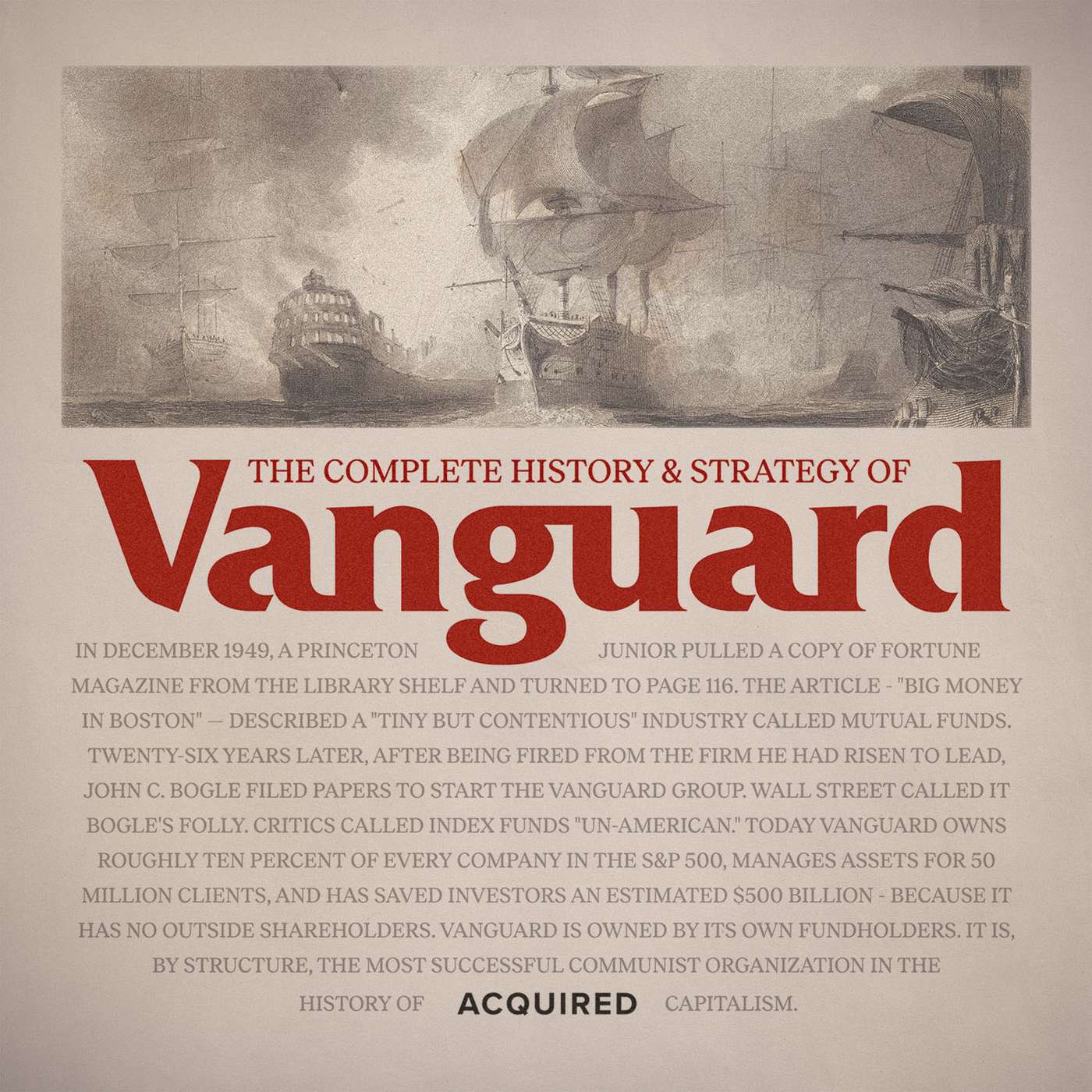
Vanguard wasn't started purely from idealism. It was a strategic counter-attack by Jack Bogle after his partners at Wellington Management fired him. He used a legal loophole, leveraging his chairmanship of the funds' board to sever ties with the management company and create a new, mutually-owned entity.
Related Insights
Vanguard founder Jack Bogle initially opposed ETFs, viewing intraday trading as speculation. Leadership overcame this by framing ETFs not as a trading product, but as an 'alternative distribution vehicle' to get their low-cost funds onto brokerage platforms and into advisors' hands, ultimately widening their market.

In the 1960s, Fidelity's aggressive, high-turnover 'Go-Go' funds massively outperformed conservative firms like Wellington. This market pressure forced new CEO Jack Bogle to abandon his firm's traditional approach and merge with a risky manager, a move that led to disaster and his ouster.
A founder's rigid ideology can become a liability. Jack Bogle was forced off Vanguard's board in 1999 for opposing Exchange-Traded Funds (ETFs). He believed ETFs encouraged harmful short-term trading, a puritanical stance that blinded him to a crucial innovation that competitors later dominated.
The world's first retail index fund was a commercial failure at launch. Vanguard aimed to raise $150 million but only secured $11 million. The fund was so sub-scale it couldn't even buy all the S&P 500 stocks and had to be saved by merging with another fund just to survive.
When Jack Bogle proposed eliminating management company profits and running funds 'at cost,' it was a fringe idea. There was no pressure from customers, regulators, or activists. He was proposing corporate suicide for a problem only he seemed to see, highlighting how far his thinking was ahead of the industry.
Vanguard's first index fund had a ~2% expense ratio (180 bps), far from today's near-zero fees. This historical fact shows that for innovative financial products, low costs are an outcome of achieving massive scale, not a viable starting point. Early fees must be high enough to build a sustainable business.

Founder Jack Bogle noted Vanguard's investor-owned structure was never copied because "there's no money in it" for external shareholders. The model's core competitive advantage is its inherent unprofitability for anyone but the end customer, making it unattractive for competitors.

Founder Jack Bogle questioned marketing spend, not realizing his constant public criticism of the industry and passionate advocacy was a powerful, free form of content marketing. Modern marketing's job became scaling and replacing that initial founder-led energy.
Vanguard's low-cost strategy is a direct result of its unique corporate structure. Since the company is owned by its fund investors, there's no incentive to generate profits for outside shareholders. Excess earnings are returned to customers via lower fees, a concept Jack Bogle called "strategy follows structure."
In a surprising twist, Wellington Management—the firm that fired Jack Bogle—became a trillion-dollar powerhouse by dedicating itself entirely to active management. They rebuilt the firm, took it private, and proved that a high-conviction, active approach could succeed even in the era of passive indexing.