Get your free personalized podcast brief
We scan new podcasts and send you the top 5 insights daily.
Store an AI agent's medium-term rolling summaries in relational databases. Vector stores excel at retrieving atomic facts, but summaries are narratives whose value lies in continuity. Conflating these memory tiers adds unnecessary complexity and results in sub-optimal performance.

Related Insights
Instead of relying on lossy LLM-based summarization, architect agent memory into three tiers: an ephemeral scratchpad for immediate tasks, a deterministic state machine for history (e.g., Redis), and a semantic anchor (e.g., vector store) for global knowledge lookup.

Instead of relying on lossy vector-based RAG systems, a well-organized file system serves as a superior memory foundation for a personal AI. It provides a stable, navigable structure for context and history, which the AI can then summarize and index for efficient, reliable retrieval.

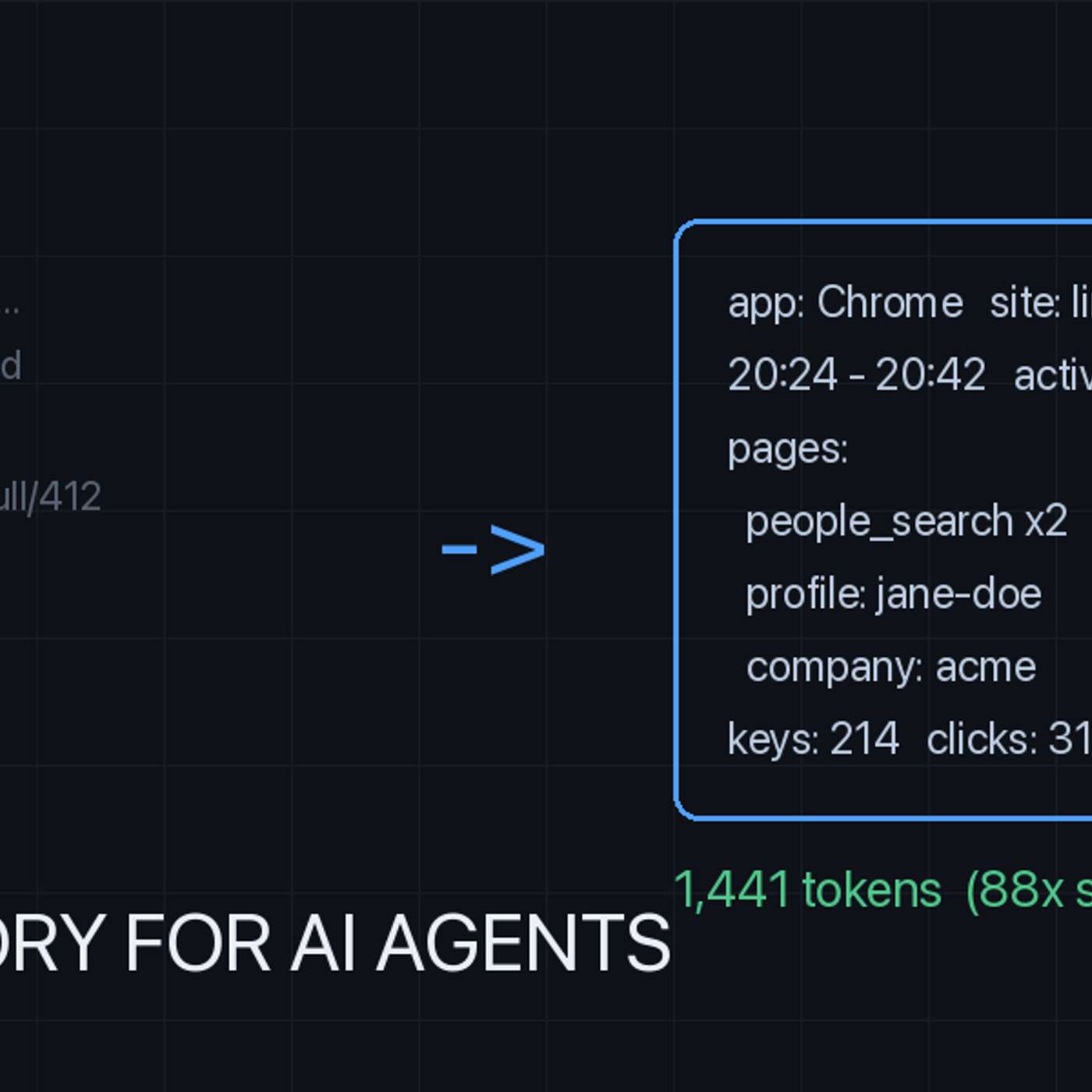
While using an LLM to summarize raw user activity seems intuitive, it is expensive, non-deterministic, and prone to hallucination. A superior approach is a "boring" deterministic compiler using plain code to transform raw data into structured, trustworthy, and recomputable memory episodes, reserving the LLM for higher-level interpretation.
Implementing effective long-term memory for AI agents is a major unsolved problem. The difficulty is not in storing information, but in automatically generating useful memories from interactions and accurately retrieving the correct, context-specific memory without cluttering the prompt with irrelevant information.

Effective agent memory is not merely a storage layer. It's an encapsulated system for learning and adaptation that integrates embedding models, re-rankers, databases, and LLMs, all working in concert to hold, move, and store data.

Instead of forcing an AI to read lengthy raw documents, create consistently formatted summaries. This allows the agent to quickly parse and synthesize information from numerous sources without hitting context limits, dramatically improving performance for complex analysis tasks.

Teams often agonize over which vector database to use for their Retrieval-Augmented Generation (RAG) system. However, the most significant performance gains come from superior data preparation, such as optimizing chunking strategies, adding contextual metadata, and rewriting documents into a Q&A format.

Long-running AI agent conversations degrade in quality as the context window fills. The best engineers combat this with "intentional compaction": they direct the agent to summarize its progress into a clean markdown file, then start a fresh session using that summary as the new, clean input. This is like rebooting the agent's short-term memory.

In multi-tier AI memory, designate raw conversation logs as the durable source of truth. All other forms—summaries, facts, embeddings—should be treated as recomputable projections. This design allows for recovery from data loss and adaptation to new extraction strategies.
To make agents useful over long periods, Tasklet engineers an "illusion" of infinite memory. Instead of feeding a long chat history, they use advanced context engineering: LLM-based compaction, scoping context for sub-agents, and having the LLM manage its own state in a SQL database to recall relevant information efficiently.