Get your free personalized podcast brief
We scan new podcasts and send you the top 5 insights daily.
Different crystalline phases frequently generate identical X-ray diffraction signatures, creating ambiguities that single-instrument measurements cannot resolve. Humans struggle to reconcile dense data across multiple modalities simultaneously. AI systems can jointly evaluate X-ray diffraction, electron morphology, magnetic behavior, and electrical conductivity, combining these signals with thermodynamic priors to reliably identify synthesized crystal phases.

Related Insights
Unlike language models trained on the internet, AI for materials science overcomes data scarcity and unreliability (e.g., conflicting literature) with a closed loop. The system actively directs experiments, analyzes grounded results for patterns, and uses that new data to drive the next cycle.

The traditional scientific method in materials science—hypothesize, experiment, learn—is being replaced. AI enables a new paradigm: treating the vast space of all possible molecules as a searchable database. Scientists can now query for materials with desired properties, radically accelerating discovery.
Google DeepMind's AI has expanded the catalog of known stable crystals from 40,000 to over 400,000. These AI-predicted materials are now being lab-tested and could lead to breakthroughs in physics-limited industries by enabling technologies like better electric vehicle batteries and superconductors.

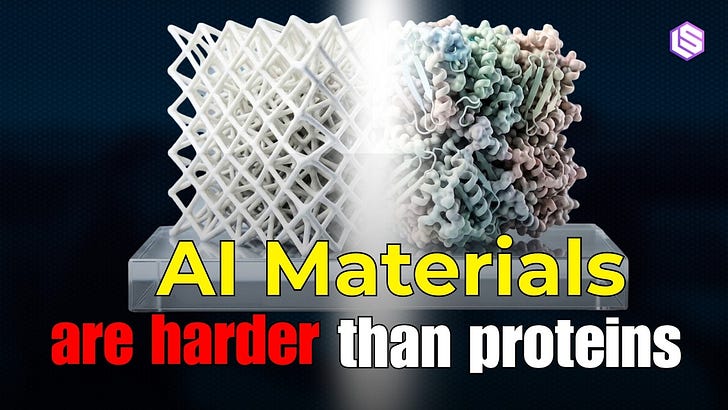
Unlike protein folding, which benefited from the CASP competition's experimental ground truth data, materials science lacks large-scale, high-quality experimental datasets. Existing data often comes from low-fidelity simulations, meaning even the best AI models are trained on imperfect information, hindering a major breakthrough.
Early AI models advanced by scraping web text and code. The next revolution, especially in "AI for science," requires overcoming a major hurdle: consolidating and formatting the world's vast but fragmented scientific data across disciplines like chemistry and materials science for model training.

Mixing precursor powders to attempt new material formulations is relatively straightforward, but characterizing the resulting synthesis is the core operational bottleneck. Without automated systems to quickly interpret complex diffraction patterns and determine what was formed, high-throughput experimentation yields little value. Periodic Labs concentrates engineering on automated characterization and simulation feedback to rapidly direct subsequent experimental rounds.
Experiments are not just for validation; they are a form of computation. By treating nature as a 'Physics Processing Unit' (PPU) working alongside digital GPUs, we can integrate physical experimentation directly into the computational loop, creating a powerful hybrid system for materials discovery.
Radical AI's system explores chemical spaces that human experts intuitively avoid due to past assumptions. This allows it to successfully create novel alloys in elemental families that scientists had written off, demonstrating AI's power to overcome cognitive bias in research.
Human perception is limited to 2D plus time, but cellular data from advanced microscopy is 5-dimensional (3D space, time, and color). The solution isn't to accelerate human analysis but to build AI models that can natively perceive and reason within these higher dimensions, much like AI for self-driving cars handles 3D plus time.

AI models can screen vast material spaces to identify novel solutions that defy conventional chemical intuition. Heather Kulik's group used AI to discover a quantum mechanical phenomenon that made a polymer four times tougher, a design experimentalists admitted they would never have conceived on their own.