Get your free personalized podcast brief
We scan new podcasts and send you the top 5 insights daily.
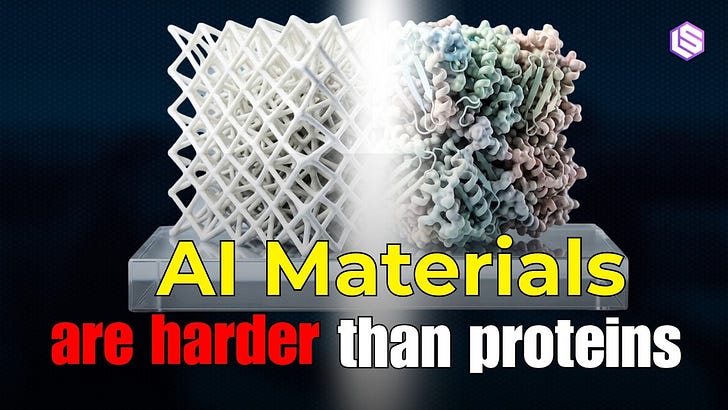
Radical AI's system explores chemical spaces that human experts intuitively avoid due to past assumptions. This allows it to successfully create novel alloys in elemental families that scientists had written off, demonstrating AI's power to overcome cognitive bias in research.
Related Insights
Wet lab experiments are slow and expensive, forcing scientists to pursue safer, incremental hypotheses. AI models can computationally test riskier, 'home run' ideas before committing lab resources. This de-risking makes scientists less hesitant to explore breakthrough concepts that could accelerate the field.

The traditional scientific method in materials science—hypothesize, experiment, learn—is being replaced. AI enables a new paradigm: treating the vast space of all possible molecules as a searchable database. Scientists can now query for materials with desired properties, radically accelerating discovery.

Scientists constrained by limited grant funding often avoid risky but groundbreaking hypotheses. AI can change this by computationally generating and testing high-risk ideas, de-risking them enough for scientists to confidently pursue ambitious "home runs" that could transform their fields.

Google DeepMind's AI has expanded the catalog of known stable crystals from 40,000 to over 400,000. These AI-predicted materials are now being lab-tested and could lead to breakthroughs in physics-limited industries by enabling technologies like better electric vehicle batteries and superconductors.
Beyond typical applications, Xiaomi deploys AI in fundamental material science. It simulated over 100 material formulas to find the optimal composition for its car's chassis. This moves AI from a process optimization tool to a core R&D engine for creating physical products.

The ultimate goal isn't just modeling specific systems (like protein folding), but automating the entire scientific method. This involves AI generating hypotheses, choosing experiments, analyzing results, and updating a 'world model' of a domain, creating a continuous loop of discovery.
Medicinal chemistry is described as a 'modern dark art' where expert opinions are often based on superstition and anecdotal experience (e.g., completely avoiding boron). These conflicting, 'pseudo-religious' beliefs create inefficiencies that unbiased AI approaches are well-positioned to overcome.
AI's key advantage isn't superior intelligence but the ability to brute-force enumerate and then rapidly filter a vast number of hypotheses against existing literature and data. This systematic, high-volume approach uncovers novel insights that intuition-driven human processes might miss.
AI research teams can explore multiple conversational paths simultaneously, altering variables like which agent speaks first or removing a 'critic' agent. This eliminates human biases like personality clashes or anchoring on the first idea, leading to more robust outcomes.

AI models can screen vast material spaces to identify novel solutions that defy conventional chemical intuition. Heather Kulik's group used AI to discover a quantum mechanical phenomenon that made a polymer four times tougher, a design experimentalists admitted they would never have conceived on their own.