Get your free personalized podcast brief
We scan new podcasts and send you the top 5 insights daily.
AI agents are a complementary technology to robotics, not a competitor. They can speed up progress by automating development tasks like coding and simulation, and in the future, by coordinating fleets of diverse robots in complex environments like warehouses.

Related Insights
Amazon’s strategic advantage isn't just in developing AI for AWS and robots for warehouses. The real breakthrough is the convergence of these technologies, where AI provides the "brain" that transforms programmed machines into adaptive, learning systems, accelerating automation's impact.

Unlike co-pilots that assist developers, Factory's “droids” are designed to be autonomous. This reframes the developer's job from writing code to mastering delegation—clearly defining tasks and success criteria for an AI agent to execute independently.

The most significant societal and economic impact of AI won't be from chatbots. Instead, it will emerge from the integration of AI with physical robotics in sectors like manufacturing, logistics (Amazon), and autonomous vehicles (Waymo), which are currently under-hyped.

Countering the narrative that AI will kill software, NVIDIA CEO Jensen Huang argues agents will be tool users, not tool builders. Just as a robot would pick up a screwdriver instead of reinventing one, AI agents will leverage existing platforms. This positions AI as an accelerator for current software, not an immediate replacement.

Tools like Claude CoWork preview a future where teams of AI agents collaborate on multi-faceted projects, like a product launch, simultaneously. This automates tactical entry-level tasks, elevating human workers to roles focused on high-level strategy, review, and orchestrating these AI "employees."

The 'agents vs. applications' debate is a false dichotomy. Future applications will be sophisticated, orchestrated systems that embed agentic capabilities. They will feature multiple LLMs, deterministic logic, and robust permission models, representing an evolution of software, not a replacement of it.

The next evolution for autonomous agents is the ability to form "agentic teams." This involves creating specialized agents for different tasks (e.g., research, content creation) that can hand off work to one another, moving beyond a single user-to-agent relationship towards a system of collaborating AIs.

Unlike previous technologies that integrated into existing workflows, AI agents require us to fundamentally re-engineer our work processes to make them effective. Early adopters who adapt their operations to how agents "think" will gain compounding advantages over competitors.
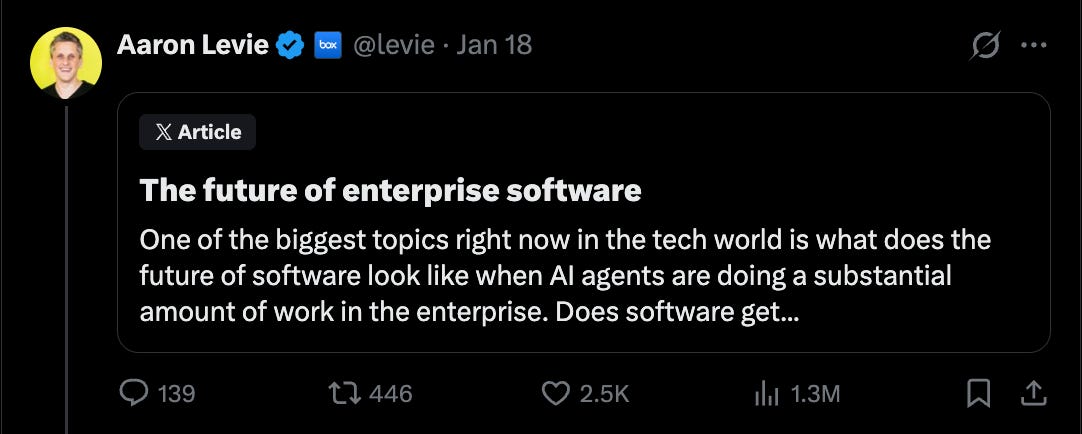
The future of software isn't just AI-powered features. It's a fundamental shift from tools that assist humans to autonomous agents that perform tasks. Human roles will evolve from *doing* the work to *orchestrating* thousands of these agents.

Unlike older robots requiring precise maps and trajectory calculations, new robots use internet-scale common sense and learn motion by mimicking humans or simulations. This combination has “wiped the slate clean” for what is possible in the field.
