Get your free personalized podcast brief
We scan new podcasts and send you the top 5 insights daily.
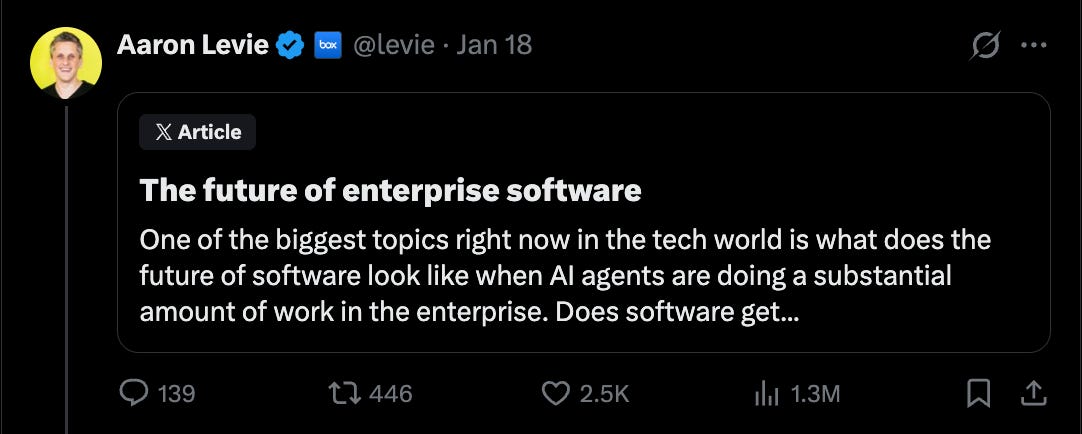
Unlike previous technologies that integrated into existing workflows, AI agents require us to fundamentally re-engineer our work processes to make them effective. Early adopters who adapt their operations to how agents "think" will gain compounding advantages over competitors.
Related Insights
Viewing AI as a simple disruption is insufficient. The better metaphor is "terraforming"—a fundamental, irreversible reshaping of the entire economic landscape. This framing emphasizes the scale and permanence of the change, forcing businesses to adapt radically or face extinction.

Incumbent companies are slowed by the need to retrofit AI into existing processes and tribal knowledge. AI-native startups, however, can build their entire operational model around agent-based, prompt-driven workflows from day one, creating a structural advantage that is difficult for larger companies to copy.

For incumbent software companies, surviving the AI era requires more than superficial changes. They must aggressively reimagine their core product with AI—not just add chatbots—and overhaul back-end operations to match the efficiency of AI-native firms. It's a fundamental "adapt or die" moment.

The biggest mistake in AI adoption is simply automating an existing manual workflow, which creates an efficient but still flawed process. True transformation occurs when AI enables a completely new, non-human way of achieving an outcome, changing the process itself rather than just the actor performing it.
The most significant gains from AI will not come from automating existing human tasks. Instead, value is unlocked by allowing AI agents to develop entirely new, non-human processes to achieve goals. This requires a shift from process mapping to goal-oriented process invention.

The true power of AI is unlocked by adopting an "AI First" approach. This means completely redesigning workflows with AI at the core, rather than simply using AI to accelerate existing processes. This shifts employees' roles from performing tasks to managing the AI agents that do the work.

The business race isn't about humans versus AI, but about your company versus competitors who integrate AI more quickly and effectively. The sustainable competitive advantage comes from shrinking the cycle time from a new AI breakthrough to its implementation within your business processes and culture.

The transition to agent-centric workflows is not a simple software deployment; it's a complex re-engineering of business processes. This creates a huge opportunity for a new generation of consulting firms that specialize in getting organizations "agent-ready."
Just as electricity's impact was muted until factory floors were redesigned, AI's productivity gains will be modest if we only use it to replace old tools (e.g., as a better Google). Significant economic impact will only occur when companies fundamentally restructure their operations and workflows to leverage AI's unique capabilities.

The productivity boom from AI won't materialize from workers simply using new tools. Citing historical parallels with electricity and computers, the real gains are unlocked only when companies fundamentally restructure their operations and business models around the technology.
