Get your free personalized podcast brief
We scan new podcasts and send you the top 5 insights daily.
An academic study found developer-written instruction files for AI agents reduce agent-introduced bugs by 35-55%. In contrast, instructions generated by an LLM actually decrease task success rates and increase inference costs by over 20%. This highlights the critical value of human judgment in steering AI systems effectively.
Related Insights
Anthropic's Claude Code team reports that AI agent skills designed for "verification"—teaching an agent to test and validate its own output—provide an extremely high return on investment. This suggests that building reliability and correctness into AI workflows is as critical, if not more so, than the initial generation capability.

A practical hack to improve AI agent reliability is to avoid built-in tool-calling functions. LLMs have more training data on writing code than on specific tool-use APIs. Prompting the agent to write and execute the code that calls a tool leverages its core strength and produces better outcomes.

A developer found that when his AI agent interacts directly with coding environments, it produces features with better value and fewer bugs compared to when he manually prompts an AI model himself. This suggests direct 'computer-to-computer' interaction is more effective for development tasks.

While an AI agent can find and propose a fix for a specific line of code, it often lacks the context to identify and solve the problem class architecturally across the entire codebase. Expert human engineers remain vital for this higher-level reasoning and pattern recognition.

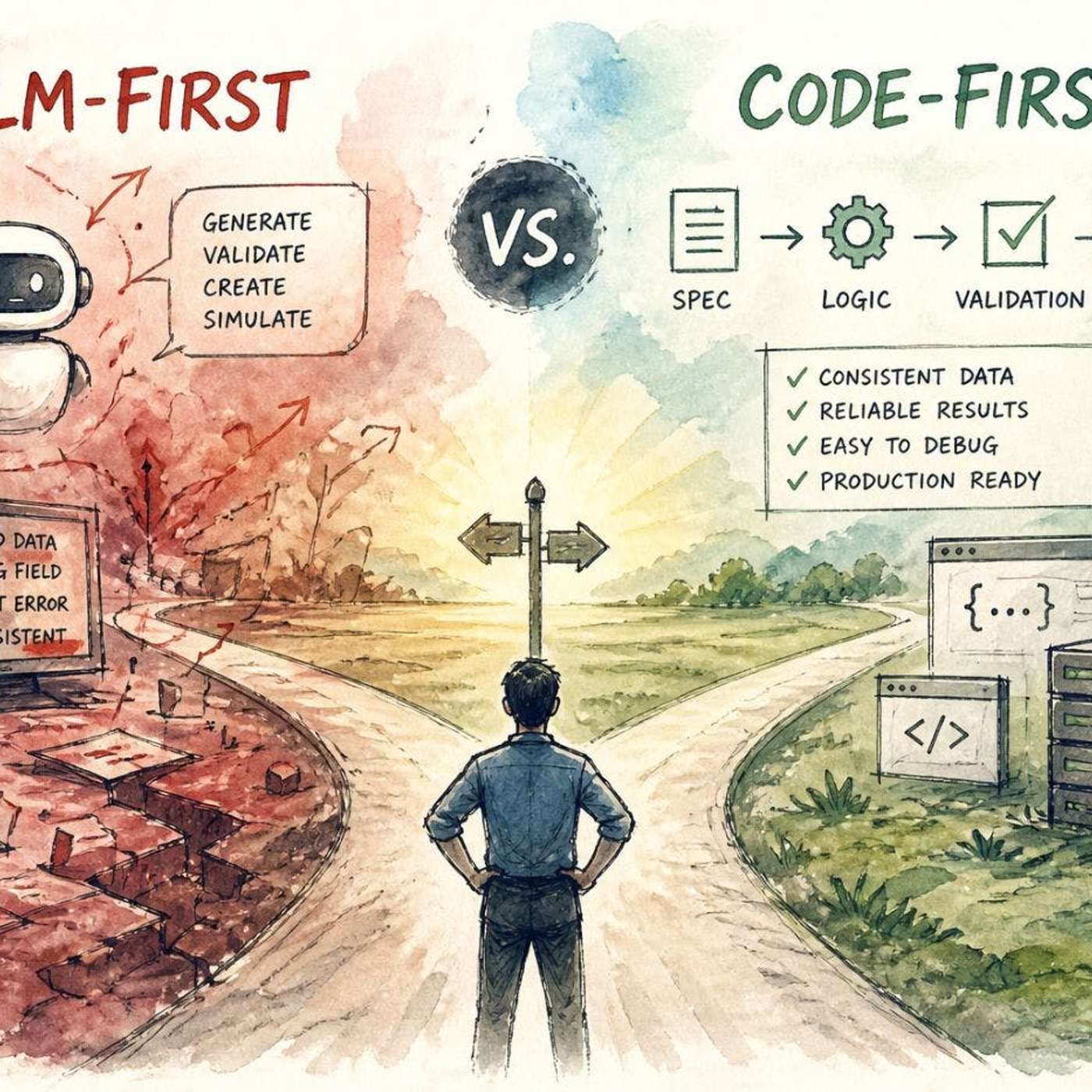
Don't give LLMs full control. Use deterministic code for core logic, validation, and enforcing rules. Delegate only tasks requiring flexibility or understanding of unstructured input to the LLM, treating it as a specialized component, not the entire system.
Standard operating procedures (SOPs) and checklists, famously championed for reducing human error, are even more effective for AI. They provide the structured, repeatable instructions that agents need to perform tasks reliably and can be used to hold them accountable for their performance.

General-purpose AI assistants produce inconsistent output. Instead, define AI agents with specific roles, boundaries, and quality gates, much like onboarding a new engineer with a clear job description. This disciplined approach leverages how LLMs are trained, leading to more reliable and predictable results within the SDLC.
Borrowing from classic management theory, the most effective way to use AI agents is to fix problems at the earliest 'lowest value stage'. This means rigorously reviewing the agent's proposed plan *before* it writes any code, preventing costly rework later on.

An agent's effectiveness is limited by its ability to validate its own output. By building in rigorous, continuous validation—using linters, tests, and even visual QA via browser dev tools—the agent follows a 'measure twice, cut once' principle, leading to much higher quality results than agents that simply generate and iterate.

As AI agents generate code, human review must shift from syntax to instructions. In 'Structured Prompt Driven Development,' prompts become version-controlled artifacts. The focus is on the quality of instructions and the automated tests that validate the output, making code a disposable implementation detail.
