Get your free personalized podcast brief
We scan new podcasts and send you the top 5 insights daily.
In an autonomous development environment, it's easy for an AI to deploy prematurely. Explicitly instructing Codex to "save for review" forces a pause, acting as a manual checkpoint. This allows the human developer to verify the build status, storage choices, and access settings before pushing changes live.

Related Insights
In large enterprises with legacy systems, AI-generated "vibe code" is not ready for direct production deployment. Treat it as a "first draft" for exploration and testing. A successful transition to production requires implementing stage gates and checks and balances, rather than a direct, one-step process from the AI tool.

AI development tools can be "resistant," ignoring change requests. A powerful technique is to prompt the AI to consider multiple options and ask for your choice before building. This prevents it from making incorrect unilateral decisions, such as applying a navigation change to the entire site by mistake.

Instead of waiting for AI models to be perfect, design your application from the start to allow for human correction. This pragmatic approach acknowledges AI's inherent uncertainty and allows you to deliver value sooner by leveraging human oversight to handle edge cases.
When an AI coding assistant goes off track, it can be hard to undo the damage. Developer Terry Lynn mitigates this risk by programming his AI workflow to make a Git commit before and after each small phase of a task. This creates a trail of "breadcrumbs," allowing him to easily revert to a stable state if the AI makes a mistake.

Implement human-in-the-loop checkpoints using a simple, fast LLM as a 'generative filter.' This agent's sole job is to interpret natural language feedback from a human reviewer (e.g., in Slack) and translate it into a structured command ('ship it' or 'revise') to trigger the correct automated pathway.

While the goal is autonomous improvement, deploying these systems safely in production requires human oversight. Implement mandatory human-in-the-loop steps, specifically code reviews for any proposed changes to the agent or its evaluation logic, before shipping to users.

Configure an AI stop hook to not only run quality checks but also to automatically commit the changes if all checks pass. This creates a fully automated loop: the AI generates code, the hook validates it, and if it's clean, it's committed to the repository with a generated message.

Use 'stop hooks' in Claude Code to create an automated quality gate. After code generation, the hook runs checks like type checking or linting. If errors exist, the output is fed back to the AI with a prompt to fix them, creating a self-correcting workflow.
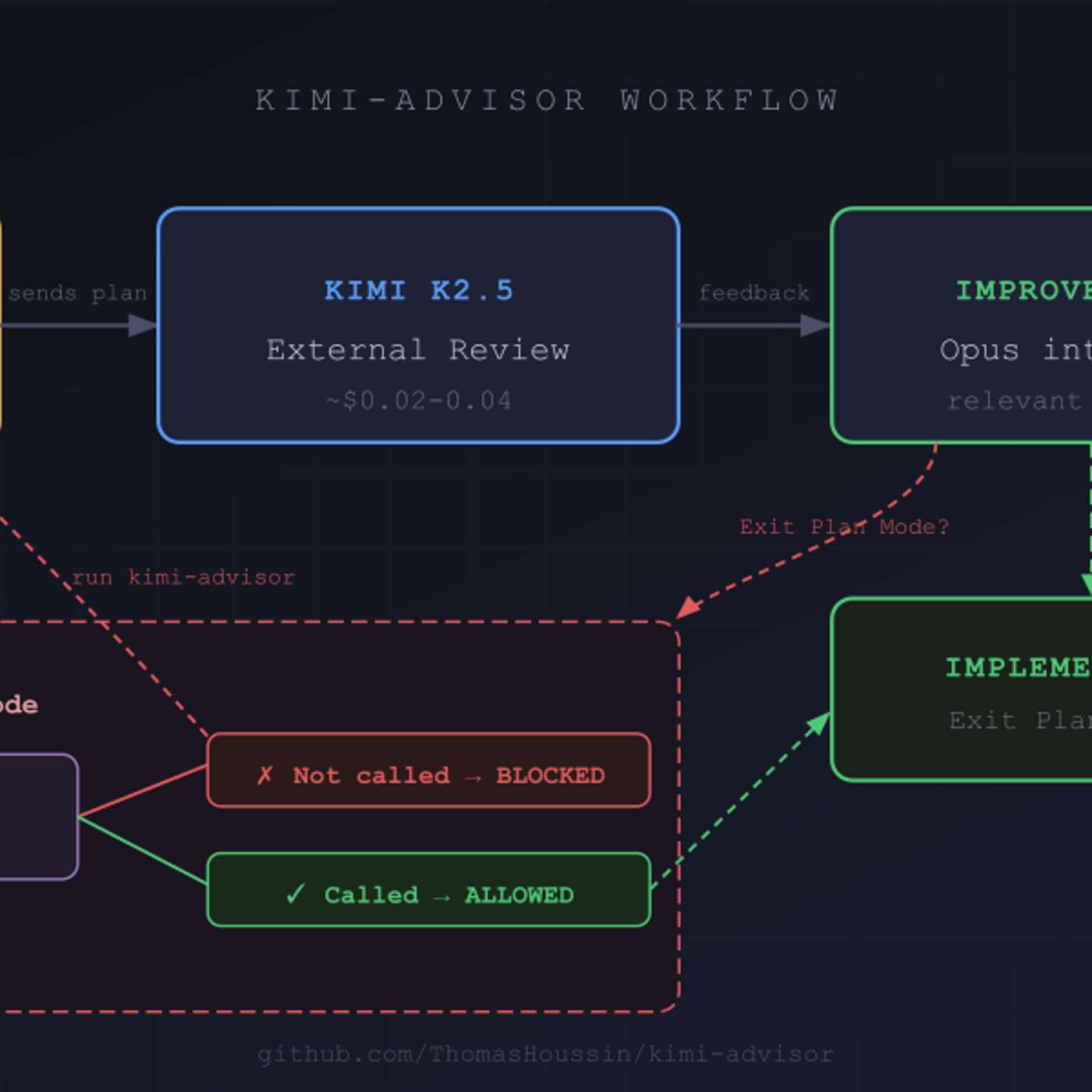
Developers often skip optional quality checks. To ensure consistent AI-powered plan reviews, implement a mandatory hook—a script that blocks the development process (e.g., exiting plan mode) until the external AI review has been verifiably completed. This engineers compliance into the workflow, guaranteeing a quality check every time.
With only 33% of developers trusting AI accuracy, the need for robust code review, diffing, and selective reverts is paramount. These are core IDE functions, shifting the development bottleneck from code generation to code verification, a task best handled within an editor.