Get your free personalized podcast brief
We scan new podcasts and send you the top 5 insights daily.
When a newer model version (GPT-5.3) became less patient with long-running tasks, the team was forced to re-architect their entire build system to complete in under a minute. This created a 'ratchet' that enforces performance discipline, preventing build time creep.

Related Insights
With AI agents completing development tasks in minutes, two-week agile sprints are inefficient. A new "Heartbeat Protocol," replacing stand-ups with hourly telemetry checks, is needed to manage rapid, agent-driven progress.

Overly structured, workflow-based systems that work with today's models will become bottlenecks tomorrow. Engineers must be prepared to shed abstractions and rebuild simpler, more general systems to capture the gains from exponentially improving models.

Tools like Git were designed for human-paced development. AI agents, which can make thousands of changes in parallel, require a new infrastructure layer—real-time repositories, coordination mechanisms, and shared memory—that traditional systems cannot support.

Classic software engineering warns against full rewrites due to risk and time ("second-system syndrome"). However, AI's ability to rebuild an entire product in days, not years, makes rewriting a powerful and low-cost tool for correcting over-complicated early versions or flawed core assumptions.

Progress in complex, long-running agentic tasks is better measured by tokens consumed rather than raw time. Improving token efficiency, as seen from GPT-5 to 5.1, directly enables more tool calls and actions within a feasible operational budget, unlocking greater capabilities.
Instead of codebases becoming harder to manage over time, use an AI agent to create a "compounding engineering" system. Codify learnings from each feature build—successful plans, bug fixes, tests—back into the agent's prompts and tools, making future development faster and easier.
The focus in AI engineering is shifting from making a single agent faster (latency) to running many agents in parallel (throughput). This "wider pipe" approach gets more total work done but will stress-test existing infrastructure like CI/CD, which wasn't built for this volume.
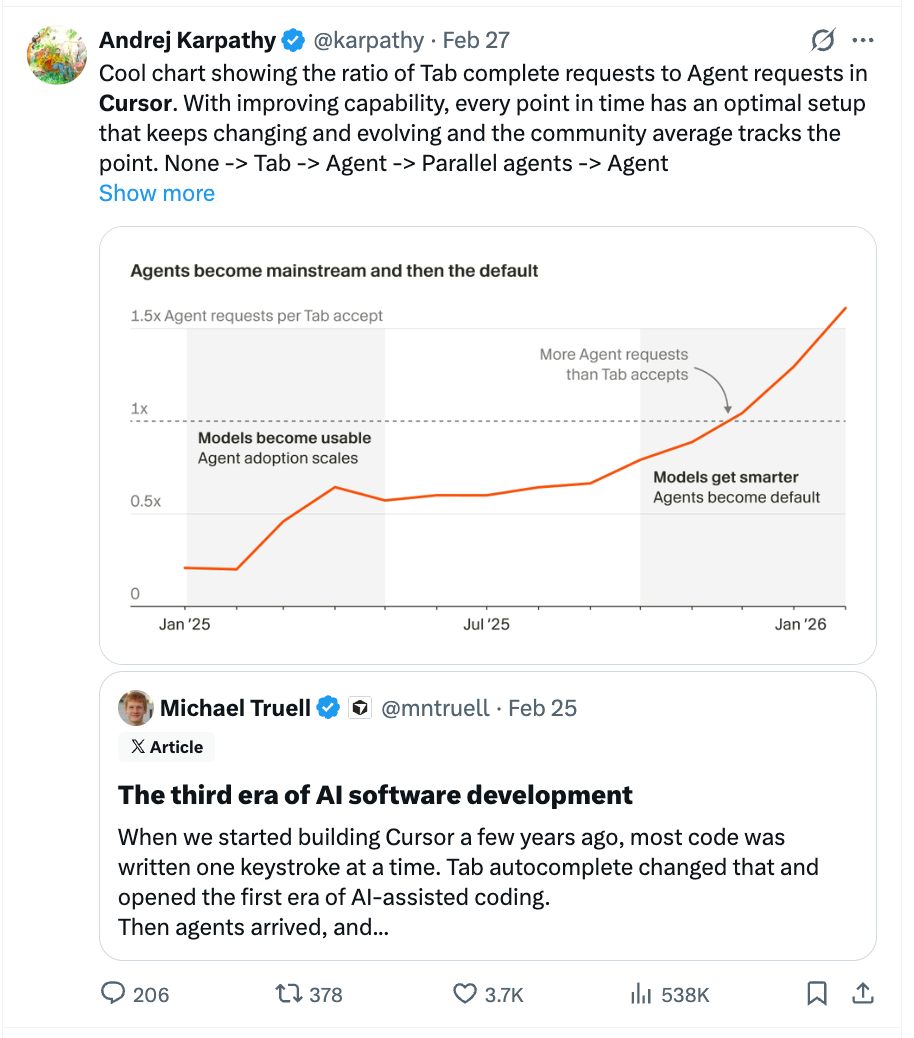
By automating mechanical build tasks, AI liberates significant time in the development cycle. Teams can reallocate this time to more strategic upstream activities like planning and exploration, and downstream refinement, focusing on high-quality craft and polish.

The belief that adding people to a late project makes it later (Brooks's Law) may not apply in an AI-assisted world. Early reports from OpenAI suggest that when using agents, adding more developers actually increases velocity, a potential paradigm shift for engineering management and team scaling.

The "Speed of Light" (SOL) principle at NVIDIA combats project delays by demanding the absolute physical limit or theoretical minimum time for a task. This forces teams to reason from first principles before layering in practical constraints and excuses.