Get your free personalized podcast brief
We scan new podcasts and send you the top 5 insights daily.
The focus in AI engineering is shifting from making a single agent faster (latency) to running many agents in parallel (throughput). This "wider pipe" approach gets more total work done but will stress-test existing infrastructure like CI/CD, which wasn't built for this volume.
Related Insights
Tools like Git were designed for human-paced development. AI agents, which can make thousands of changes in parallel, require a new infrastructure layer—real-time repositories, coordination mechanisms, and shared memory—that traditional systems cannot support.

The focus in AI has evolved from rapid software capability gains to the physical constraints of its adoption. The demand for compute power is expected to significantly outstrip supply, making infrastructure—not algorithms—the defining bottleneck for future growth.

The workflow of a "100x engineer" involves managing multiple AI coding agents simultaneously, with each agent working independently on tasks. The engineer's role shifts from writing code to orchestrating these agents, rotating attention between them like a conductor directing an orchestra.

The current focus on building massive, centralized AI training clusters represents the 'mainframe' era of AI. The next three years will see a shift toward a distributed model, similar to computing's move from mainframes to PCs. This involves pushing smaller, efficient inference models out to a wide array of devices.

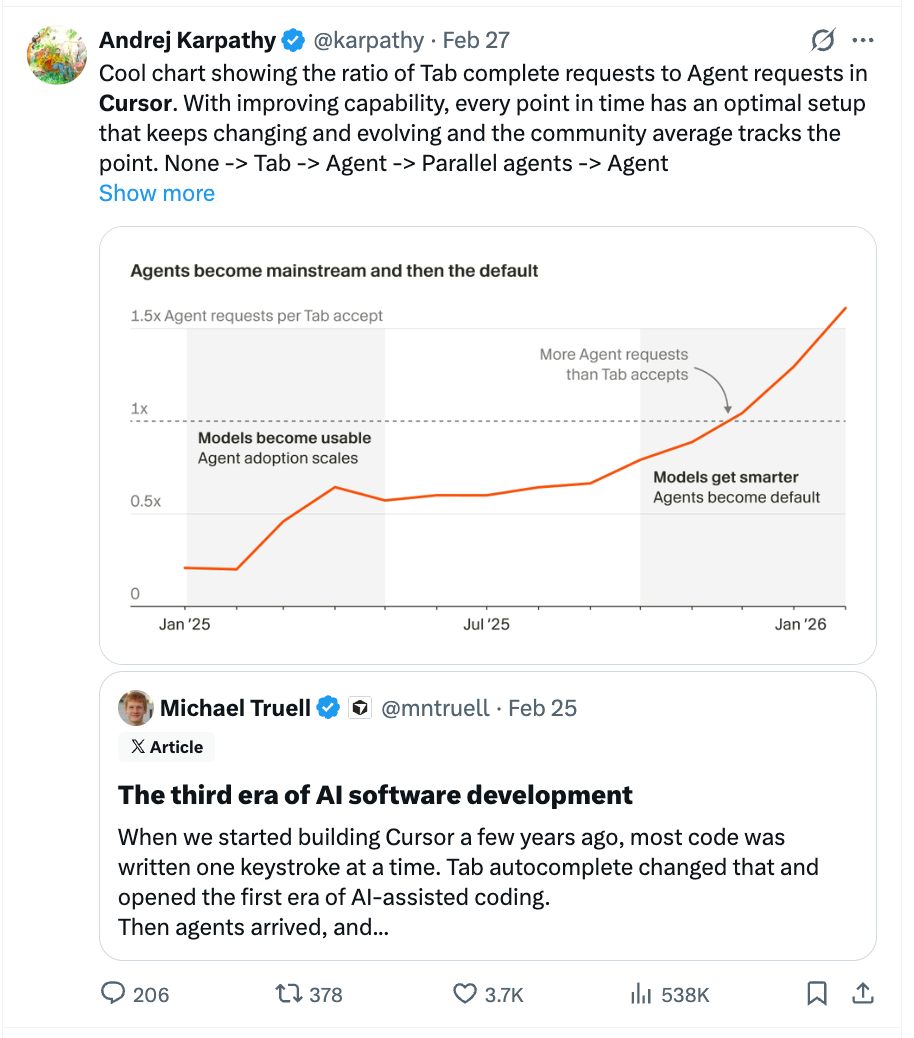
The evolution from AI autocomplete to chat is reaching its next phase: parallel agents. Replit's CEO Amjad Masad argues the next major productivity gain will come not from a single, better agent, but from environments where a developer manages tens of agents working simultaneously on different features.

The agent development process can be significantly sped up by running multiple tasks concurrently. While one agent is engineering a prompt, other processes can be simultaneously scraping websites for a RAG database and conducting deep research on separate platforms. This parallel workflow is key to building complex systems quickly.

Obsessing over linear model benchmarks is becoming obsolete, akin to comparing dial-up speeds. The real value and locus of competition is moving to the "agentic layer." Future performance will be measured by the ability to orchestrate tools, memory, and sub-agents to create complex outcomes, not just generate high-quality token responses.

The current model of a developer using an AI assistant is like a craftsman with a power tool. The next evolution is "factory farming" code, where orchestrated multi-agent systems manage the entire development lifecycle—planning, implementation, review, and testing—moving it from a craft to an industrial process.

While developers leverage multiple AI agents to achieve massive productivity gains, this velocity can create incomprehensible and tightly coupled software architectures. The antidote is not less AI but more human-led structure, including modularity, rapid feedback loops, and clear specifications.

By deploying multiple AI agents that work in parallel, a developer measured 48 "agent-hours" of productive work completed in a single 24-hour day. This illustrates a fundamental shift from sequential human work to parallelized AI execution, effectively compressing project timelines.
