Get your free personalized podcast brief
We scan new podcasts and send you the top 5 insights daily.
The belief that adding people to a late project makes it later (Brooks's Law) may not apply in an AI-assisted world. Early reports from OpenAI suggest that when using agents, adding more developers actually increases velocity, a potential paradigm shift for engineering management and team scaling.
Related Insights
The most significant and immediate productivity leap from AI is happening in software development, with some teams reporting 10-20x faster progress. This isn't just an efficiency boost; it's forcing a fundamental re-evaluation of the structure and roles within product, engineering, and design organizations.

As AI agents handle the mechanics of code generation, the primary role of a developer is elevated. The new bottlenecks are not typing speed or syntax, but higher-level cognitive tasks: deciding what to build, designing system architecture, and curating the AI's work.

The workflow of a "100x engineer" involves managing multiple AI coding agents simultaneously, with each agent working independently on tasks. The engineer's role shifts from writing code to orchestrating these agents, rotating attention between them like a conductor directing an orchestra.

The focus in AI engineering is shifting from making a single agent faster (latency) to running many agents in parallel (throughput). This "wider pipe" approach gets more total work done but will stress-test existing infrastructure like CI/CD, which wasn't built for this volume.
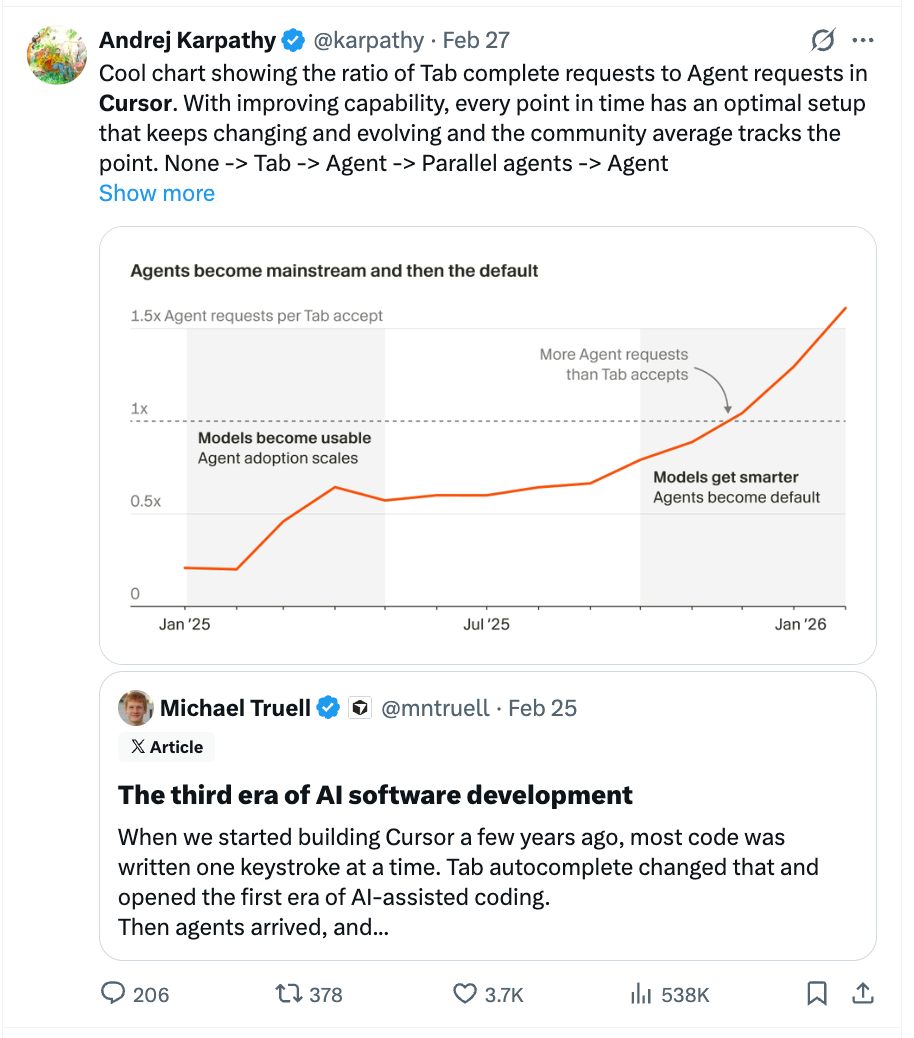
The study's finding that adding AI agents diminishes productivity provides a modern validation of Brooks's Law. The overhead required for coordination among agents completely negated any potential speed benefits from parallelizing the work, proving that simply adding more "developers" is counterproductive.

Tools like Claude CoWork preview a future where teams of AI agents collaborate on multi-faceted projects, like a product launch, simultaneously. This automates tactical entry-level tasks, elevating human workers to roles focused on high-level strategy, review, and orchestrating these AI "employees."

The evolution from AI autocomplete to chat is reaching its next phase: parallel agents. Replit's CEO Amjad Masad argues the next major productivity gain will come not from a single, better agent, but from environments where a developer manages tens of agents working simultaneously on different features.

AI acts as a massive force multiplier for software development. By using AI agents for coding and code review, with humans providing high-level direction and final approval, a two-person team can achieve the output of a much larger engineering organization.

Experienced engineers using tools like Claude Code are no longer writing significant amounts of code. Their primary role shifts to designing systems, defining tasks, and managing a team of AI agents that perform the actual implementation, fundamentally changing the software development workflow.

By deploying multiple AI agents that work in parallel, a developer measured 48 "agent-hours" of productive work completed in a single 24-hour day. This illustrates a fundamental shift from sequential human work to parallelized AI execution, effectively compressing project timelines.
