Get your free personalized podcast brief
We scan new podcasts and send you the top 5 insights daily.
Customers like Starbucks don't just want a prediction that Frappuccino sales will fall. They want to know what actions to take to prevent that from happening. The true value of simulation AI is providing a causal model that allows businesses to test interventions and proactively shape their future, not just passively observe it.

Related Insights
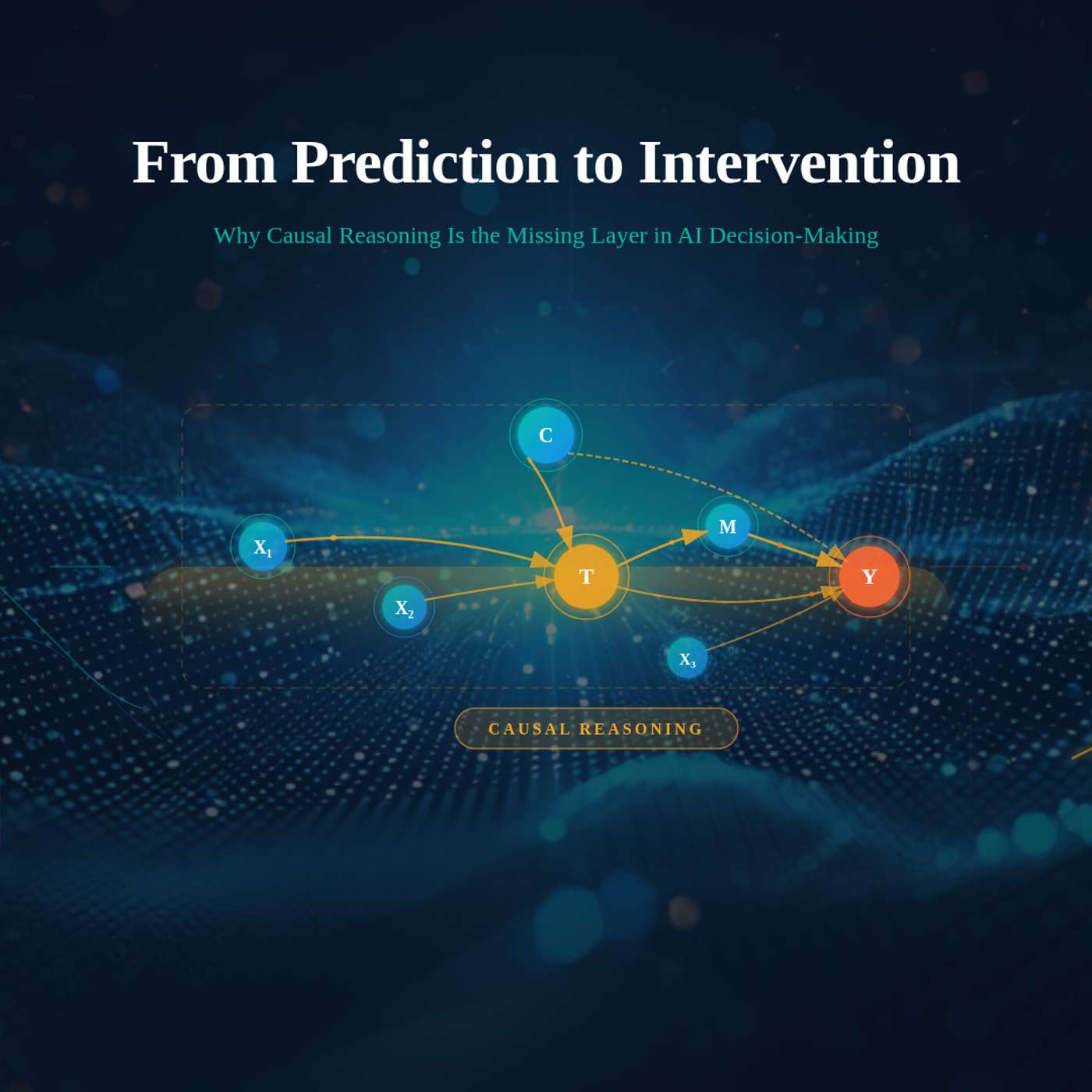
An estimated 80% of companies fail to scale their AI initiatives because they are caught in a 'prediction trap.' Their models produce accurate forecasts but do not support or inform actual business decisions, rendering them commercially ineffective. Causal reasoning is positioned as the solution to bridge this gap from prediction to actionable intelligence.
Human wisdom derives from a single lifetime of experience. AI will achieve a superior form of wisdom by simulating billions of potential future scenarios and identifying the statistically optimal paths. This predictive power, already matching elite human forecasters, will be its core advisory function.

Predictive models often mistake correlation for causation, leading to poor decisions. For example, a model might link marketing spend to revenue, but causal analysis can reveal that customer seasonality is the true cause of both. This deeper understanding prevents wasteful investments based on misleading correlations.
Beyond simple concept testing, AI simulations allow businesses to model downstream consequences. A car company can simulate how launching a new EV might change market perception of its entire gas-powered product line, revealing second-order effects that are impossible to test in the real world.
Causal AI is transforming the analyst's function from passively interpreting model predictions to actively prescribing and validating business interventions. This shift requires new skills, such as communicating causal diagrams and developing 'what if' narratives to guide stakeholder decisions and challenge model assumptions.
The next frontier of AI monetization involves extremely high-value, compute-intensive services. A single simulation session might cost $10-20 million to run but prevent a half-billion-dollar mistake for an enterprise. In this world, customers will willingly pay $100 million for that single outcome.
C-suite conversations have evolved from encouraging broad AI experimentation to demanding measurable ROI. The critical mindset shift is away from fascination with specific models and toward redesigning core, enterprise-grade workflows for tangible business impact, moving from a 'playground' to 'production grade' mode.

AI companies are pivoting from simply building more powerful models to creating downstream applications. This shift is driven by the fact that enterprises, despite investing heavily in AI promises, have largely failed to see financial returns. The focus is now on customized, problem-first solutions to deliver tangible value.

Unlike traditional automation that follows simple rules (e.g., match competitor price), AI agents optimize for a business goal. They synthesize data from siloed systems like inventory and finance, simulate potential outcomes, and then recommend the best course of action.
A clear market shift has occurred: enterprise clients are no longer interested in AI pilots. They now demand outcome-based contracts where AI is a core pillar tied to measurable productivity gains. The conversation has moved from "Can AI help?" to "How fast can we scale it?"
