Get your free personalized podcast brief
We scan new podcasts and send you the top 5 insights daily.
In agentic workflows, structured documentation (e.g., Markdown files defining rules and data structures) acts as the primary control layer. This "shadow application" written in Markdown becomes the API that allows the agent to orchestrate complex tasks correctly.
Related Insights
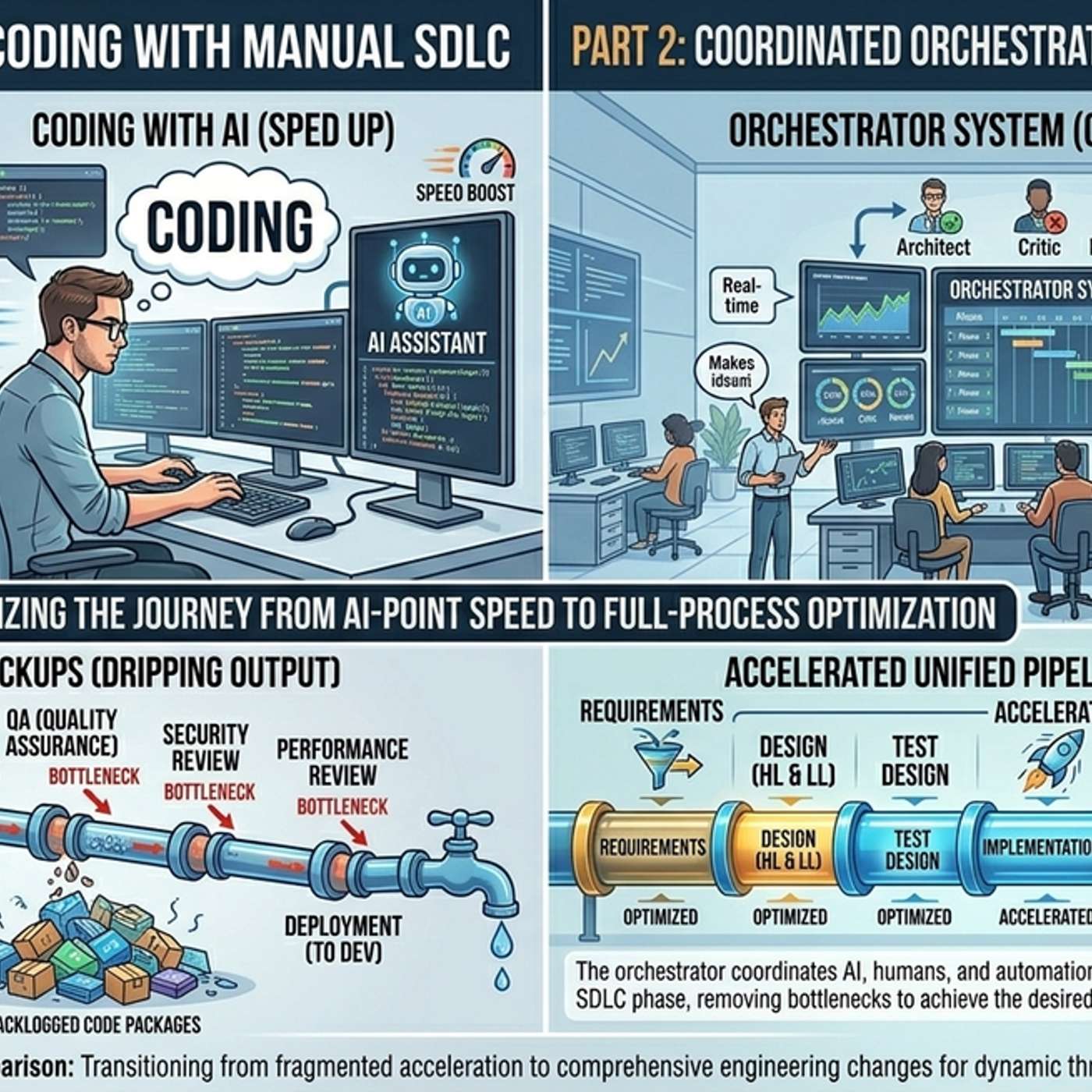
For AI to manage the software development process from idea to completion, the entire SDLC cannot be an unspoken or abstract set of habits. It must be explicitly documented with defined inputs, tasks, outputs, and quality gates that an AI agent can interpret and execute against.
Creating "skills" (e.g., Markdown files) to teach AI agents how to interact with a codebase forces developers to explicitly document processes and best practices. This AI-centric documentation serves a dual purpose as a clear contribution guide for humans, effectively turning what should be a `contributing.md` file into a machine-readable, actionable standard.

Agentic frameworks like OpenClaw are pioneering a new software paradigm where 'skills' act as lightweight replacements for entire applications. These skills are essentially instruction manuals or recipes in simple markdown files, combining natural language prompts with calls to deterministic code ('tools'), condensing complex functionality into a tiny, efficient format.

Instead of building complex orchestration platforms with rigid code, define your agent's entire workflow in a detailed natural language markdown file (like OpenAI's Symphony). Modern LLMs can adhere to this spec, simplifying setup and making the system easier to modify.

The 'agents.md' file is an open format that functions like a README, but specifically for AI agents. It provides a dedicated, predictable place to store context and instructions, ensuring the AI consistently follows rules for commits, tests, and project setup across all your repositories.

Documentation is shifting from a passive reference for humans to an active, queryable context for AI agents. Well-structured docs on internal APIs and class hierarchies become crucial for agent performance, reducing inefficient and slow context window stuffing for faster code generation.

The operational core of powerful AI agents is a simple, robust combination of time-based triggers (cron jobs) that execute tasks defined in detailed instruction sets (Markdown files, or "skills"). This mental model demystifies agent architecture and makes it more accessible.

Standard APIs for human developers are often too verbose for AI agents. Notion created agent-centric APIs, like a special markdown dialect and a SQLite interface, by treating the AI as a new type of user. This involved empirical testing to understand what formats agents are naturally good at using.

Documentation is no longer just for humans. AI agents now read it directly as operational input, making its accuracy critical for system function. Outdated docs, once a nuisance, now cause system failures, elevating documentation to the level of essential infrastructure.
By codifying a task into a 'skill file'—a combination of markdown instructions, code, and tests—companies can create AI-powered 'employees' that execute processes flawlessly and repeatedly. This transforms one-time human effort into a permanent, scalable asset.