Get your free personalized podcast brief
We scan new podcasts and send you the top 5 insights daily.
Facing an 86x increase in token usage, Man Group chose to educate employees on model costs and capabilities rather than building an automated router. This transparent approach empowered users to find creative efficiencies, fostering a culture of responsible AI use instead of imposing top-down restrictions.

Related Insights
To combat 'token maxing,' Palantir created 'Evolve,' a tool that analyzes production logs to recommend optimal AI models and workflow changes. One customer used it to swap models, tune prompts, and re-architect to eliminate 60% of their token costs in just two days.

The optimal strategy for managing AI costs is neither total restriction nor a free-for-all. It's providing engineers with dedicated "learning budgets" and experimentation pools, coupled with clear visibility into costs. This fosters innovation responsibly without incurring surprise invoices and turns cost into a first-class constraint.
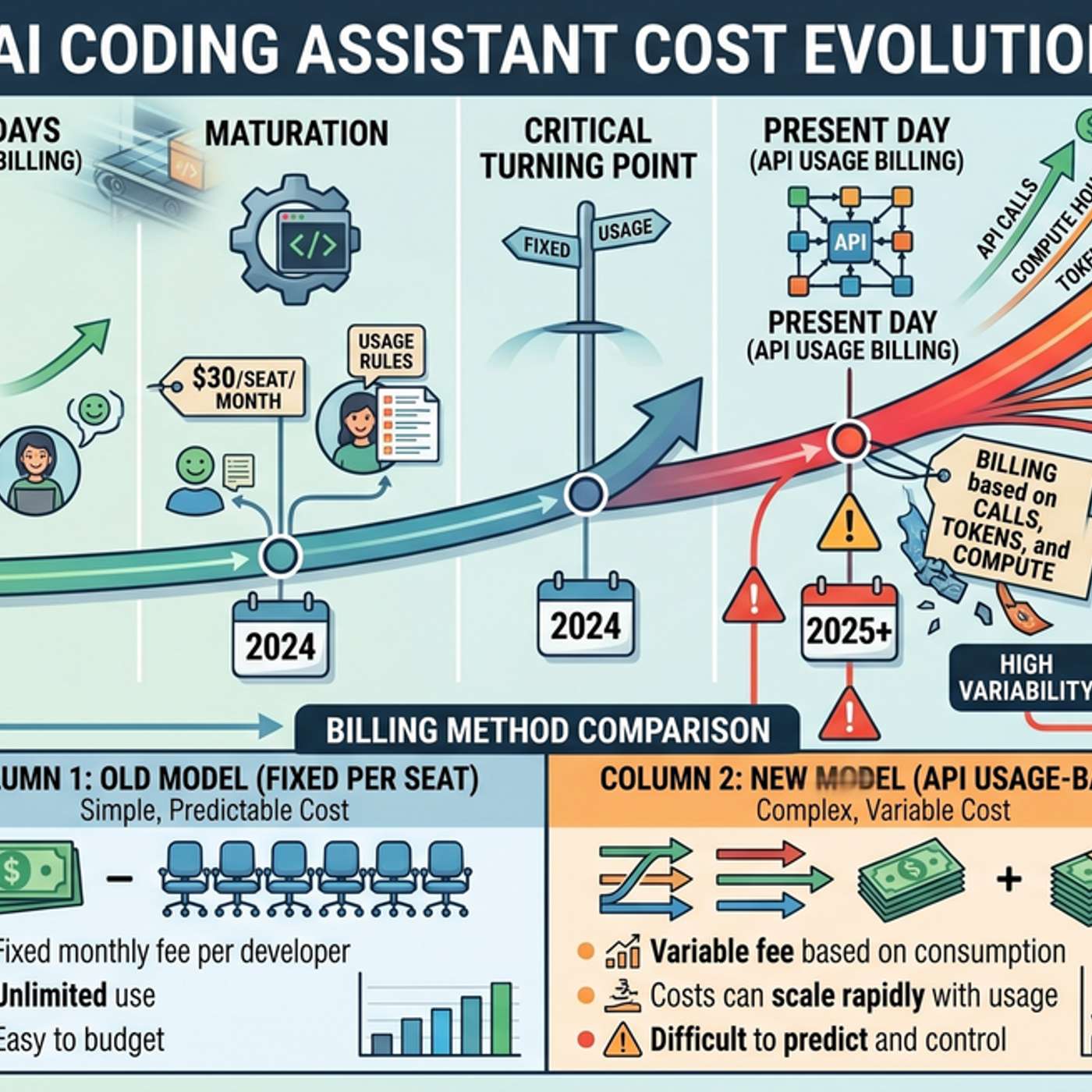
As AI adoption expands within a company, a key challenge is managing costs from non-technical teams. Without proper governance and education, employees may use expensive, "high-thinking" models like Opus 4.8 for trivial tasks like formatting an email, leading to significant and unnecessary token expenditure.

In response to budget blowouts from agentic AI, enterprises are moving beyond simple adoption to active cost management. A new "token efficiency" stack is emerging, featuring tactics like model routing to cheaper alternatives (e.g., DeepSeek) and custom post-trained models to reduce reliance on expensive foundation models.

Companies initially gamified AI use, leading to a "token maxing" culture. Now, facing enormous, unexpected bills, they are experiencing "sticker shock." This is forcing a strategic shift from encouraging maximum usage to demanding ROI calculations and finding the most cost-effective AI model for a given task.

To encourage creativity, Goldman uses a central 'Model Gateway' to intelligently route queries to the most cost-effective AI model. This strategy isolates users from 'token anxiety'—the fear of consuming expensive resources—and allows a central team to optimize costs without stifling innovation.
Despite fears of runaway costs from "token maxing," enterprises are overwhelmingly encouraging more AI model consumption. A developer survey found 7x more companies were told to increase spending. The value gained from experimenting on AI's rapidly expanding capability frontier currently outweighs the push for cost optimization.
To control inference costs, companies are implementing model routing systems. They differentiate between expensive tokens from frontier models for complex reasoning and cheaper tokens from fine-tuned open-source models for simpler workflow tasks. This tiered approach optimizes both performance and budget, avoiding "token maxing."

After encouraging heavy internal AI usage ('token maxing'), Meta is now launching an efficiency program to control ballooning costs. It's building an "AI Gateway" to track usage, set budgets, and push employees toward cheaper, in-house tools, signaling a broader industry trend of reining in AI spending.
Giving teams a 'token budget' is flawed because it incentivizes generating low-value output to hit a quota, similar to bad hiring quotas. Instead, companies must tie token consumption directly to business KPIs. This reframes AI spend as a value-creating investment, not a cost to be managed.
