Get your free personalized podcast brief
We scan new podcasts and send you the top 5 insights daily.
The current approach of scaling a single type of qubit technology is inefficient. The founder of quantum startup Sigildry argues the future lies in a multi-modal architecture, architecting systems that combine various quantum hardware types (e.g., trapped ions, photonics) specifically tailored to AI workloads.

Related Insights
The AI ecosystem will evolve into an "orchestration age" where large 'boss' models delegate tasks to a network of smaller, faster, specialized models. This means different chip architectures (e.g., NVIDIA for large models, Cerebras for speed) will function as complementary parts of a larger system, not just direct competitors.

Cisco's OutShift incubator focuses on enabling distributed systems rather than building monolithic ones. Their strategy for both AI and quantum computing is not to create the most powerful single agent or computer, but to build the network fabric that connects them all.

Martin Shkreli makes a case for photonic computing—using light instead of electrons—as the next major paradigm in AI hardware. He argues that because matrix multiplications (95% of a GPU's job) are a natural function of light interference, photonic chips could offer an "insane speedup" with O-of-one complexity, making them a potential successor to GPUs.

With Moore's Law over, computing progress now depends on networking vast numbers of chips. Lightmatter's photonic interconnects overcome the distance limits of copper cables, allowing thousands of GPUs kilometers apart to function as a single, cohesive supercomputer. This creates a new scaling vector for AI performance.
Just as developers use various databases for different needs, AI applications will rely on a "constellation" of specialized models. Some tasks will require expensive, high-reasoning models, while others will prioritize low-latency or low-cost models. The market will become heterogeneous, not monolithic.

Breakthroughs will emerge from 'systems' of AI—chaining together multiple specialized models to perform complex tasks. GPT-4 is rumored to be a 'mixture of experts,' and companies like Wonder Dynamics combine different models for tasks like character rigging and lighting to achieve superior results.

With ~90 hardware firms pursuing varied, competing qubit modalities, quantum is analogous to biotech's diverse approaches to curing a disease. This differs sharply from the consolidated, single-paradigm semiconductor industry and requires a different mindset for investment and policy.

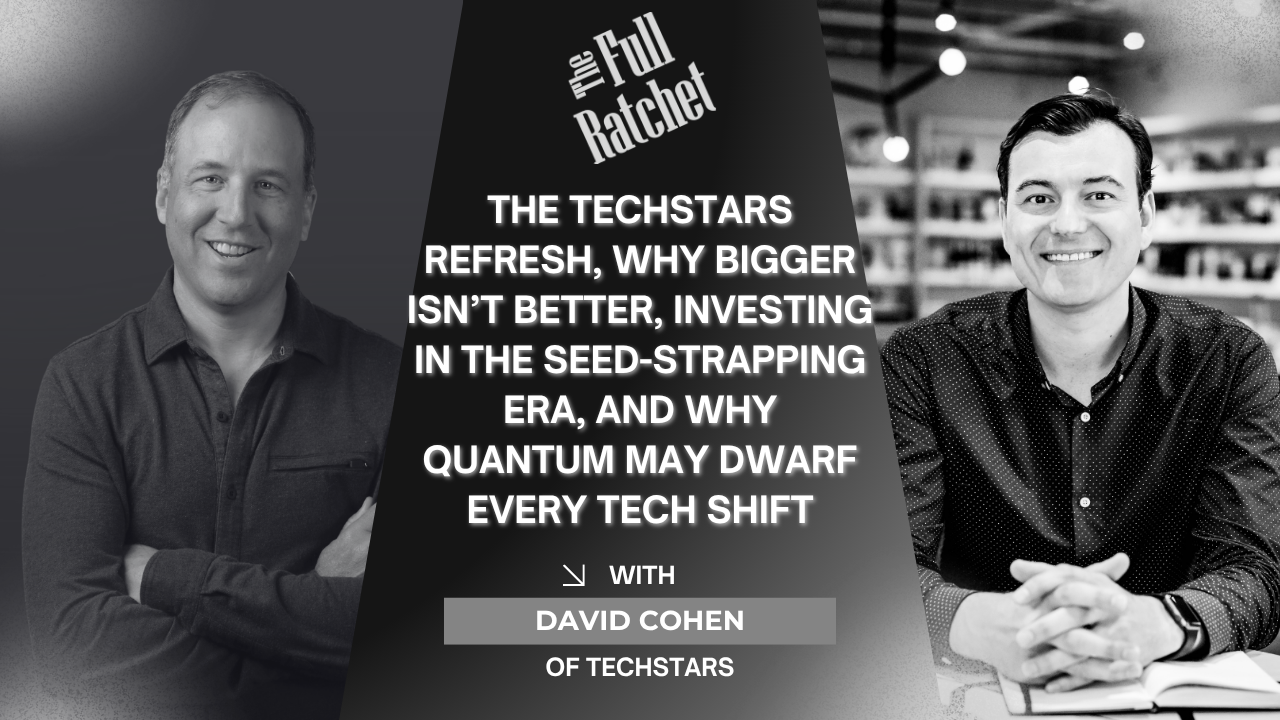
While AI dominates current conversations, Techstars' David Cohen believes Quantum Computing represents a far larger future paradigm shift. He posits that a single quantum computer will eventually surpass the combined power of all AI-driven classical computers. The "killer app" for this new era will be in healthcare, enabling truly personalized medicine.
A symbiotic relationship exists between AI and quantum computing, where AI is used to significantly speed up the optimization and calibration of quantum machines. By automating solutions to the critical 'noise' and error-rate problems, AI is shortening the development timeline for achieving stable, powerful quantum computers.

The primary impact of quantum computing won't just be faster calculations. It will be its ability to generate entirely new insights into complex systems like molecules—knowledge that is currently out of reach. This new data can then be fed into AI models, creating a powerful synergistic loop of discovery.
