Get your free personalized podcast brief
We scan new podcasts and send you the top 5 insights daily.
The primary impact of quantum computing won't just be faster calculations. It will be its ability to generate entirely new insights into complex systems like molecules—knowledge that is currently out of reach. This new data can then be fed into AI models, creating a powerful synergistic loop of discovery.

Related Insights
Contrary to the belief that it has no current utility, quantum computing is already being used commercially and generating revenue. Major companies like HSBC and AstraZeneca are leveraging quantum machines via cloud platforms (AWS, Azure) for practical applications like financial modeling and drug discovery, proving its value today.

Startups and major labs are focusing on "world models," which simulate physical reality, cause, and effect. This is seen as the necessary step beyond text-based LLMs to create agents that can truly understand and interact with the physical world, a key step towards AGI.
The next leap in biotech moves beyond applying AI to existing data. CZI pioneers a model where 'frontier biology' and 'frontier AI' are developed in tandem. Experiments are now designed specifically to generate novel data that will ground and improve future AI models, creating a virtuous feedback loop.

To make genuine scientific breakthroughs, an AI needs to learn the abstract reasoning strategies and mental models of expert scientists. This involves teaching it higher-level concepts, such as thinking in terms of symmetries, a core principle in physics that current models lack.

AI is developing spatial reasoning that approaches human levels. This will enable it to solve novel physics problems, leading to breakthroughs that create entirely new classes of technology, much like discoveries in the 1940s led to GPS and cell phones.

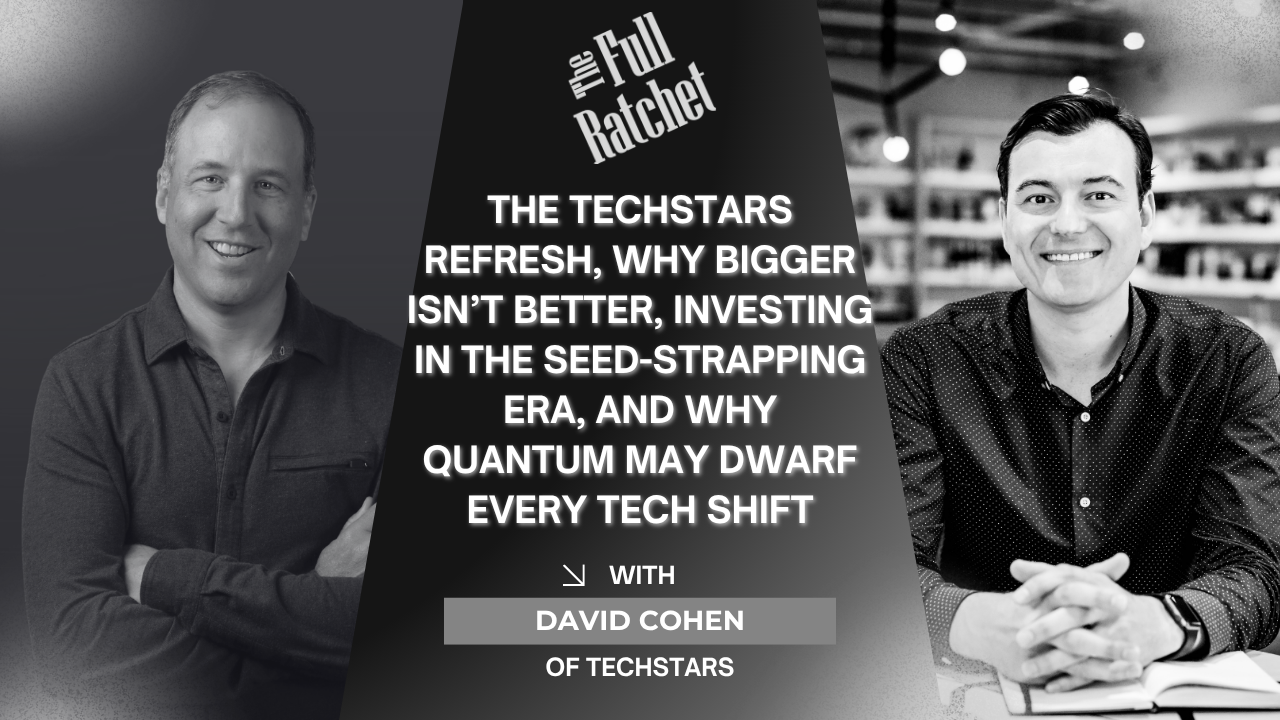
While AI dominates current conversations, Techstars' David Cohen believes Quantum Computing represents a far larger future paradigm shift. He posits that a single quantum computer will eventually surpass the combined power of all AI-driven classical computers. The "killer app" for this new era will be in healthcare, enabling truly personalized medicine.
The most significant value from AI is not in automating existing tasks, but in performing work that was previously too costly or complex for an organization to attempt. This creates entirely new capabilities, like analyzing every single purchase order for hidden patterns, thereby unlocking new enterprise value.

Despite hype around its potential to solve famously complex problems like the "traveling salesman," experts in the field caution that the number of actual, practical problems quantum computing can currently solve is extremely small. The gap between its theoretical power and tangible business application remains vast, making its near-term commercial impact questionable.

A symbiotic relationship exists between AI and quantum computing, where AI is used to significantly speed up the optimization and calibration of quantum machines. By automating solutions to the critical 'noise' and error-rate problems, AI is shortening the development timeline for achieving stable, powerful quantum computers.
Contrary to fears of displacement, AI tools like 'AI co-scientists' amplify human ingenuity. By solving foundational problems (like protein folding) and automating tedious tasks, AI enables more researchers, even junior ones, to tackle more complex, high-level scientific challenges, accelerating discovery.