Get your free personalized podcast brief
We scan new podcasts and send you the top 5 insights daily.
The true second-order effect of AI isn't just a single massive solo company. It's a "golden age" of B2B SaaS, where a one-person unicorn will rely on hundreds of other small, hyper-specialized software startups to handle its various functions.
Related Insights
AI enables "software does labor" business models in industries previously deemed too small for specialized software, like dental offices or trial law. By replacing or augmenting specific labor tasks, startups can justify high-value contracts in markets that historically wouldn't pay for traditional SaaS tools.

The exponential growth in AI agent capabilities creates a plausible scenario where a single entrepreneur can manage a vast array of automated tasks, from development to operations. This raises the possibility of a "solopreneur" achieving a billion-dollar valuation without a traditional human workforce.

Most successful SaaS companies weren't built on new core tech, but by packaging existing tech (like databases or CRMs) into solutions for specific industries. AI is no different. The opportunity lies in unbundling a general tool like ChatGPT and rebundling its capabilities into vertical-specific products.
Ben Thompson's analysis suggests the era of siloed SaaS growth is over. With AI enabling infinite software creation, companies will be forced to attack adjacent business functions to grow. This shifts the market from collaborative expansion to a competitive battle for existing customer spend, with AI model providers as the key "arms dealers."

The cloud era created a fragmented landscape of single-purpose SaaS tools, leading to enterprise fatigue. AI enables unified platforms to perform these specialized tasks, creating a massive consolidation wave and disrupting the niche application market.
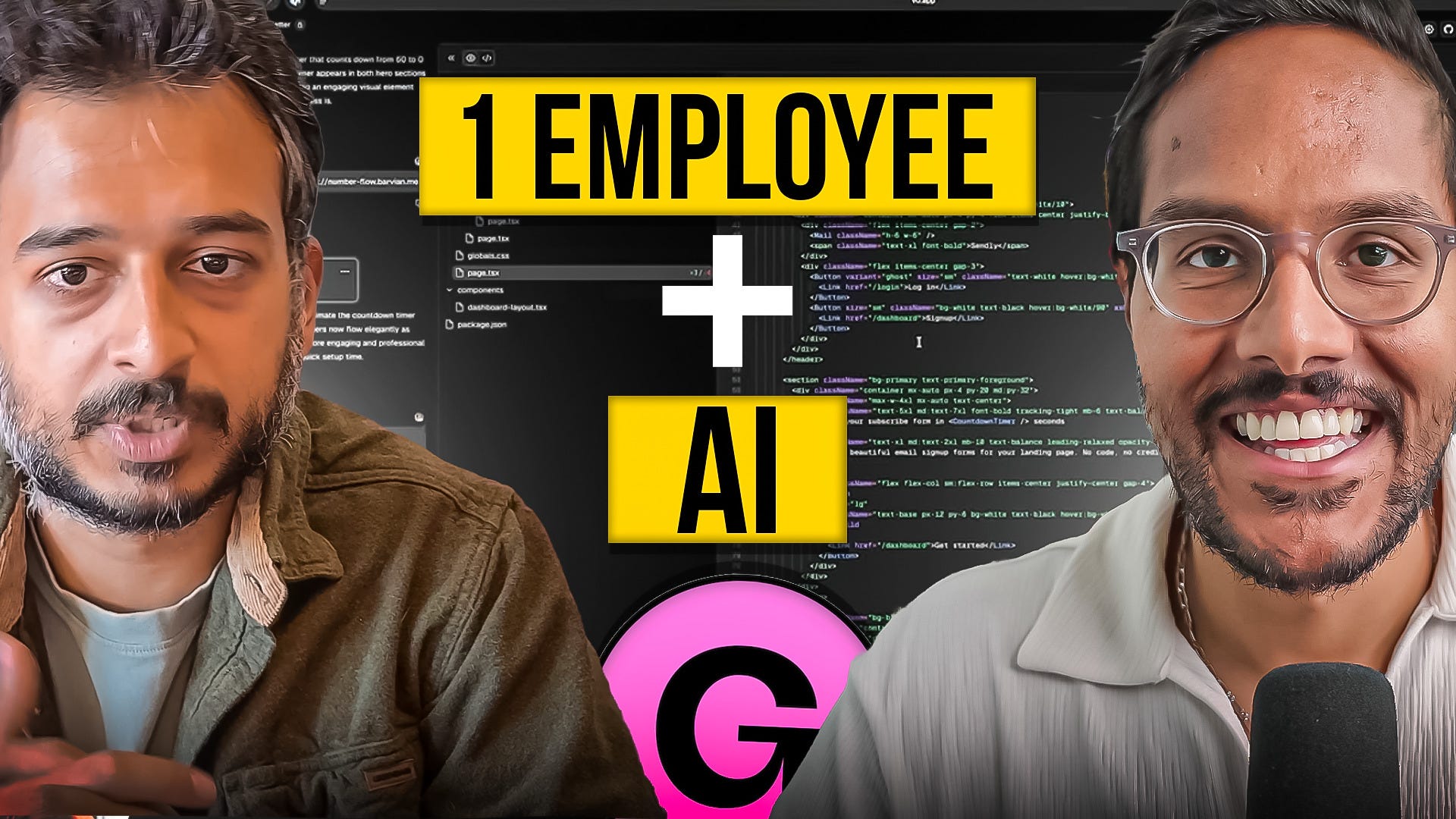
The most forward-thinking founders are exploring whether AI enables the entire concept of a company to be redefined. The ultimate goal is a 'super-powered individual' who oversees an army of AI bots to handle coding, marketing, sales, and support, creating a billion-dollar outcome with a single human employee.

The idea of a solo founder running a billion-dollar company is more a marketing gimmick than a future reality. While technologically feasible with AI, individuals won't want to handle all the associated operational burdens like bookkeeping and taxes. The logical endpoint of AI automation isn't a one-person company, but a zero-person, fully automated business.
AI is predicted to reduce engineering costs to near-zero, enabling individuals with strong product taste to build, launch, and market SaaS companies alone. The critical skill will shift from coding to user testing and product insight, functions that AI cannot yet fully replace.
The fundamental shift from AI isn't about replacing foundational model companies like OpenAI. Instead, AI creates a new technological substrate—productized intelligence—that will engender an entirely new breed of software companies, marking the end of the traditional SaaS playbook.
AI will decentralize entrepreneurship by enabling solo founders to build software for niche markets. These small markets, often dismissed by VCs, can support highly profitable lifestyle businesses for individuals, creating a new wave of company creation outside the traditional Silicon Valley model.
