Get your free personalized podcast brief
We scan new podcasts and send you the top 5 insights daily.
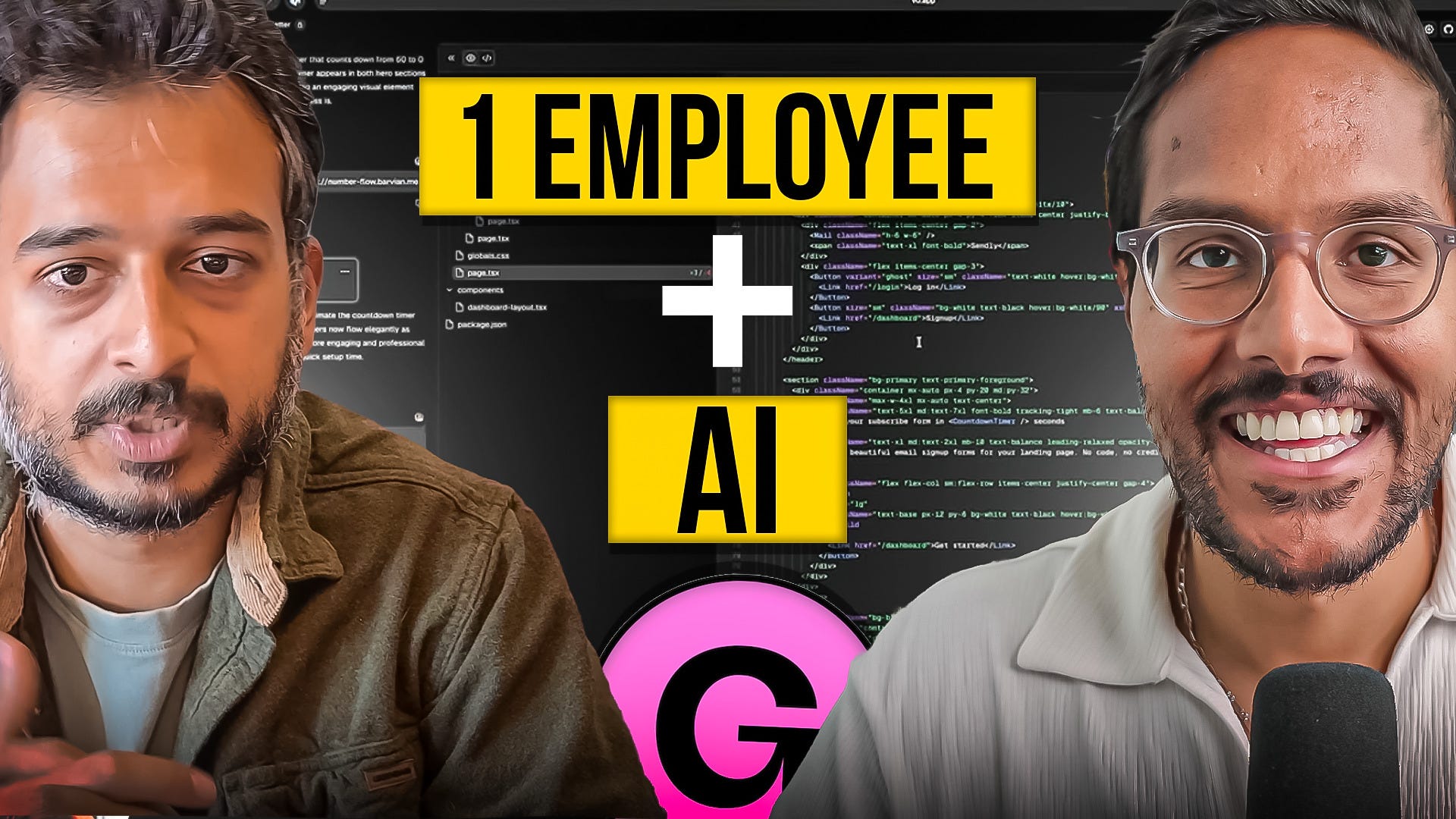
The idea of a solo founder running a billion-dollar company is more a marketing gimmick than a future reality. While technologically feasible with AI, individuals won't want to handle all the associated operational burdens like bookkeeping and taxes. The logical endpoint of AI automation isn't a one-person company, but a zero-person, fully automated business.
Related Insights
Despite hype, true 'autonomous marketing' is not imminent. AI excels at automating the first 80-90% of a workflow, but the final, most complex steps involving anomalies, nuance, and judgment still require a human. This 'last mile' problem ensures AI's role will be augmentation, not replacement.

The primary economic incentive driving AI development is not replacing software, but automating the vastly larger human labor market. This includes high-skill jobs like accountants, lawyers, and auditors, representing a multi-trillion dollar opportunity that dwarfs the SaaS industry and dictates where investment will flow.
The democratization of technology via AI shifts the entrepreneurial goalpost. Instead of focusing on creating a handful of billion-dollar "unicorns," the more impactful ambition is to empower millions of people to each build a million-dollar "donkey corn" business, truly broadening economic opportunity.

As AI agents handle technical execution, the most valuable human skill becomes ideation. Replit CEO Amjad Massad predicts this will dissolve rigid corporate hierarchies in favor of adaptable teams of generalists who collaborate with autonomous AI tools to bring ideas to life.
The most powerful use of AI for business owners isn't task automation, but leveraging it as an infinitely patient strategic advisor. The most advanced technique is asking AI what questions you should be asking about your business, turning it from a simple tool into a discovery engine for growth.

Most companies use AI for optimization—making existing processes faster and cheaper. The greater opportunity is innovation: using AI to create entirely new forms of value. This "10x thinking" is critical for growth, especially as pure efficiency gains will ultimately lead to a reduced need for human workers.

The economic incentive for VCs funding AI is replacing human labor, a $13 trillion market in the US alone. This dwarfs the $300 billion SaaS market, revealing the ultimate goal is automating knowledge work, not just building software.

Backed by top tech leaders, the startup Mechanize operates on the thesis that fully automating all jobs is a technologically determined and desirable future. Their public goal is to accelerate this 'inevitable' outcome, revealing a deliberate and well-funded movement to replace human labor entirely, not just augment it.
The transition from AI as a productivity tool (co-pilot) to an autonomous agent integrated into team workflows represents a quantum leap in value creation. This shift from efficiency enhancement to completing material tasks independently is where massive revenue opportunities lie.

Previously, building 'just a feature' was a flawed strategy. Now, an AI feature that replaces a human role (e.g., a receptionist) can command a high enough price to be a viable company wedge, even before it becomes a full product.