Get your free personalized podcast brief
We scan new podcasts and send you the top 5 insights daily.
The most effective way to manage AI software development is to mirror a physical assembly line. "Isolate" is the custom order station. "Build" is the assembly line. "Prove" is quality control testing. "Ship" is the final packaging and delivery. This analogy provides a robust mental model for managing complex AI workflows.

Related Insights
For AI to manage the software development process from idea to completion, the entire SDLC cannot be an unspoken or abstract set of habits. It must be explicitly documented with defined inputs, tasks, outputs, and quality gates that an AI agent can interpret and execute against.
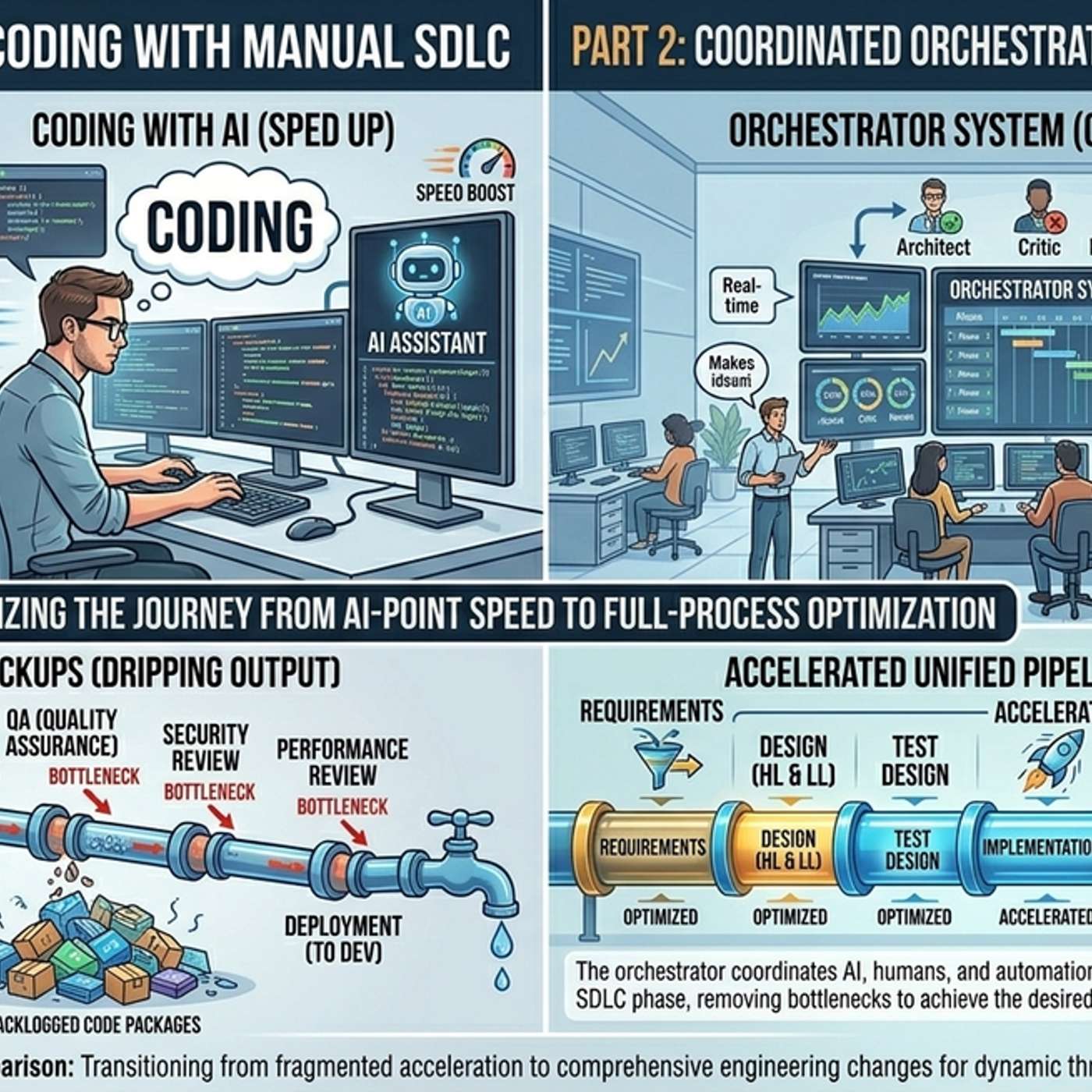
To achieve a state where AI agents handle nearly all coding, a solo founder must implement a surprisingly formal Software Development Lifecycle (SDLC), like one for a large team. This includes rigorous processes like mandatory Pull Requests (PRs), providing a structured system for agent-driven development.

The key to creating effective and reliable AI workflows is distinguishing between tasks AI excels at (mechanical, repetitive actions) and those it struggles with (judgment, nuanced decisions). Focus on automating the mechanical parts first to build a valuable and trustworthy product.
At OpenAI, engineers use AI to build ideas instantly. This inverts the traditional product model, shifting the PM's role from upfront planning to evaluating already-built prototypes and deciding which ones to ship, dramatically accelerating development.
The endgame for software development isn't just code completion, but an "AI factory." A chain of specialized agents will handle design, coding, review, and security. This requires an interoperable platform where different models can check each other's work, with humans as "agent managers."

Historically, the 'build' phase was the primary bottleneck in software development. With AI making building nearly instantaneous, the critical path to success has shifted. Mastery of the 'define' (scoping) and 'feedback' (learning) stages is now what separates winning teams from the rest.

Don't ask an AI agent to build an entire product at once. Structure your plan as a series of features. For each step, have the AI build the feature, then immediately write a test for it. The AI should only proceed to the next feature once the current one passes its test.
To avoid common pitfalls in AI development, treat building an agent like making a burger. Ensure you have all core components: a model (patty), tools (condiments), knowledge/memory (vegetables), and guardrails (bun). While the specific 'ingredients' can change, omitting any component results in an incomplete or broken agent.

The current model of a developer using an AI assistant is like a craftsman with a power tool. The next evolution is "factory farming" code, where orchestrated multi-agent systems manage the entire development lifecycle—planning, implementation, review, and testing—moving it from a craft to an industrial process.

The modern product development cycle for AI is a tight, iterative loop executed within a coding agent. This involves creating the agent, tracing every step for observability, running evaluations (evals) to find weaknesses, and then improving the agent based on those findings.
