Get your free personalized podcast brief
We scan new podcasts and send you the top 5 insights daily.
To avoid common pitfalls in AI development, treat building an agent like making a burger. Ensure you have all core components: a model (patty), tools (condiments), knowledge/memory (vegetables), and guardrails (bun). While the specific 'ingredients' can change, omitting any component results in an incomplete or broken agent.

Related Insights
Contrary to the vision of free-wheeling autonomous agents, most business automation relies on strict Standard Operating Procedures (SOPs). Products like OpenAI's Agent Builder succeed by providing deterministic, node-based workflows that enforce business logic, which is more valuable than pure autonomy.

Effective prompt engineering for AI agents isn't an unstructured art. A robust prompt clearly defines the agent's persona ('Role'), gives specific, bracketed commands for external inputs ('Instructions'), and sets boundaries on behavior ('Guardrails'). This structure signals advanced AI literacy to interviewers and collaborators.

To build a useful multi-agent AI system, model the agents after your existing human team. Create specialized agents for distinct roles like 'approvals,' 'document drafting,' or 'administration' to replicate and automate a proven workflow, rather than designing a monolithic, abstract AI.

Treating AI evaluation like a final exam is a mistake. For critical enterprise systems, evaluations should be embedded at every step of an agent's workflow (e.g., after planning, before action). This is akin to unit testing in classic software development and is essential for building trustworthy, production-ready agents.
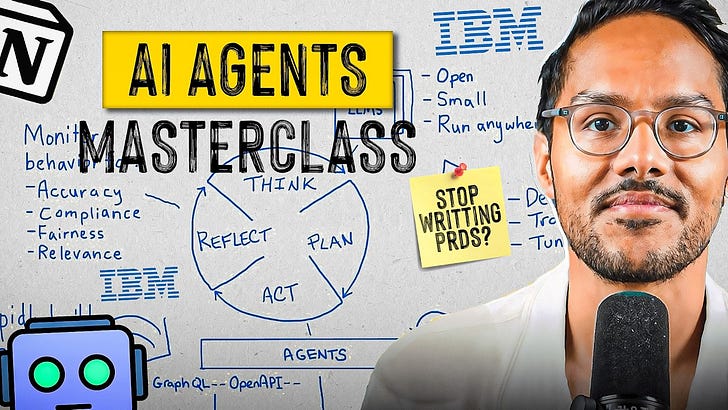
Frame AI agent development like training an intern. Initially, they need clear instructions, access to tools, and your specific systems. They won't be perfect at first, but with iterative feedback and training ('progress over perfection'), they can evolve to handle complex tasks autonomously.

Users get frustrated when AI doesn't meet expectations. The correct mental model is to treat AI as a junior teammate requiring explicit instructions, defined tools, and context provided incrementally. This approach, which Claude Skills facilitate, prevents overwhelm and leads to better outcomes.

Building a functional AI agent is just the starting point. The real work lies in developing a set of evaluations ("evals") to test if the agent consistently behaves as expected. Without quantifying failures and successes against a standard, you're just guessing, not iteratively improving the agent's performance.
Don't view AI tools as just software; treat them like junior team members. Apply management principles: 'hire' the right model for the job (People), define how it should work through structured prompts (Process), and give it a clear, narrow goal (Purpose). This mental model maximizes their effectiveness.
Instead of building monolithic agents, create modular sub-workflows that function as reusable 'tools' (e.g., an 'image-to-video' tool). These can be plugged into any number of different agents. This software engineering principle of modularity dramatically speeds up development and increases scalability across your automation ecosystem.
To get AI agents to perform complex tasks in existing code, a three-stage workflow is key. First, have the agent research and objectively document how the codebase works. Second, use that research to create a step-by-step implementation plan. Finally, execute the plan. This structured approach prevents the agent from wasting context on discovery during implementation.
