Get your free personalized podcast brief
We scan new podcasts and send you the top 5 insights daily.
Physical AI manifests in two distinct branches: robotics, which combines AI with non-living physical atoms, and 'Bio-AI,' which integrates digital software code with living atoms in our bodies. While robotics receives broad attention, bio-AI represents an ultimate frontier where software-driven genetic design can fundamentally transform disease treatment, enabling therapeutics to be programmed and manipulated through digital bits rather than traditional chemistry.

Related Insights
Top AI researchers often feel they must choose between working on frontier AI (e.g., chatbots) or applying AI to science. Radical Numerics argues you can do both, as biology presents fundamental challenges that push the boundaries of AI itself, from architecture to alignment.
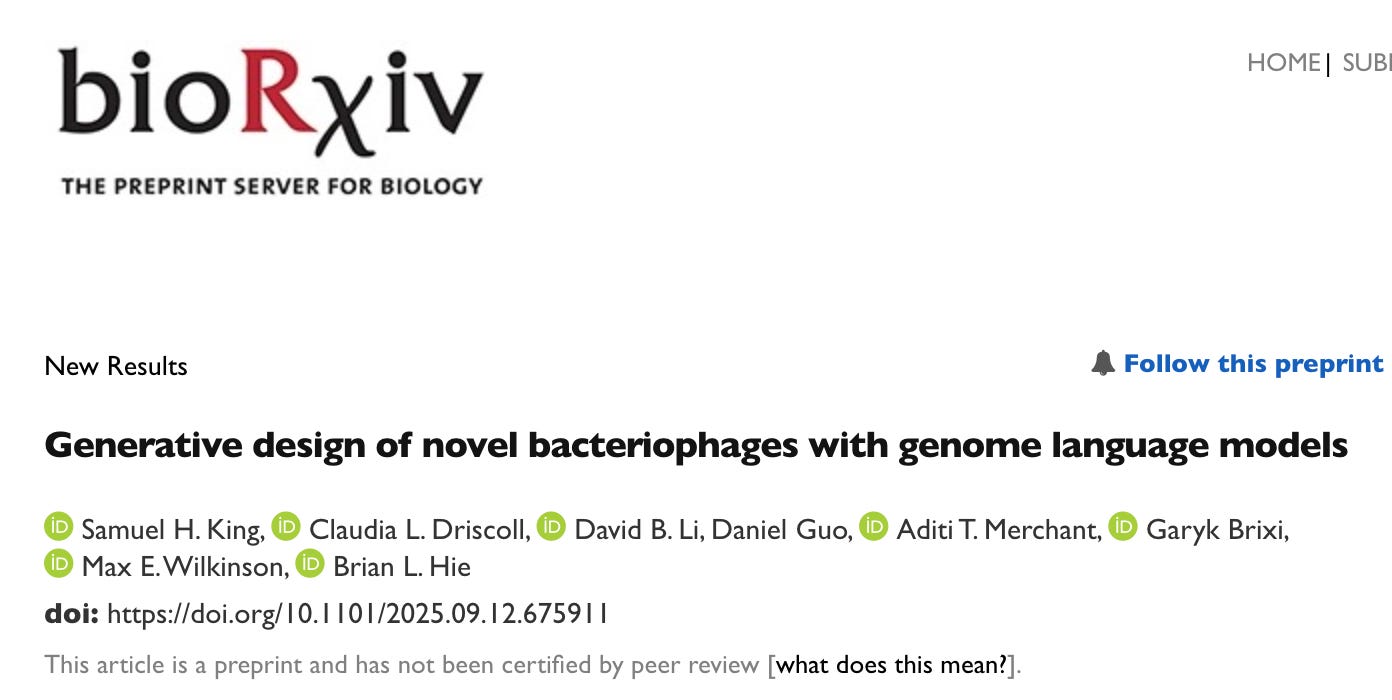
The next generation of AI may move beyond pure silicon. Researchers are already integrating human brain cells and "organoids" (mini 3D brains) onto chips for computation. This hybrid approach could satisfy both biological and computational theories of consciousness, accelerating its emergence.
The combination of AI reasoning and robotic labs could create a new model for biotech entrepreneurship. It enables individual scientists with strong ideas to test hypotheses and generate data without raising millions for a physical lab and staff, much like cloud computing lowered the barrier for software startups.
A convergence of DNA sequencing, CRISPR, and AI allows scientists to move beyond just understanding biology to actively intervening. Medicine is now programming cellular behavior by rewriting DNA, representing a "step function" leap in what's achievable for treating disease at its root cause.

AI isn't just for designing RNA sequences. Its real value is in creating predictive models of complex cellular functions. This allows scientists to determine the precise set of instructions (RNAs) needed to make a cell perform a complex series of tasks, like targeting a brain tumor.
The next major AI breakthrough will come from applying generative models to complex systems beyond human language, such as biology. By treating biological processes as a unique "language," AI could discover novel therapeutics or research paths, leading to a "Move 37" moment in science.

The future of AI in drug discovery is shifting from merely speeding up existing processes to inventing novel therapeutics from scratch. The paradigm will move toward AI-designed drugs validated with minimal wet lab reliance, changing the key question from "How fast can AI help?" to "What can AI create?"

Generate Biomedicines' AI learns the fundamental rules of protein structure and function, much like a language's grammar. This allows it to design entirely new proteins by generating novel "sentences" (sequences) that are biologically coherent and functional, rather than just mimicking existing ones found in nature.

Futurist Freeman Dyson predicted biotechnology would follow computing's path, moving from large institutions to individual creators. AI is accelerating this shift by lowering the cognitive barrier to entry, potentially making biological design an accessible, decentralized craft. This counters the dominant narrative of AI as a purely centralizing force.

Top AI labs realize that progress in digital, keyboard-based AI is accelerating so vertically that it will soon saturate. The next major frontier for innovation and growth will be applying AI to the physical world: robotics, manufacturing, and industrialization.
