Get your free personalized podcast brief
We scan new podcasts and send you the top 5 insights daily.
Top AI researchers often feel they must choose between working on frontier AI (e.g., chatbots) or applying AI to science. Radical Numerics argues you can do both, as biology presents fundamental challenges that push the boundaries of AI itself, from architecture to alignment.
Related Insights
AI capabilities are rapidly advancing beyond theory. Today's frontier models can troubleshoot complex laboratory experiments from a simple cell phone picture, often outperforming human PhDs. This dramatically lowers the barrier to entry for conducting sophisticated biological research.

Future progress in biology requires moving beyond static models. The new paradigm involves an AI that reasons over hypotheses, prioritizes experiments, learns from the empirical outcomes, and updates its internal world model. This creates a scalable, closed-loop system for scientific discovery.

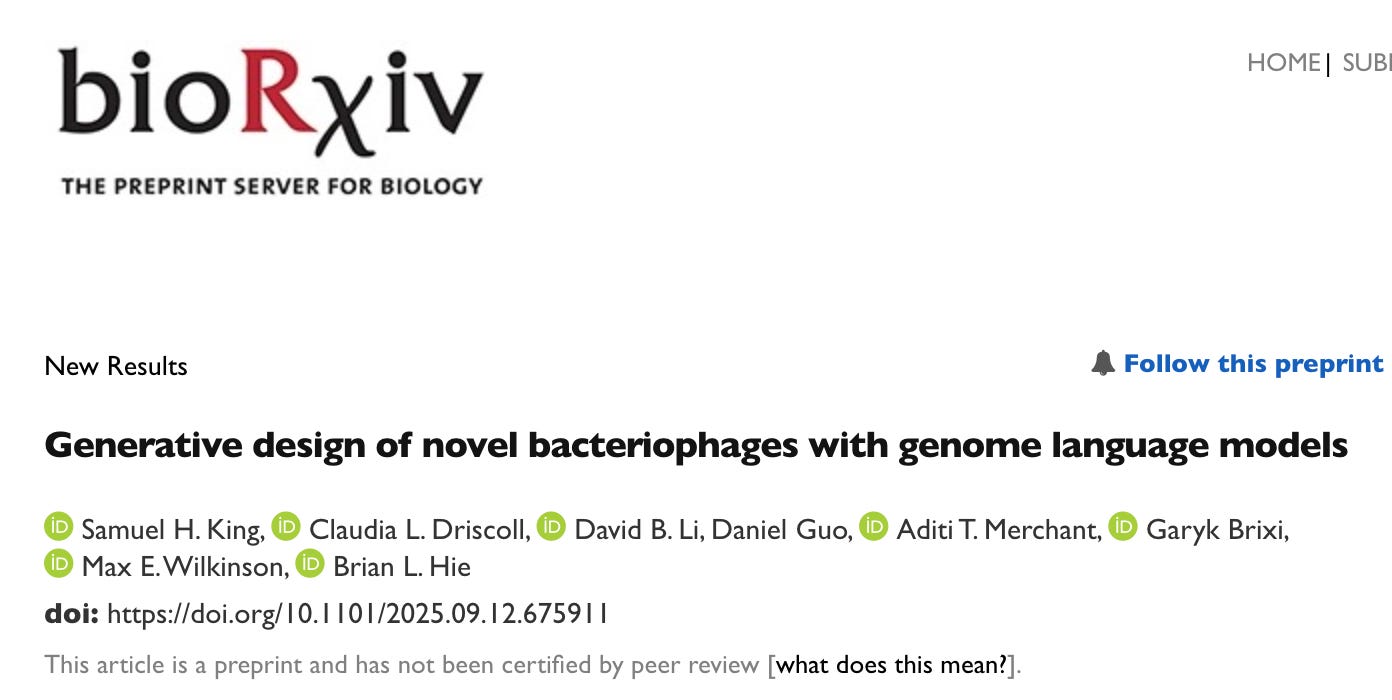
The next major AI breakthrough will come from applying generative models to complex systems beyond human language, such as biology. By treating biological processes as a unique "language," AI could discover novel therapeutics or research paths, leading to a "Move 37" moment in science.

The next leap in biotech moves beyond applying AI to existing data. CZI pioneers a model where 'frontier biology' and 'frontier AI' are developed in tandem. Experiments are now designed specifically to generate novel data that will ground and improve future AI models, creating a virtuous feedback loop.

Human minds struggle to grasp the vast complexity of biological systems. The guest argues that AI is the natural language for biology, just as mathematics is for physics, because AI models can capture the intricate, interconnected dynamics that are beyond human intuition.

AI is moving beyond simply identifying patterns in existing research papers. It is now able to extrapolate fundamental biological principles, enabling it to understand complex systems from the ground up, like the relationship between atoms, molecules, and proteins.

Unlike language models trained on existing internet data, Biohub's biological models require data that doesn't exist yet. Their strategy pairs a frontier AI lab with a "frontier biology" effort to invent new imaging and measurement tools, creating proprietary data streams to fuel their models.

CZI operates at the intersection of two cultures: biologists who saw their goals as "crazy ambitious" and AI experts who saw them as "boring" and inevitable. Their strategy is to actively merge these fields to create breakthroughs that neither could achieve alone.

While acknowledging the power of Large Language Models (LLMs) for linear biological data like protein sequences, CZI's strategy recognizes that biological processes are highly multidimensional and non-linear. The organization is focused on developing new types of AI that can accurately model this complexity, moving beyond the one-dimensional, sequential nature of language-based models.
Traditional science failed to create equations for complex biological systems because biology is too "bespoke." AI succeeds by discerning patterns from vast datasets, effectively serving as the "language" for modeling biology, much like mathematics is the language of physics.
